Brigham and Women's Hospital & Harvard Medical School, Boston, MA, USA.
Sleep & Neurodevelopment Core, National Institute of Mental Health, NIH, Bethesda, MD, USA.
Neuroimage Clin. 2024;41:103552. doi: 10.1016/j.nicl.2023.103552. Epub 2023 Dec 19.
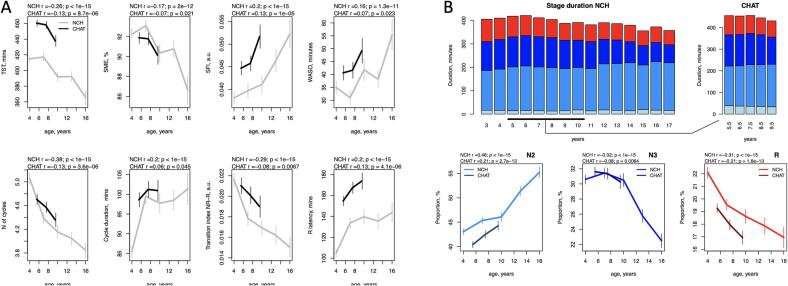
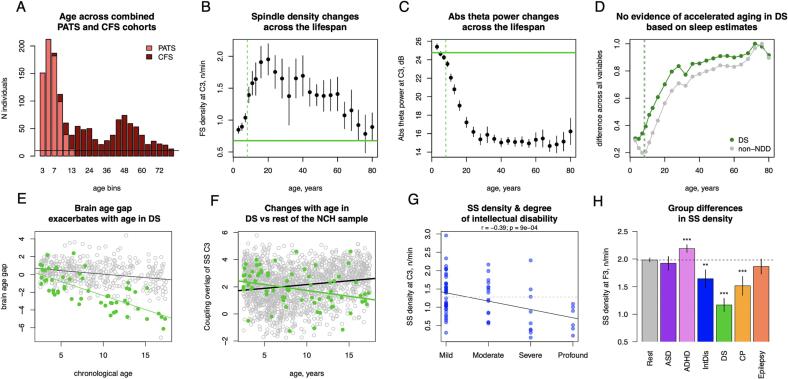
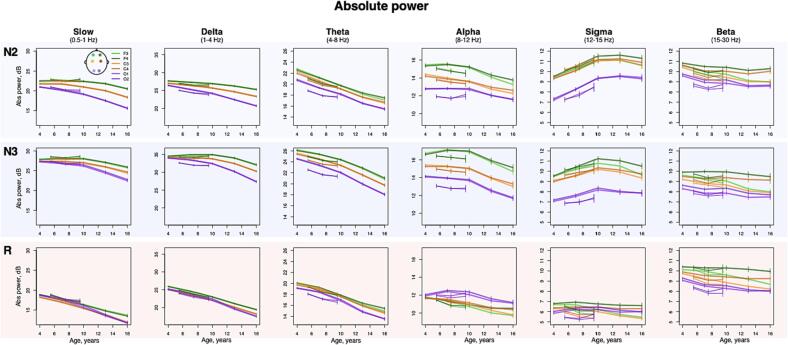
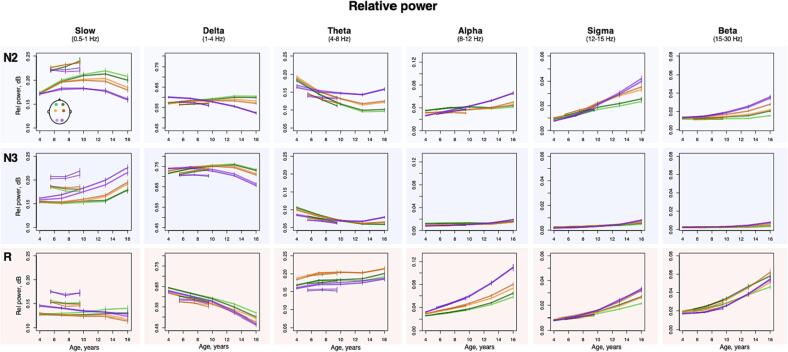
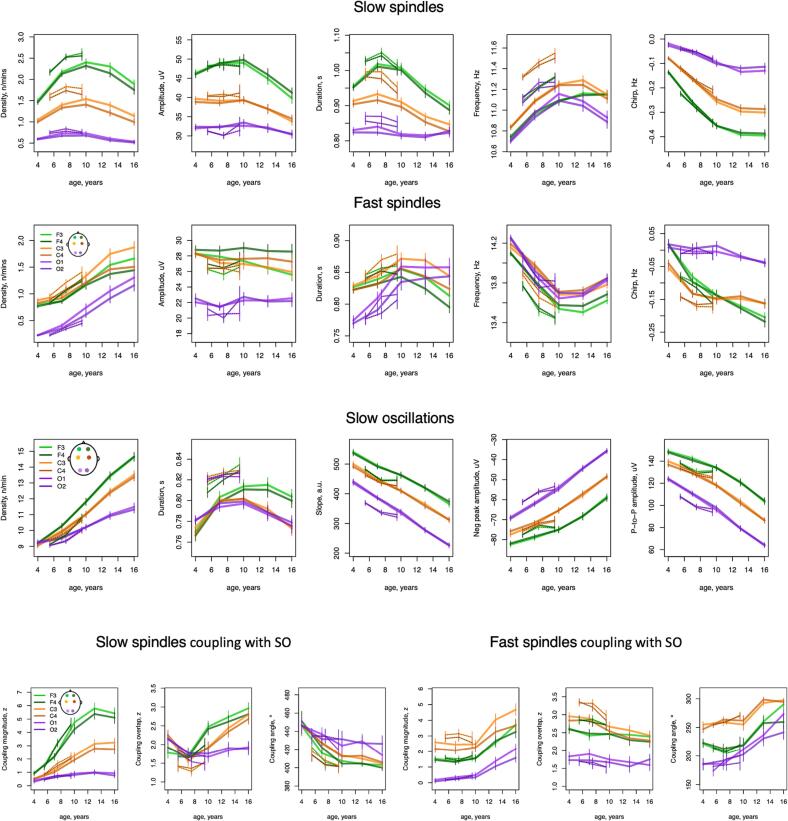
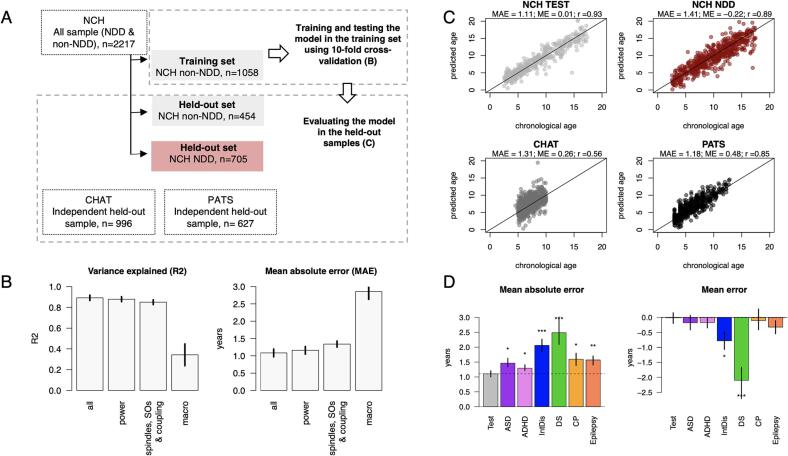
Profiles of sleep duration and timing and corresponding electroencephalographic activity reflect brain changes that support cognitive and behavioral maturation and may provide practical markers for tracking typical and atypical neurodevelopment. To build and evaluate a sleep-based, quantitative metric of brain maturation, we used whole-night polysomnography data, initially from two large National Sleep Research Resource samples, spanning childhood and adolescence (total N = 4,013, aged 2.5 to 17.5 years): the Childhood Adenotonsillectomy Trial (CHAT), a research study of children with snoring without neurodevelopmental delay, and Nationwide Children's Hospital (NCH) Sleep Databank, a pediatric sleep clinic cohort. Among children without neurodevelopmental disorders (NDD), sleep metrics derived from the electroencephalogram (EEG) displayed robust age-related changes consistently across datasets. During non-rapid eye movement (NREM) sleep, spindles and slow oscillations further exhibited characteristic developmental patterns, with respect to their rate of occurrence, temporal coupling and morphology. Based on these metrics in NCH, we constructed a model to predict an individual's chronological age. The model performed with high accuracy (r = 0.93 in the held-out NCH sample and r = 0.85 in a second independent replication sample - the Pediatric Adenotonsillectomy Trial for Snoring (PATS)). EEG-based age predictions reflected clinically meaningful neurodevelopmental differences; for example, children with NDD showed greater variability in predicted age, and children with Down syndrome or intellectual disability had significantly younger brain age predictions (respectively, 2.1 and 0.8 years less than their chronological age) compared to age-matched non-NDD children. Overall, our results indicate that sleep architectureoffers a sensitive window for characterizing brain maturation, suggesting the potential for scalable, objective sleep-based biomarkers to measure neurodevelopment.
睡眠时长和时间分配的特征以及相应的脑电图活动反映了支持认知和行为成熟的大脑变化,并且可能为跟踪典型和非典型神经发育提供实用的标志物。为了构建和评估基于睡眠的大脑成熟度定量指标,我们使用了整夜多导睡眠图数据,最初来自两个大型国家睡眠研究资源样本,涵盖了儿童期和青春期(总 N=4013 名,年龄 2.5 至 17.5 岁):儿童腺样体扁桃体切除术试验(CHAT),这是一项针对无神经发育障碍的打鼾儿童的研究;以及全国儿童医院(NCH)睡眠数据库,这是一个儿科睡眠诊所队列。在没有神经发育障碍(NDD)的儿童中,源自脑电图(EEG)的睡眠指标在整个数据集之间显示出与年龄相关的稳健变化。在非快速眼动(NREM)睡眠期间,纺锤波和慢波进一步表现出与发生频率、时间耦合和形态有关的特征性发育模式。基于 NCH 中的这些指标,我们构建了一个模型来预测个体的实际年龄。该模型具有很高的准确性(在 NCH 的保留样本中 r=0.93,在第二个独立复制样本 - 小儿腺样体扁桃体切除术治疗打鼾试验(PATS)中 r=0.85)。基于 EEG 的年龄预测反映了具有临床意义的神经发育差异;例如,NDD 儿童的预测年龄变化较大,而唐氏综合征或智力障碍儿童的大脑年龄预测值明显较小(分别比实际年龄小 2.1 岁和 0.8 岁),而年龄匹配的非 NDD 儿童。总体而言,我们的研究结果表明,睡眠结构为描述大脑成熟提供了一个敏感窗口,这表明基于睡眠的可扩展、客观生物标志物有潜力用于测量神经发育。