Kulak Meghan J, Los Angeles William Lewis-de, Daniels Teresa E, Mathis Karen J, Gobin Asi P, Laumann Laura E, Beck Quincy, Tyrka Audrey R
From the Initiative on Stress, Trauma, and Resilience (STAR), Department of Psychiatry and Human Behavior (Kulak, Daniels, Mathis, Gobin, Laumann, Beck, Tyrka), Warren Alpert Medical School, Brown University; Mood Disorders Research Program and Laboratory for Clinical and Translational Neuroscience (Kulak, Daniels, Gobin, Laumann, Beck, Tyrka), Butler Hospital; Department of Pediatrics (Lewis-de los Angeles), Hasbro Children's Hospital and Bradley Hospital; Warren Alpert Medical School (Lewis-de los Angeles), Brown University, Providence; University of Rhode Island College of Nursing (Mathis), Kingston, Rhode Island.
Psychosom Med. 2024;86(2):72-82. doi: 10.1097/PSY.0000000000001273. Epub 2023 Dec 29.
This study aimed to evaluate the relationship between early life stress (ELS) and metabolic risk in healthy young adults and assess the role of health behaviors.
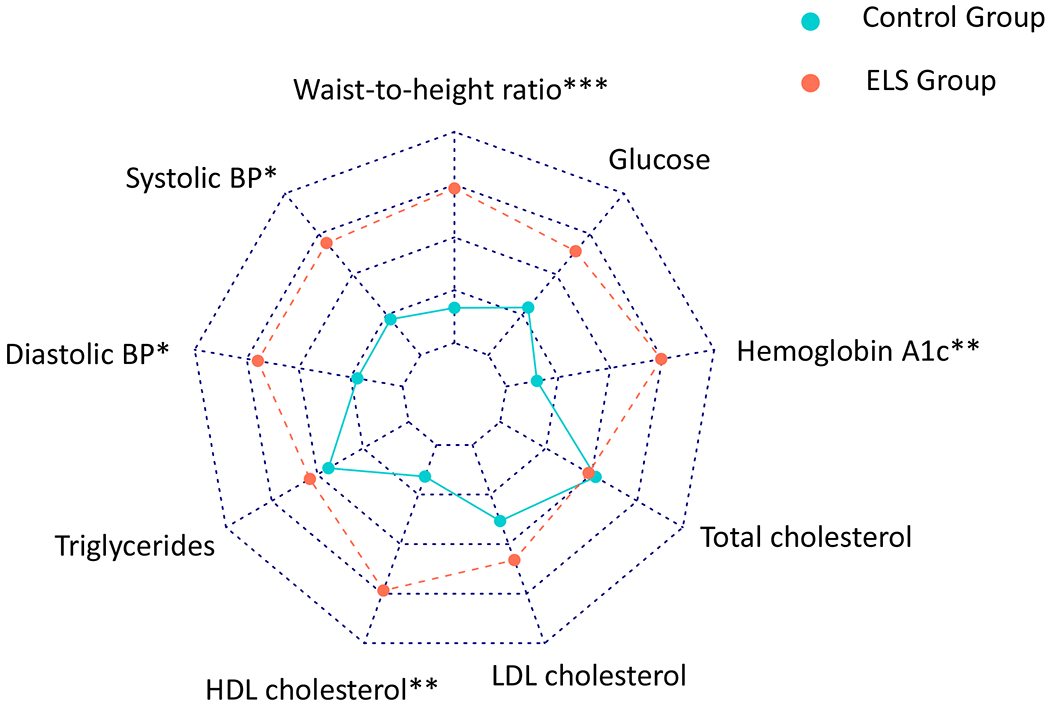
Young adults aged 18 to 40 years ( N = 190) with no medical conditions or medication usage were recruited from the community. Participants with ELS ( N = 113) had a history of childhood maltreatment, and most also experienced parental loss ( n = 88). Controls ( N = 77) had no history of maltreatment or parental loss. Standardized interviews and self-reports assessed demographics, adversity, medical/psychiatric history, and health behaviors. Blood pressure and anthropometrics were measured, and fasting plasma assayed for lipid profiles, glucose, insulin level, and hemoglobin A 1c . We calculated both a clinical cut-point and continuous composite metabolic risk score based on clinical risk factors and the mean of z scores of each measure, respectively.
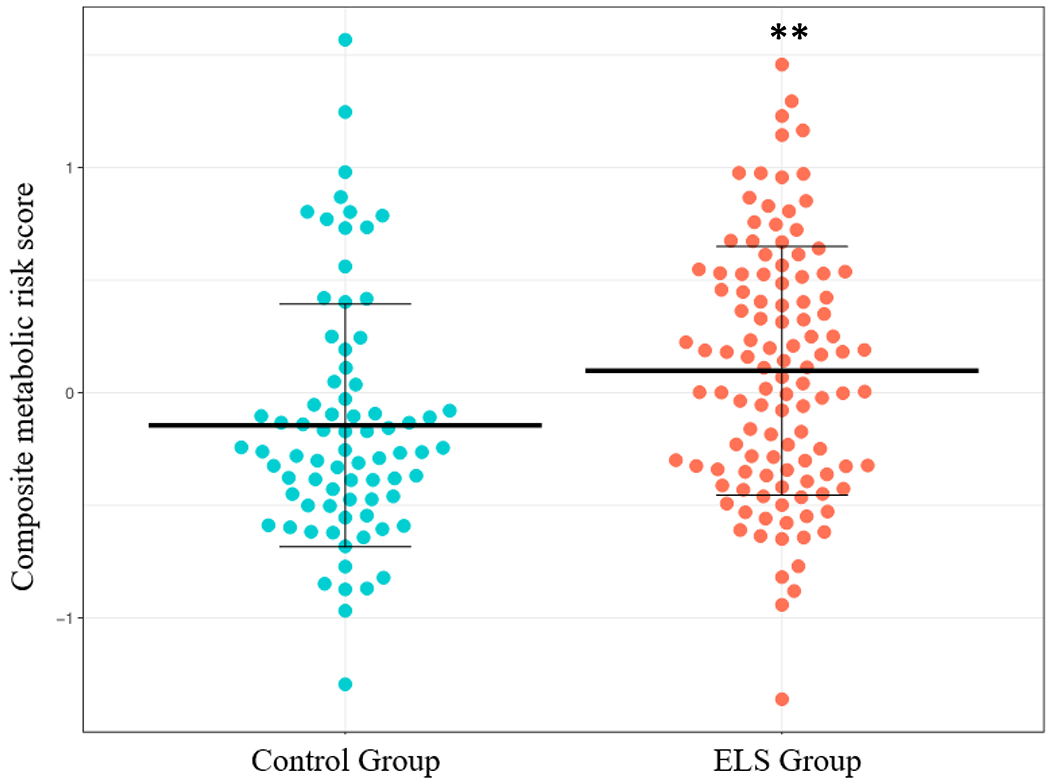
ELS was significantly associated with increased clinical cut-point ( β = 0.68, 95% confidence interval [CI] = 0.20-1.17, p = .006) and continuous ( β = 0.23, 95% CI = 0.08-0.038, p = .003) composite metabolic risk scores. On sensitivity analysis, the association of ELS with the continuous composite metabolic risk score was reduced to a trend after adjusting for a range of psychosocial and health predictors ( β = 0.18, 95% CI = 0.00-0.36, p = .053), with both diet and college graduate status significant in the model.
Healthy young adults with a history of ELS have increased metabolic risk scores as compared with controls. This relationship may be partially due to health behaviors and socioeconomic factors. These findings underline that ELS is an early contributor to metabolic risk.
本研究旨在评估健康年轻成年人的早期生活压力(ELS)与代谢风险之间的关系,并评估健康行为的作用。
从社区招募18至40岁(N = 190)无疾病或未使用药物的年轻成年人。有ELS的参与者(N = 113)有童年虐待史,且大多数人还经历过父母离世(n = 88)。对照组(N = 77)无虐待或父母离世史。通过标准化访谈和自我报告评估人口统计学、逆境、医疗/精神病史和健康行为。测量血压和人体测量指标,并检测空腹血浆中的血脂谱、葡萄糖、胰岛素水平和糖化血红蛋白A1c。我们分别基于临床风险因素和各测量指标z分数的平均值计算了临床切点和连续综合代谢风险评分。
ELS与临床切点(β = 0.68,95%置信区间[CI] = 0.20 - 1.17,p = .006)和连续(β = 0.23,95% CI = 0.08 - 0.38,p = .003)综合代谢风险评分的增加显著相关。在敏感性分析中,在调整一系列心理社会和健康预测因素后,ELS与连续综合代谢风险评分的关联降至趋势水平(β = 0.18,95% CI = 0.00 - 0.36,p = .053),模型中饮食和大学毕业状态均具有显著性。
与对照组相比,有ELS病史的健康年轻成年人代谢风险评分增加。这种关系可能部分归因于健康行为和社会经济因素。这些发现强调ELS是代谢风险的早期影响因素。