Nutrition and Metabolism Branch, International Agency for Research on Cancer, Lyon, France.
MRC Integrative Epidemiology Unit (IEU), Population Health Sciences, Bristol Medical School, University of Bristol, Bristol, UK.
Cancer Med. 2024 Jan;13(1):e6732. doi: 10.1002/cam4.6732. Epub 2023 Dec 28.
Sedentary behaviours have been associated with increased risks of some common cancers in epidemiological studies; however, it is unclear if these associations are causal.
We used univariable and multivariable two-sample Mendelian randomisation (MR) to examine potential causal relationships between sedentary behaviours and risks of breast, colorectal and prostate cancer. Genetic variants associated with self-reported leisure television watching and computer use were identified from a recent genome-wide association study (GWAS). Data related to cancer risk were obtained from cancer GWAS consortia. A series of sensitivity analyses were applied to examine the robustness of the results to the presence of confounding.
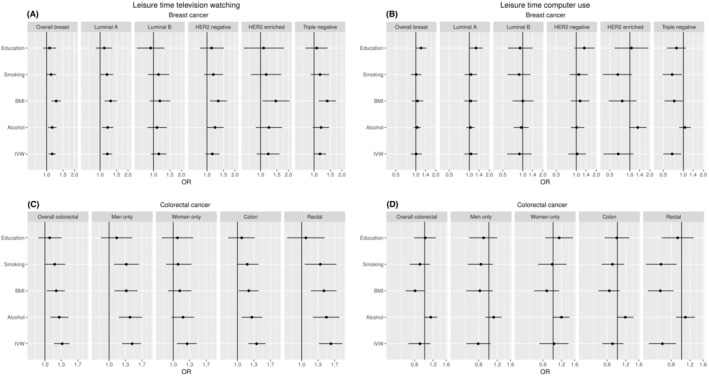
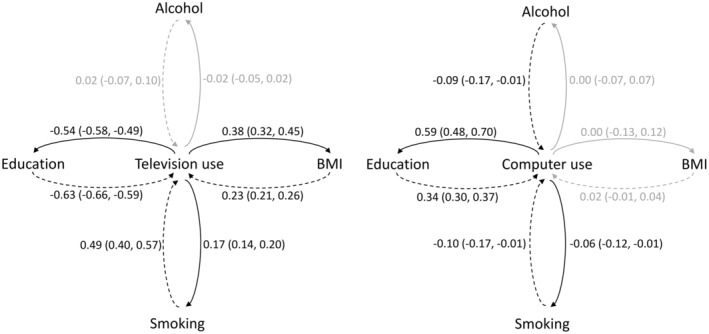
A 1-standard deviation (SD: 1.5 h/day) increment in hours of television watching increased risk of breast cancer (OR per 1-SD: 1.15, 95% confidence interval [CI]: 1.05-1.26) and colorectal cancer (OR per 1-SD: 1.32, 95% CI: 1.16-1.49) while there was little evidence of an association for prostate cancer risk (OR per 1-SD: 0.94, 95% CI: 0.84-1.06). After adjusting for years of education, the effect estimates for television watching were attenuated (breast cancer, OR per 1-SD: 1.08, 95% CI: 0.92-1.27; colorectal cancer, OR per 1-SD: 1.08, 95% CI: 0.90-1.31). Post hoc analyses showed that years of education might have a possible confounding and mediating role in the association between television watching with breast and colorectal cancer. Consistent results were observed for each cancer site according to sex (colorectal cancer), anatomical subsites and cancer subtypes. There was little evidence of associations between genetically predicted computer use and cancer risk.
Our univariable analysis identified some positive associations between hours of television watching and risks of breast and colorectal cancer. However, further adjustment for additional lifestyle factors especially years of education attenuated these results. Future studies using objective measures of exposure can provide new insights into the possible role of sedentary behaviour in cancer development.
在流行病学研究中,久坐行为与某些常见癌症的风险增加有关;然而,这些关联是否具有因果关系尚不清楚。
我们使用单变量和多变量两样本孟德尔随机化(MR)来检查久坐行为与乳腺癌、结直肠癌和前列腺癌风险之间的潜在因果关系。与自我报告的休闲电视观看和计算机使用相关的遗传变异是从最近的全基因组关联研究(GWAS)中确定的。癌症风险相关数据来自癌症 GWAS 联盟。进行了一系列敏感性分析,以检查结果对混杂因素存在的稳健性。
看电视时间每增加 1 个标准差(SD:1.5 小时/天),乳腺癌风险增加(每 1-SD 比值比:1.15,95%置信区间[CI]:1.05-1.26)和结直肠癌风险增加(每 1-SD 比值比:1.32,95% CI:1.16-1.49),而前列腺癌风险几乎没有关联(每 1-SD 比值比:0.94,95% CI:0.84-1.06)。在调整教育年限后,电视观看的效应估计值减弱(乳腺癌,每 1-SD 比值比:1.08,95% CI:0.92-1.27;结直肠癌,每 1-SD 比值比:1.08,95% CI:0.90-1.31)。事后分析表明,教育年限可能在电视观看与乳腺癌和结直肠癌之间的关联中具有潜在的混杂和中介作用。根据性别(结直肠癌)、解剖亚部位和癌症亚型,在每个癌症部位都观察到了一致的结果。遗传预测的计算机使用与癌症风险之间几乎没有关联。
我们的单变量分析发现,看电视时间与乳腺癌和结直肠癌风险之间存在一些正相关关系。然而,进一步调整其他生活方式因素,尤其是教育年限,会减弱这些结果。未来使用暴露的客观测量方法的研究可以为久坐行为在癌症发展中的可能作用提供新的见解。