Bodenlenz Manfred, Yeoh Thean, Berstein Gabriel, Mathew Shibin, Shah Jaymin, Banfield Christopher, Hollingshead Brett, Steyn Stefanus J, Osgood Sarah M, Beaumont Kevin, Kainz Sonja, Holeček Christian, Trausinger Gert, Raml Reingard, Birngruber Thomas
HEALTH - Institute for Biomedical Research and Technologies, Joanneum Research Forschungsgesellschaft M.B.H, Neue Stiftingtalstrasse 2, 8010, Graz, Austria.
Pfizer Research Technology Center, 1 Portland St, Cambridge, MA, 02139, USA.
Pharm Res. 2024 Feb;41(2):223-234. doi: 10.1007/s11095-023-03645-3. Epub 2023 Dec 29.
Accurate methods to determine dermal pharmacokinetics are important to increase the rate of clinical success in topical drug development. We investigated in an in vivo pig model whether the unbound drug concentration in the interstitial fluid as determined by dermal open flow microperfusion (dOFM) is a more reliable measure of dermal exposure compared to dermal biopsies for seven prescription or investigational drugs. In addition, we verified standard dOFM measurement using a recirculation approach and compared dosing frequencies (QD versus BID) and dose strengths (high versus low drug concentrations).
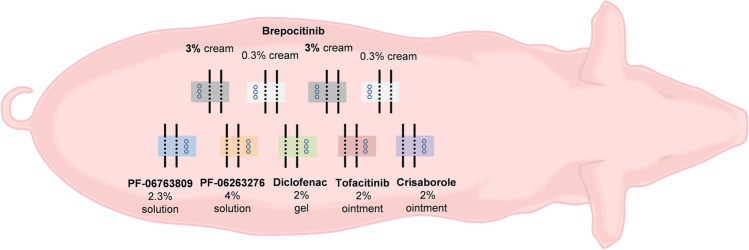
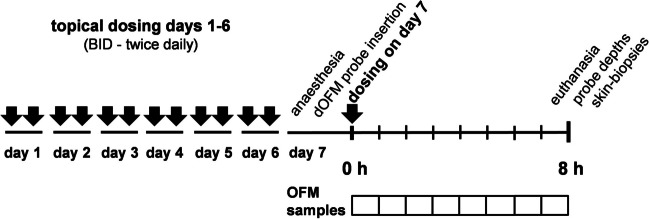
Domestic pigs were topically administered seven different drugs twice daily in two studies. On day 7, drug exposures in the dermis were assessed in two ways: (1) dOFM provided the total and unbound drug concentrations in dermal interstitial fluid, and (2) clean punch biopsies after heat separation provided the total concentrations in the upper and lower dermis.
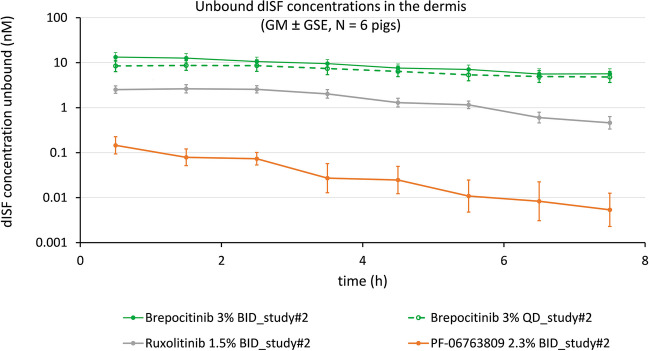
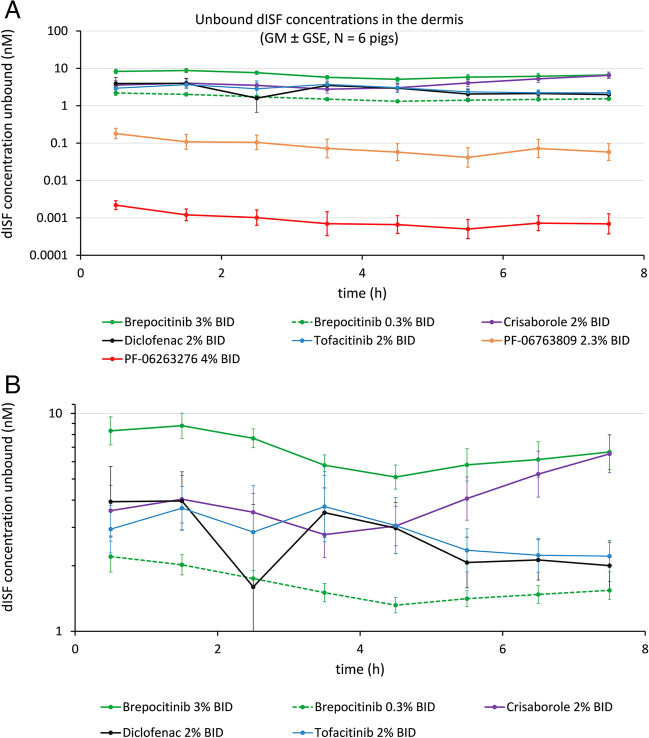
dOFM showed sufficient intra-study precision to distinguish interstitial fluid concentrations between different drugs, dose frequencies and dose strengths, and had good reproducibility between studies. Biopsy concentrations showed much higher and more variable values. Standard dOFM measurements were consistent with values obtained with the recirculation approach.
dOFM pig model is a robust and reproducible method to directly determine topical drug concentration in dermal interstitial fluid. Dermal biopsies were a less reliable measure of dermal exposure due to possible contributions from drug bound to tissue and drug associated with skin appendages.
准确测定皮肤药代动力学的方法对于提高局部用药物研发的临床成功率至关重要。我们在一个体内猪模型中研究了,对于七种处方药或研究用药物,与皮肤活检相比,通过皮肤开放流动微灌注(dOFM)测定的组织间液中游离药物浓度是否是一种更可靠的皮肤暴露量度。此外,我们使用再循环方法验证了标准dOFM测量,并比较了给药频率(每日一次与每日两次)和剂量强度(高药物浓度与低药物浓度)。
在两项研究中,每天给家猪局部施用七种不同的药物两次。在第7天,通过两种方式评估真皮中的药物暴露:(1)dOFM提供真皮组织间液中的总药物浓度和游离药物浓度,(2)热分离后的干净打孔活检提供真皮上层和下层中的总浓度。
dOFM显示出足够的研究内精密度,能够区分不同药物、给药频率和剂量强度之间的组织间液浓度,并且在研究之间具有良好的重现性。活检浓度显示出高得多且更具变异性的值。标准dOFM测量结果与通过再循环方法获得的值一致。
dOFM猪模型是一种可靠且可重现的方法,可直接测定真皮组织间液中的局部药物浓度。由于与组织结合的药物和与皮肤附属器相关的药物可能产生影响,皮肤活检作为皮肤暴露量度的可靠性较低。