
分娩体验的影响因素:一项混合方法研究。
Factors intervening in the childbirth experience: a mixed-methods study.
机构信息
Federal University of Sao Carlos, São Carlos, SP, 13565-905, Rod. Washington Luís, s/n, Brazil.
Western Paraná State University, Cascavel Campus, Paraná, Brazil.
出版信息
BMC Pregnancy Childbirth. 2024 Jan 2;24(1):14. doi: 10.1186/s12884-023-06175-3.
OBJECTIVE
To analyze the childbirth experience focusing on the intervening factors and on the delivery method.
METHOD
A sequential and explanatory mixed-methods study guided by the World Health Organization document for positive childbirth experiences. The participants were puerperal women in a maternity teaching hospital from inland São Paulo (Brazil). The first quantitative stage involved descriptive analysis with Poisson regression of 265 answers to the "Termômetro da Iniciativa Hospital Amigo da Mulher e da Criança" ("Women- and Baby-Friendly Hospital Initiative Thermometer") questionnaire. The second stage, qualitative, thematically analyzed the interviews conducted with 44 puerperal women who took part in the first stage. Data integration was by connection.
THE RESULTS AND DISCUSSION
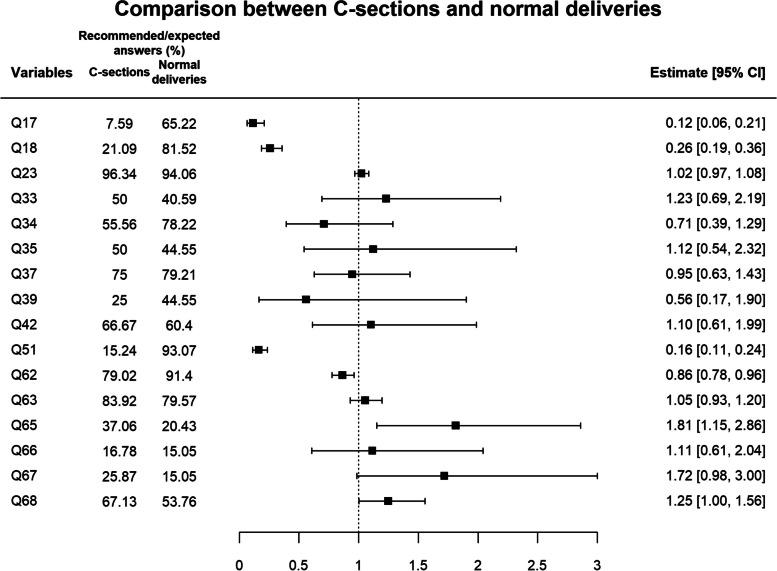
The analysis by connection showed that among the factors that restricted the positive experience, C-section was predominant (61.9%), understood as an option due to fear of pain, the treatment modality and previous traumas. Restrictions referring to the presence of a companion (99.6%), not having privacy (83%), disrespectful situations (69.5%), too many touches (56.9%) and the absence of skin-to-skin contact (55%), among others, potentiated fear, loneliness, concern, shame, the perception of disrespect and insecurity with the assistance provided. The promoting factors were as follows: choosing the companion (95.4%) for collaborating in the safety perception, not having infections (83.9%), having continuous team monitoring (82.2%) and pain relief methods (78.9%), which were valued by the women.
CONCLUSION
The intervening factors that promoted positive experiences were related to clinical and protocol-related issues and to service availability. The restrictive factors were associated with excess interventions, deprivation of rights and of choice, absence of privacy and restriction referring to the presence of a companion. Women with a normal postpartum period felt more insecure and disrespected when compared to those subjected to C-sections, whose choices were considered, although they had lower prevalence of skin-to-skin contact. There is an urgent need to apprehend women's experiences and turn them into actions that guarantee their lives in a safe and respectful way.
目的
分析分娩体验,重点关注干预因素和分娩方式。
方法
本研究采用顺序和解释性混合方法,以世界卫生组织关于积极分娩体验的文件为指导。参与者为内陆圣保罗(巴西)一家教学医院的产妇。第一阶段是定量阶段,对 265 名产妇回答“妇女和婴儿友好医院倡议温度计”问卷的结果进行描述性分析和泊松回归。第二阶段是定性的,对第一阶段中参与的 44 名产妇进行了主题分析访谈。数据整合是通过连接实现的。
结果与讨论
连接分析表明,在限制积极体验的因素中,剖宫产占主导地位(61.9%),这被理解为一种因害怕疼痛、治疗方式和先前创伤而选择的方式。限制因素包括陪伴者的存在(99.6%)、没有隐私(83%)、不尊重的情况(69.5%)、过多的触摸(56.9%)和缺乏皮肤接触(55%)等,这些因素加剧了恐惧、孤独、担忧、羞耻、不被尊重和对提供的帮助缺乏安全感。促进因素如下:选择陪伴者(95.4%)以增强安全感、没有感染(83.9%)、持续的团队监测(82.2%)和缓解疼痛的方法(78.9%),这些都得到了产妇的认可。
结论
促进积极体验的干预因素与临床和方案相关问题以及服务可用性有关。限制因素与过度干预、权利和选择的剥夺、缺乏隐私以及陪伴者的限制有关。与接受剖宫产的女性相比,产后正常的女性感到更不安全和不受尊重,尽管她们的皮肤接触较少,但她们的选择被认为是合理的。迫切需要理解女性的体验,并将其转化为行动,以确保她们的生命安全和受到尊重。

 Zotero 插件