Guangdong Key Laboratory for Biomedical Measurements and Ultrasound Imaging, National-Regional Key Technology Engineering Laboratory for Medical Ultrasound, School of Biomedical Engineering, Shenzhen University Medical School, 1066 Xueyuan Avenue, Shenzhen, 518060, China.
Department of Medical Cell Biology and Genetics, Shenzhen Key Laboratory of Anti-Aging and Regenerative Medicine, Shenzhen Engineering Laboratory of Regenerative Technologies for Orthopedic Diseases, Shenzhen University Medical School, Shenzhen, 518060, China.
BMC Biol. 2024 Jan 2;22(1):1. doi: 10.1186/s12915-023-01780-2.
Cell senescence is a sign of aging and plays a significant role in the pathogenesis of age-related disorders. For cell therapy, senescence may compromise the quality and efficacy of cells, posing potential safety risks. Mesenchymal stem cells (MSCs) are currently undergoing extensive research for cell therapy, thus necessitating the development of effective methods to evaluate senescence. Senescent MSCs exhibit distinctive morphology that can be used for detection. However, morphological assessment during MSC production is often subjective and uncertain. New tools are required for the reliable evaluation of senescent single cells on a large scale in live imaging of MSCs.
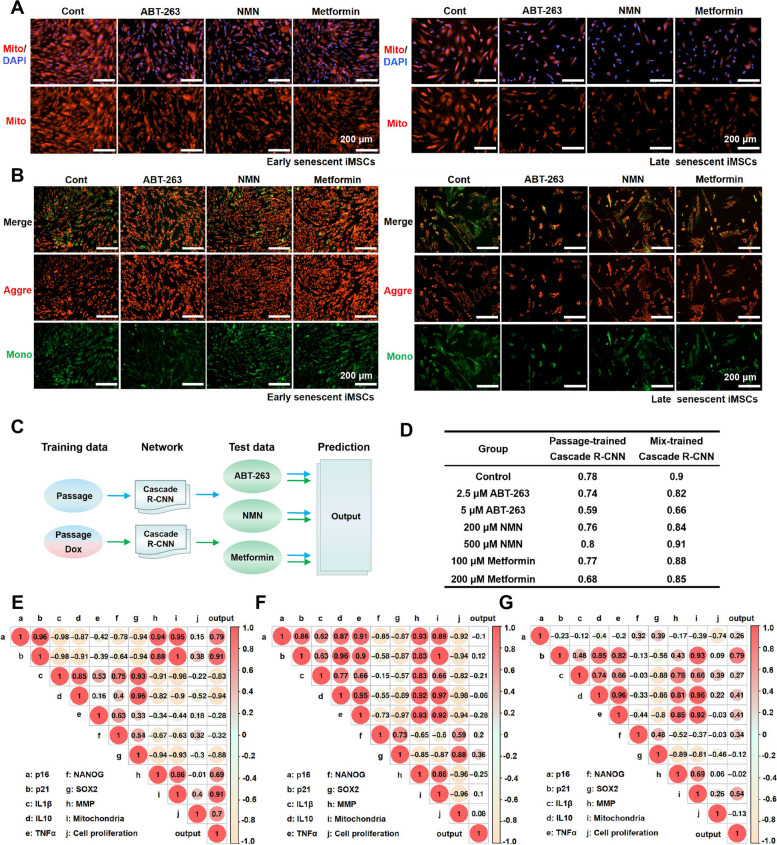
We have developed a successful morphology-based Cascade region-based convolution neural network (Cascade R-CNN) system for detecting senescent MSCs, which can automatically locate single cells of different sizes and shapes in multicellular images and assess their senescence state. Additionally, we tested the applicability of the Cascade R-CNN system for MSC senescence and examined the correlation between morphological changes with other senescence indicators.
This deep learning has been applied for the first time to detect senescent MSCs, showing promising performance in both chronic and acute MSC senescence. The system can be a labor-saving and cost-effective option for screening MSC culture conditions and anti-aging drugs, as well as providing a powerful tool for non-invasive and real-time morphological image analysis integrated into cell production.
细胞衰老是衰老的标志,在与年龄相关的疾病发病机制中起着重要作用。对于细胞治疗,衰老可能会降低细胞的质量和功效,带来潜在的安全风险。间充质干细胞(MSCs)目前正在进行广泛的细胞治疗研究,因此需要开发有效的方法来评估衰老。衰老的间充质干细胞表现出独特的形态,可用于检测。然而,在 MSC 生产过程中进行形态评估通常是主观和不确定的。需要新的工具来可靠地评估活细胞成像中 MSC 衰老的单细胞的大规模衰老。
我们已经开发出一种成功的基于形态的级联区域卷积神经网络(Cascade R-CNN)系统,用于检测衰老的间充质干细胞,该系统可以自动定位多细胞图像中不同大小和形状的单细胞,并评估其衰老状态。此外,我们测试了 Cascade R-CNN 系统在 MSC 衰老中的适用性,并检查了形态变化与其他衰老指标之间的相关性。
深度学习首次应用于检测衰老的间充质干细胞,在慢性和急性 MSC 衰老中均表现出良好的性能。该系统可作为筛选 MSC 培养条件和抗衰老药物的省力且具有成本效益的选择,为非侵入性和实时形态图像分析提供强大的工具,集成到细胞生产中。