He Yi, Chen Yuxia, Tang Li, Chen Jing, Tang Jing, Yang Xiaoxuan, Su Songchuan, Zhao Chen, Xiao Nong
Department of Rehabilitation Medicine, The First Affiliated Hospital of Chongqing Medical University, No.1 Youyi Road, Yuzhong District, Chongqing, 400016, China.
Department of Rehabilitation, Children's Hospital of Chongqing Medical University, National Clinical Research Center for Child Health and Disorders, Ministry of Education Key Laboratory of Child Development and Disorders, Chongqing Key Laboratory of Pediatrics, No. 136 Zhongshan 2nd Road, Yuzhong District, Chongqing, 400016, China.
BMC Sports Sci Med Rehabil. 2024 Jan 2;16(1):2. doi: 10.1186/s13102-023-00792-3.
The aim of this study was to assess the accuracy and test-retest reliability of a wearable inertial measurement unit (IMU) system for gait analysis in healthy female compared to a gold-standard optoelectronic motion capture (OMC) system.
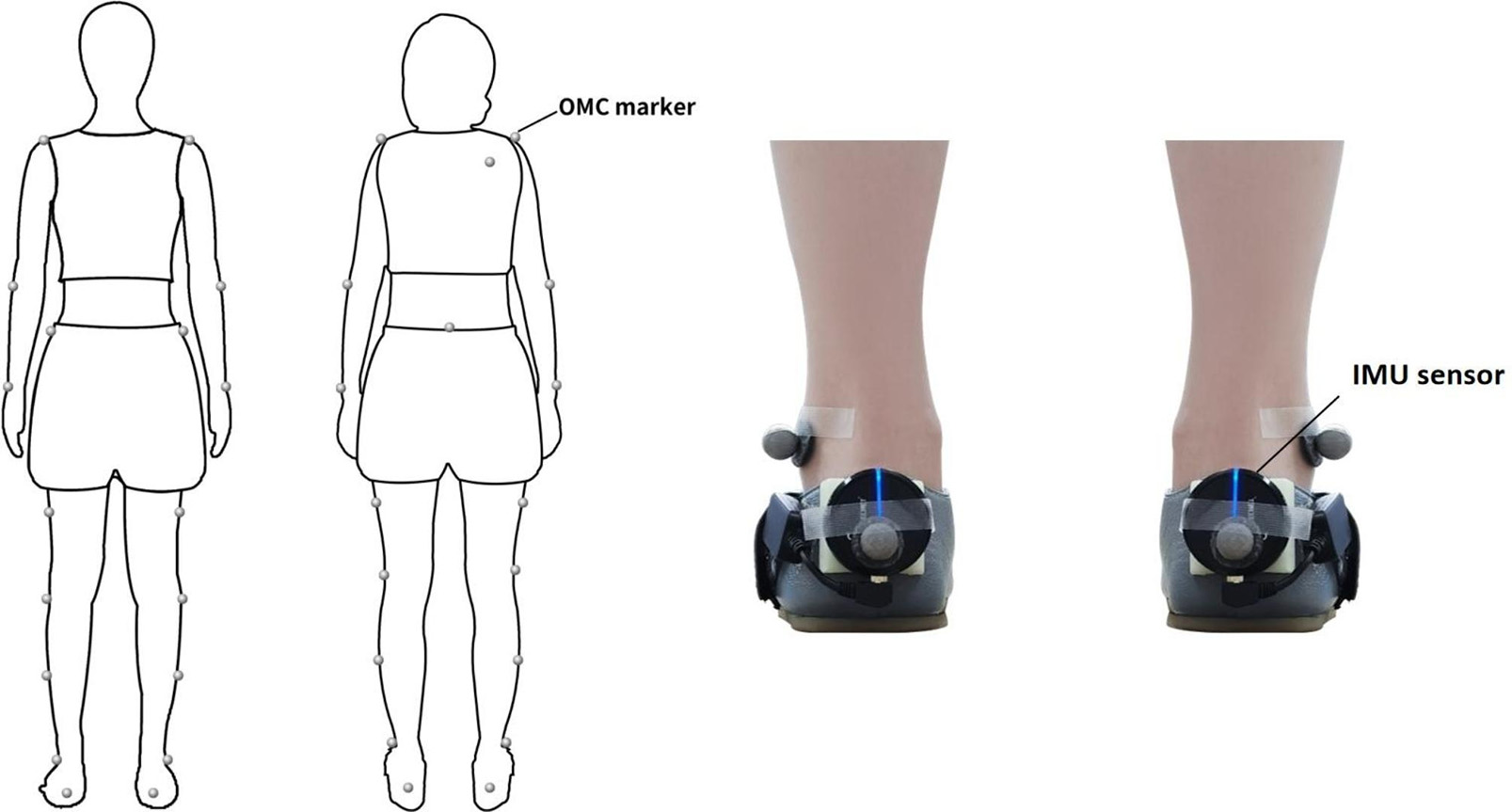
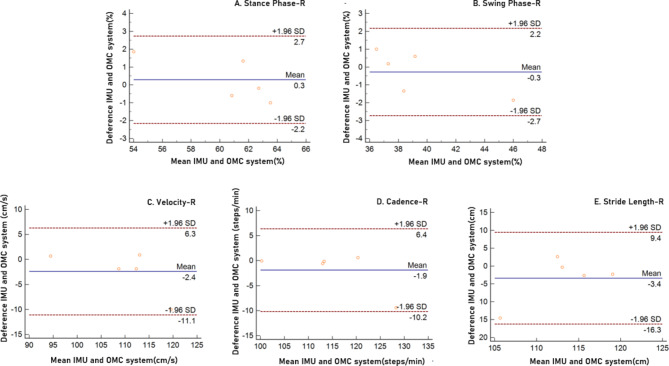
In our study, we collected data from 5 healthy young females. Participants were attached with markers from both the OMC system and the IMU system simultaneously. Data was collected when participants walked on a 7 m walking path. Each participant performed 50 repetitions of walking on the path. To ensure the collection of complete gait cycle data, a gait cycle was considered valid only if the participant passed through the center of the walking path at the same time that the OMC system detected a valid marker signal. As a result, 5 gait cycles that met the standards of the OMC system were included in the final analysis. The stride length, cadence, velocity, stance phase and swing phase of the spatio-temporal parameters were included in the analysis. A generalized linear mixture model was used to assess the repeatability of the two systems. The Wilcoxon rank-sum test for continuous variables was used to compare the mean differences between the two systems. For evaluating the reliability of the IMU system, we calculated the Intra-class Correlation Coefficient (ICC). Additionally, Bland-Altman plots were used to compare the levels of agreement between the two systems.
The measurements of Spatio-temporal parameters, including the stance phase (P = 0.78, 0.13, L-R), swing phase (P = 0.78, 0.13, L-R), velocity (P = 0.14, 0.13, L-R), cadence (P = 0.53, 0.22, L-R), stride length (P = 0.05, 0.19, L-R), by the IMU system and OMC system were similar. Which suggested that IMU and OMC systems could be used interchangeably for gait measurements. The intra-rater reliability showed an excellent correlation for the stance phase, swing phase, velocity and cadence (Intraclass Correlation Coefficient, ICC > 0.9) for both systems. However, the correlation of stride length was poor (ICC = 0.36, P = 0.34, L) to medium (ICC = 0.56, P = 0.22, R). Additionally, the measurements of IMU systems were repeatable.
The results of IMU system and OMC system shown good repeatability. Wearable IMU system could analyze gait data accurately. In particular, the measurement of stance phase, swing phase, velocity and cadence showed excellent reliability. IMU system provided an alternative measurement to OMC for gait analysis. However, the measurement of stride length by IMU needs further consideration.
本研究旨在评估与金标准光电运动捕捉(OMC)系统相比,可穿戴惯性测量单元(IMU)系统用于健康女性步态分析的准确性和重测信度。
在我们的研究中,我们收集了5名健康年轻女性的数据。参与者同时佩戴来自OMC系统和IMU系统的标记物。当参与者在一条7米长的步行路径上行走时收集数据。每位参与者在该路径上进行50次步行重复。为确保收集到完整的步态周期数据,仅当参与者在OMC系统检测到有效标记信号的同时穿过步行路径中心时,该步态周期才被视为有效。结果,最终分析纳入了5个符合OMC系统标准的步态周期。时空参数的步长、步频、速度、站立相和摆动相被纳入分析。使用广义线性混合模型评估两个系统的重复性。对连续变量使用Wilcoxon秩和检验来比较两个系统之间的平均差异。为评估IMU系统的可靠性,我们计算了组内相关系数(ICC)。此外,使用Bland-Altman图来比较两个系统之间的一致性水平。
IMU系统和OMC系统对时空参数的测量结果相似,包括站立相(P = 0.78,0.13,左右)、摆动相(P = 0.78,0.13,左右)、速度(P = 0.