Guo Ruohan, Yu Yiwen, Huang Yini, Lin Min, Liao Ying, Hu Yixin, Li Qing, Peng Chuan, Zhou Jianhua
Department of Ultrasound, Sun Yat-sen University Cancer Center, State Key Laboratory of Oncology in South China, Collaborative Innovation Center for Cancer Medicine, No. 651 Dongfeng Road East, Guangzhou, 510060, PR China.
Heliyon. 2023 Dec 6;10(1):e23383. doi: 10.1016/j.heliyon.2023.e23383. eCollection 2024 Jan 15.
BRCA1/2 status is a key to personalized therapy for invasive breast cancer patients. This study aimed to explore the association between ultrasound radiomics features and germline BRCA1/2 mutation in patients with invasive breast cancer.
In this retrospective study, 100 lesions in 92 BRCA1/2-mutated patients and 390 lesions in 357 non-BRCA1/2-mutated patients were included and randomly assigned as training and validation datasets in a ratio of 7:3. Gray-scale ultrasound images of the largest plane of the lesions were used for feature extraction. Maximum relevance minimum redundancy (mRMR) algorithm and multivariate logistic least absolute shrinkage and selection operator (LASSO) regression were used to select features. The multivariate logistic regression method was used to construct predictive models based on clinicopathological factors, radiomics features, or a combination of them.
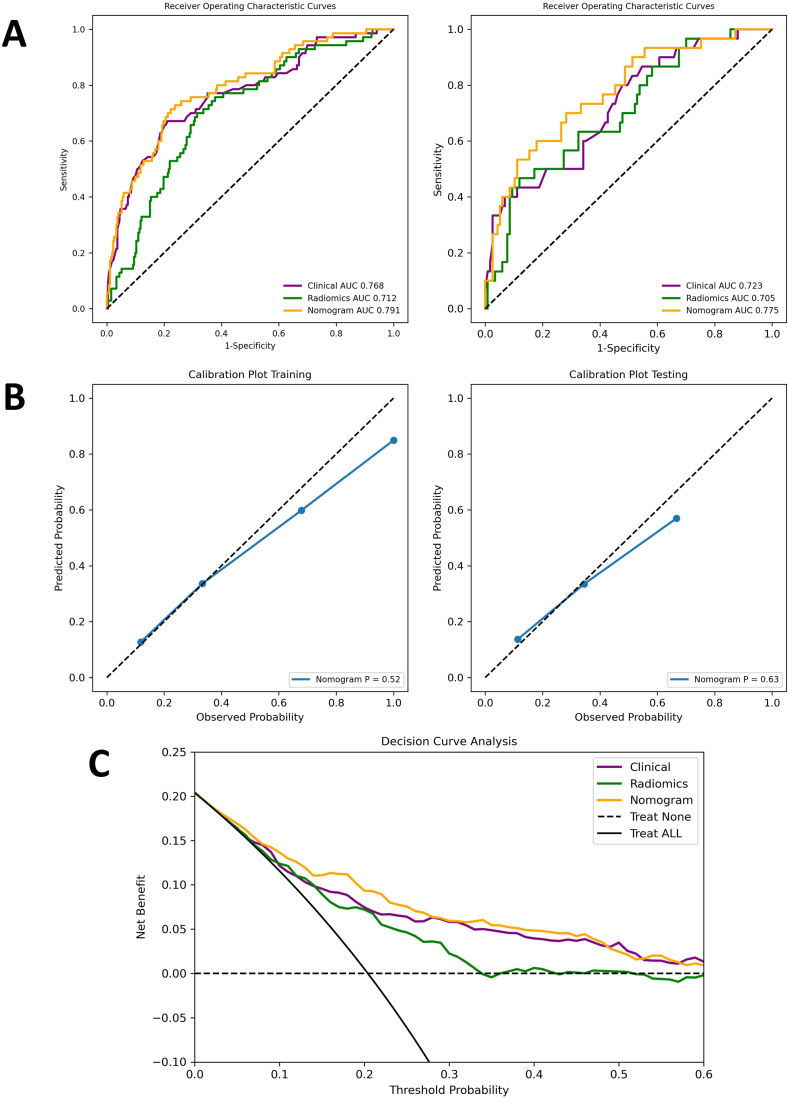
In the clinical model, age at first diagnosis, family history of BRCA1/2-related malignancies, HER2 status, and Ki-67 level were found to be independent predictors for BRCA1/2 mutation. In the radiomics model, 10 significant features were selected from the 1032 radiomics features extracted from US images. The AUCs of the radiomics model were not inferior to those of the clinical model in both training dataset [0.712 (95% CI, 0.647-0.776) vs 0.768 (95% CI, 0.704-0.835); p = 0.429] and validation dataset [0.705 (95% CI, 0.597-0.808) vs 0.723 (95% CI, 0.625-0.828); p = 0.820]. The AUCs of the nomogram model combining clinical and radiomics features were 0.804 (95% CI, 0.748-0.861) in the training dataset and 0.811 (95% CI, 0.724-0.894) in the validation dataset, which were proved significantly higher than those of the clinical model alone by DeLong's test (p = 0.041; p = 0.007). To be noted, the negative predictive values (NPVs) of the nomogram model reached a favorable 0.93 in both datasets.
This machine nomogram model combining ultrasound-based radiomics and clinical features exhibited a promising performance in identifying germline BRCA1/2 mutation in patients with invasive breast cancer and may help avoid unnecessary gene tests in clinical practice.
BRCA1/2状态是浸润性乳腺癌患者个体化治疗的关键。本研究旨在探讨浸润性乳腺癌患者超声影像组学特征与胚系BRCA1/2突变之间的关联。
在这项回顾性研究中,纳入了92例BRCA1/2突变患者的100个病灶以及357例非BRCA1/2突变患者的390个病灶,并按照7:3的比例随机分为训练集和验证集。使用病灶最大平面的灰阶超声图像进行特征提取。采用最大相关最小冗余(mRMR)算法和多变量逻辑最小绝对收缩和选择算子(LASSO)回归进行特征选择。运用多变量逻辑回归方法,基于临床病理因素、影像组学特征或两者的组合构建预测模型。
在临床模型中,首次诊断年龄、BRCA1/2相关恶性肿瘤家族史、HER2状态和Ki-67水平被发现是BRCA1/2突变的独立预测因素。在影像组学模型中,从超声图像提取的1032个影像组学特征中选择了10个显著特征。影像组学模型在训练集[0.712(95%CI,0.647-0.776)vs 0.768(95%CI,0.704-0.835);p = 0.429]和验证集[0.705(95%CI,0.597-0.808)vs 0.723(95%CI,0.625-0.828);p = 0.820]中的AUC均不低于临床模型。结合临床和影像组学特征的列线图模型在训练集和验证集中的AUC分别为0.804(95%CI,0.748-0.861)和0.811(95%CI,0.724-0.894),DeLong检验证明其显著高于单独的临床模型(p = 0.041;p = 0.007)。需要注意的是,列线图模型在两个数据集中的阴性预测值(NPV)均达到了良好的0.93。
这种结合基于超声的影像组学和临床特征的机器列线图模型在识别浸润性乳腺癌患者的胚系BRCA1/2突变方面表现出了良好的性能,可能有助于在临床实践中避免不必要的基因检测。