Department of Neurosurgery, Center for Translational Neural Prosthetics and Interfaces, Center for Neuroregeneration, Houston Methodist Research Institute, Houston, Texas, USA.
Department of Mechanical Engineering, Rice University, Houston, Texas, USA.
Top Spinal Cord Inj Rehabil. 2023 Fall;29(Suppl):15-22. doi: 10.46292/sci23-00040S. Epub 2023 Nov 17.
Despite the positive results in upper limb (UL) motor recovery after using electrical neuromodulation in individuals after cervical spinal cord injury (SCI) or stroke, there has been limited exploration of potential benefits of combining task-specific hand grip training with transcutaneous electrical spinal stimulation (TSS) for individuals with UL paralysis.
This study investigates the combinatorial effects of task-specific hand grip training and noninvasive TSS to enhance hand motor output after paralysis.
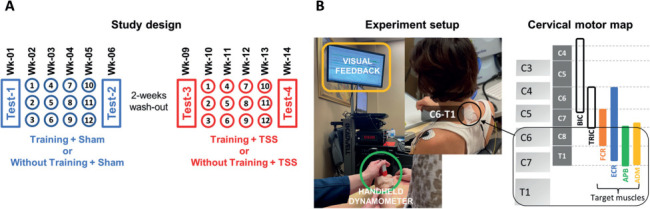
Four participants with cervical SCI classified as AIS A and B and two participants with cerebral stroke were recruited in this study. The effects of cervical TSS without grip training and during training with sham stimulation were contrasted with hand grip training with TSS. TSS was applied at midline over cervical spinal cord. During hand grip training, 5 to 10 seconds of voluntary contraction were repeated at a submaximum strength for approximately 10 minutes, three days per week for 4 weeks. Signals from hand grip dynamometer along with the electromyography (EMG) activity from UL muscles were recorded and displayed as visual feedback.
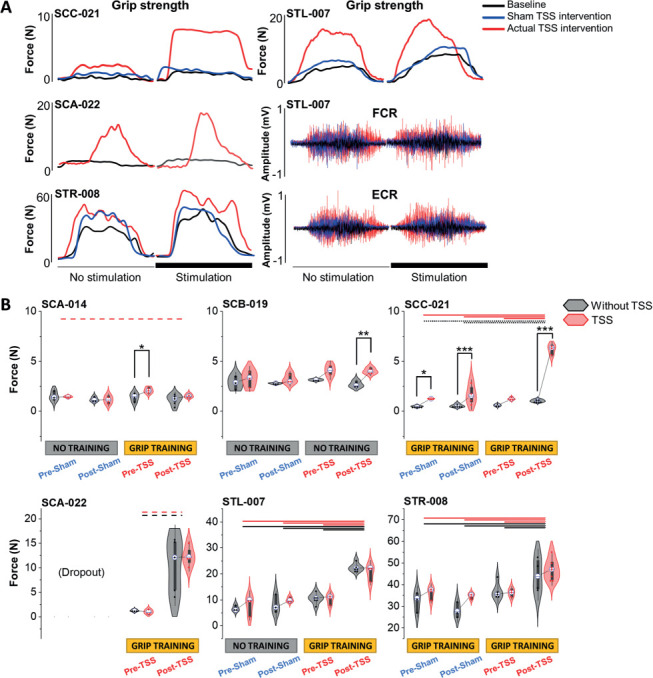
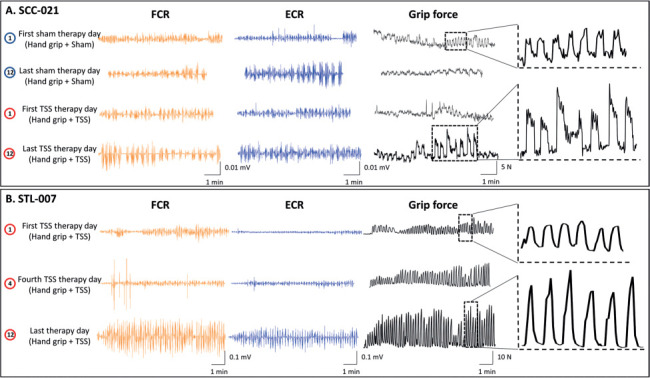
Our case study series demonstrated that combined task-specific hand grip training and cervical TSS targeting the motor pools of distal muscles in the UL resulted in significant improvements in maximum hand grip strength. However, TSS alone or hand grip training alone showed limited effectiveness in improving grip strength.
Task-specific hand grip training combined with TSS can result in restoration of hand motor function in paralyzed upper limbs in individuals with cervical SCI and stroke.
尽管在颈脊髓损伤(SCI)或中风后使用电神经调节在改善上肢(UL)运动功能方面取得了积极的结果,但对于将特定任务的手抓握训练与经皮脊髓电刺激(TSS)结合用于 UL 瘫痪患者的潜在益处,探索有限。
本研究旨在探讨特定任务的手抓握训练和非侵入性 TSS 的组合效应,以增强瘫痪后手的运动输出。
本研究招募了 4 名颈 SCI 分类为 AIS A 和 B 的患者和 2 名脑卒患者。比较了无握力训练和假刺激时的颈 TSS 与 TSS 辅助手抓握训练的效果。TSS 在颈脊髓中线施加。在手抓握训练期间,以次最大强度重复约 5 到 10 秒的自愿收缩,每周 3 天,持续 4 周。手抓力测力计的信号以及 UL 肌肉的肌电图(EMG)活动被记录并显示为视觉反馈。
我们的病例系列研究表明,针对 UL 远端肌肉运动池的特定任务的手抓握训练与颈 TSS 的结合,可显著提高最大手抓握力。然而,单独的 TSS 或手抓握训练在提高握力方面效果有限。
特定任务的手抓握训练与 TSS 相结合,可以恢复颈 SCI 和中风患者瘫痪上肢的手运动功能。