Department of Emergency, The First Hospital of China Medical University, Shenyang, China.
These authors contributed equally to this work.
Ear Hear. 2024;45(3):658-665. doi: 10.1097/AUD.0000000000001453. Epub 2024 Jan 5.
Otitis media is one of the most important causes of hearing loss at an early age. Effective vaccination with the routine 7-valent pneumococcal conjugate vaccine (PCV-7) was introduced in 2000. It has been gradually replaced by the pneumococcal nontypeable Haemophilus influenzae protein D conjugate vaccine or the higher-valent 13-valent PCV (PCV-13) since 2010. Data on the change in otitis media burden in recent years are sparse at the global, regional, and national levels.
The Global Burden of Disease 2019 study was used to evaluate the prevalence, incidence, mortality, disability-adjusted life year (DALY) rates, and the average annual percentage changes (AAPCs) in otitis media in geographic populations worldwide from 1990 to 2019. These global trends were further analyzed by subgroup (age, sex, and sociodemographic index [SDI]).
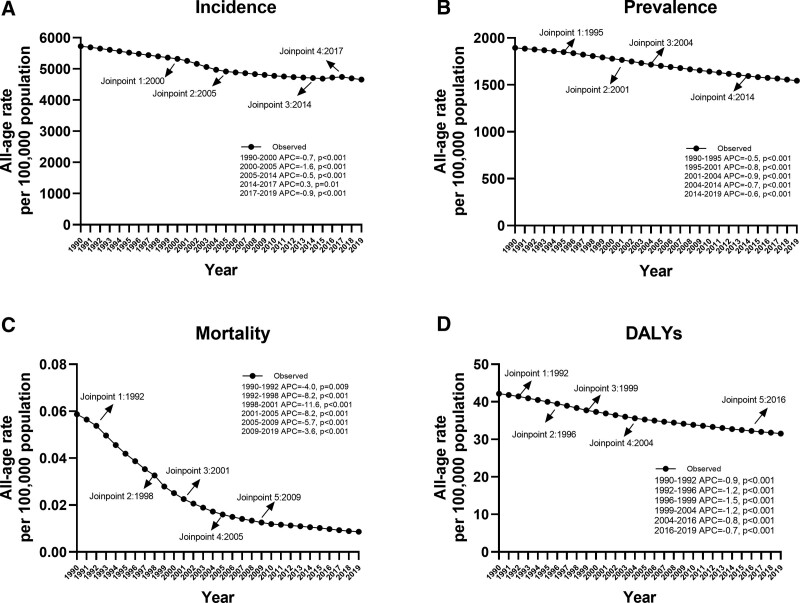
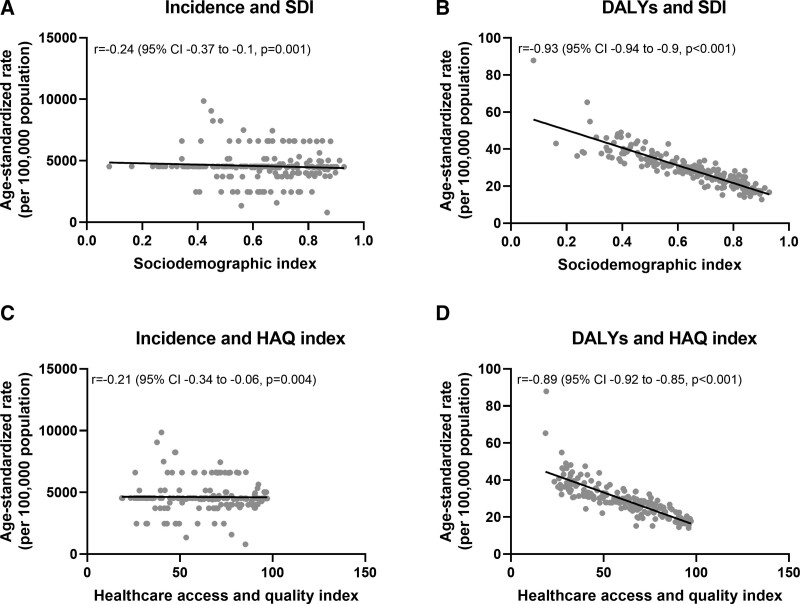
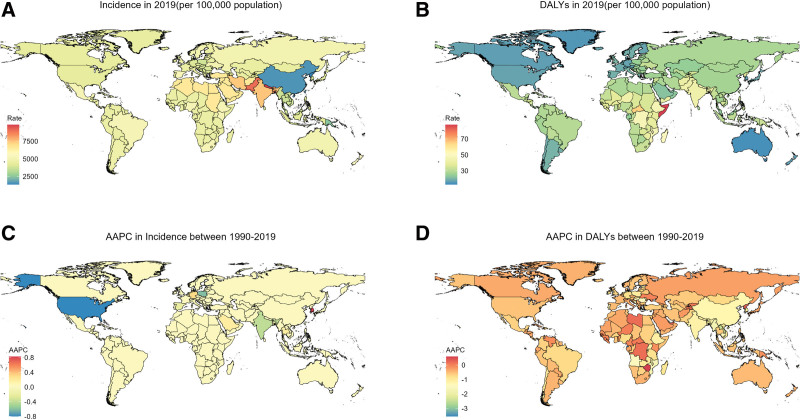
Globally, the all-age rate of prevalence (AAPC = -0.7, 95% confidence interval [CI] = -0.7 to -0.8), DALYs (AAPC = -1.0, 95% CI = -1.1 to -1.0), and mortality (AAPC = -6.8, 95% CI = -7.3 to -6.4) from otitis media decreased constantly between 1990 and 2019. The all-age rate of incidence decreased sharply between 2000 and 2009 with an AAPC of -1.2 (95% CI = -1.4 to -0.9) and continued the downward trend between 2010 and 2019 (AAPC = -0.2, 95% CI = -0.3 to -0.1). In 2019, children aged 1 to 4 years old had the highest incidence at 29,127.3 per 100,000 population, while young adults under 30 years old accounted for 91.3% of the incident cases. Individuals living in middle-SDI countries had the largest increase in the incidence of otitis media, with an AAPC of 0.3 (95% CI = 0.3 to 0.3) between 1990 and 2019. The incidence and DALYs from otitis media decreased with increasing SDI. Regionally, the largest increase in incidence was observed in high-income Asia Pacific, Eastern Europe, and Western Sub-Saharan Africa between 1990 and 2019. Nationally, the largest increase in the incidence of otitis media was observed in the Republic of Korea, with an AAPC of 0.8 (95% CI = 0.6 to 1.1) in the same time period.
There have been successful previous endeavors to reduce DALYs and mortality attributed to otitis media on a global scale. The worldwide incidence of otitis media experienced a sharp decline following the introduction of PCV-7 in 2000, and this downward trend persisted in subsequent years with the adoption of PCV-13/pneumococcal nontypeable Haemophilus influenzae protein D conjugate vaccine. Continual epidemiological surveillance of otitis media's global trends, pathogen distribution, and resistance patterns remains imperative.
中耳炎是儿童早期听力损失的最重要原因之一。自 2000 年以来,常规的 7 价肺炎球菌结合疫苗(PCV-7)已被有效推广使用。自 2010 年以来,它已逐渐被肺炎球菌非分型流感嗜血杆菌蛋白 D 结合疫苗或更高价的 13 价 PCV(PCV-13)所取代。近年来,全球、地区和国家层面有关中耳炎负担变化的数据非常有限。
使用 2019 年全球疾病负担研究来评估全球范围内 1990 年至 2019 年地理人群中中耳炎的患病率、发病率、死亡率、残疾调整生命年(DALY)率和中耳炎发病率的年均百分比变化(AAPC)。这些全球趋势按年龄、性别和社会人口指数(SDI)分组进一步进行分析。
在全球范围内,中耳炎的全年龄段患病率(AAPC=-0.7,95%置信区间[CI]:-0.7 至-0.8)、DALY(AAPC=-1.0,95%CI:-1.1 至-1.0)和死亡率(AAPC=-6.8,95%CI:-7.3 至-6.4)自 1990 年以来持续下降。2000 年至 2009 年期间,中耳炎的全年龄段发病率急剧下降,AAPC 为-1.2(95%CI:-1.4 至-0.9),并在 2010 年至 2019 年期间继续保持下降趋势(AAPC=-0.2,95%CI:-0.3 至-0.1)。2019 年,1 至 4 岁儿童的发病率最高,为每 100,000 人 29,127.3 例,而 30 岁以下的年轻人占发病例数的 91.3%。中 SDI 国家的中耳炎发病率增幅最大,1990 年至 2019 年间 AAPC 为 0.3(95%CI:0.3 至 0.3)。随着 SDI 的增加,中耳炎的发病率和 DALY 都有所下降。在区域层面,2019 年高收入亚太地区、东欧和撒哈拉以南非洲西部的发病率增幅最大。在国家层面,韩国的中耳炎发病率增幅最大,在同一时期,AAPC 为 0.8(95%CI:0.6 至 1.1)。
全球范围内已经有成功的努力来降低与中耳炎相关的 DALY 和死亡率。自 2000 年 PCV-7 推出以来,全球范围内中耳炎的发病率急剧下降,随后几年随着 PCV-13/肺炎球菌非分型流感嗜血杆菌蛋白 D 结合疫苗的采用,这一下降趋势持续存在。对中耳炎全球趋势、病原体分布和耐药模式的持续流行病学监测仍然至关重要。