TB Alliance, New York, NY, United States of America.
National Tuberculosis and Leprosy Control Programme, Abuja, Nigeria.
PLoS One. 2024 Jan 5;19(1):e0296448. doi: 10.1371/journal.pone.0296448. eCollection 2024.
The WHO has issued a call to action urging countries to accelerate the rollout of new WHO-recommended shorter all-oral treatment regimens for drug-resistant TB (DR-TB), which remains a public-health crisis. The all-oral, 6-month BPaL/M regimen comprises 3-4 drugs: pretomanid used in combination with bedaquiline and linezolid, with or without moxifloxacin. This regimen has been recommended by the WHO for use in DR-TB patients instead of ≥9-month (up to 24-month) regimens. This study aims to project this regimen's use, along with its components bedaquiline, pretomanid and linezolid, and other treatments for DR-TB globally through 2026. It is intended to guide global health stakeholders in planning and budgeting for DR-TB interventions. Projected usage could help estimate cost of the individual components of DR-TB regimens over time.
Semi-structured interviews were conducted with national TB programme participants in key countries to gather intelligence on established plans and targets for use of various DR-TB treatment regimens from 2023 to 2026. These data informed development of projections for the global use of regimens and drugs.
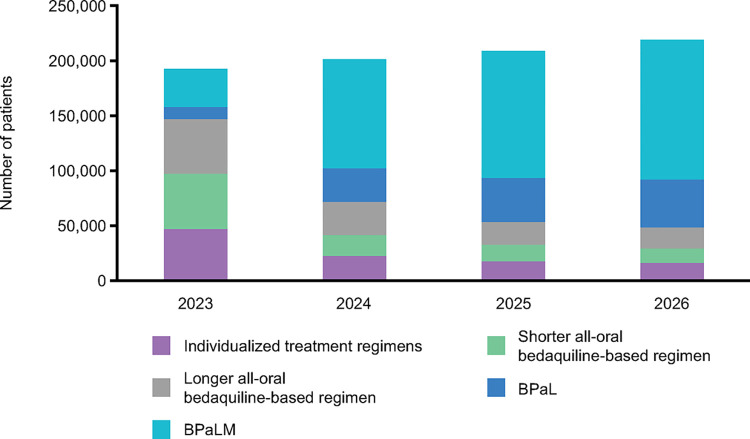
Consistent global growth in the use of shorter regimens in DR-TB treatment was shown: BPaLM reaching 126,792 patients, BPaL reaching 43,716 patients, and the 9-11-month all-oral bedaquiline-based regimen reaching 13,119 patients by 2026. By 2026, the longer all-oral regimen is projected to be used by 19,262 patients, and individualised treatment regimens by 15,344 patients.
The study shows BPaL/M will be used in majority of DR-TB patients by 2024, reaching 78% by 2026. However, national efforts to scale-up, case-finding, monitoring, drug-susceptibility testing, and implementation of new treatments will be essential for ensuring they are accessible to all eligible patients in the coming years and goals for ending TB are met. There is an urgent need to engage communities in capacity building and demand generation.
世界卫生组织(WHO)发出行动呼吁,敦促各国加快推出新的世卫组织推荐的耐多药结核病(DR-TB)短程全口服治疗方案,该方案仍然是一个公共卫生危机。全口服、6 个月的 BPaL/M 方案包含 3-4 种药物:贝达喹啉与巴利沙星和利奈唑胺联合使用,或与莫西沙星联合使用。该方案已被世卫组织推荐用于治疗 DR-TB 患者,以替代≥9 个月(最长 24 个月)的方案。本研究旨在预测该方案及其组成部分贝达喹啉、贝达喹啉、利奈唑胺以及其他治疗 DR-TB 的药物在全球范围内的使用情况,直至 2026 年。它旨在为全球卫生利益相关者规划和预算 DR-TB 干预措施提供指导。预计使用情况可以帮助估计 DR-TB 方案中各个组成部分的成本随时间的变化。
对关键国家的国家结核病规划参与者进行了半结构式访谈,以收集关于 2023 年至 2026 年各种 DR-TB 治疗方案使用的既定计划和目标的情报。这些数据为制定全球方案和药物使用预测提供了信息。
显示出 DR-TB 治疗中较短方案的使用持续增长:到 2026 年,BPaLM 将有 126792 名患者使用,BPaL 将有 43716 名患者使用,9-11 个月的全口服贝达喹啉为基础的方案将有 13119 名患者使用。到 2026 年,预计较长的全口服方案将有 19262 名患者使用,个体化治疗方案将有 15344 名患者使用。
研究表明,到 2024 年,BPaL/M 将在大多数 DR-TB 患者中使用,到 2026 年将达到 78%。然而,扩大规模、发现病例、监测、药物敏感性测试和实施新治疗方法的国家努力对于确保未来几年所有符合条件的患者都能获得这些方案以及实现终止结核病的目标至关重要。迫切需要让社区参与能力建设和需求产生。