Beckmann Tal Sarah, Samer Caroline Flora, Wozniak Hannah, Savoldelli Georges Louis, Suppan Mélanie
Division of Anaesthesiology, Department of Anaesthesiology, Clinical Pharmacology, Intensive Care and Emergency Medicine, Geneva University Hospitals and Faculty of Medicine, Geneva, Switzerland.
Division of Clinical Pharmacology and Toxicology, Department of Anaesthesiology, Clinical Pharmacology, Intensive Care and Emergency Medicine, Geneva University Hospitals and Faculty of Medicine, Geneva, Switzerland.
Heliyon. 2023 Dec 13;10(1):e23545. doi: 10.1016/j.heliyon.2023.e23545. eCollection 2024 Jan 15.
The use of local anaesthetics (LAs) is usually associated with few adverse effects, but local anaesthetic systemic toxicity (LAST) can result in serious harm and even death. However, practitioner awareness regarding this risk has been little studied.
This was a closed, web-based study carried out at two Swiss university hospitals using a fully automated questionnaire. The main objective was to evaluate LAST awareness and LA use among various medical practitioners. The secondary objective was to determine whether these physicians felt that a tool designed to compute maximum safe LA doses should be developed.
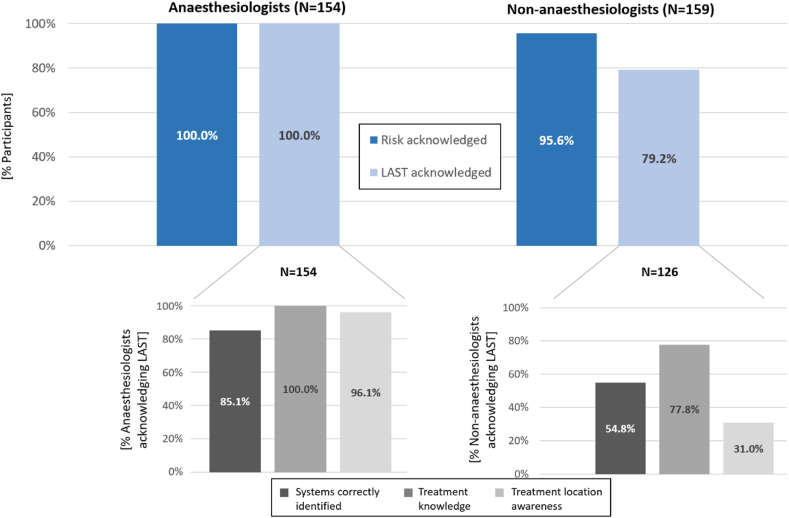
The overall participation rate was 40.2 % and was higher among anaesthesiologists (154/249, 61.8 % vs 159/530, 30.0 %; < .001). Anaesthesiologists identified the risk of LAST and the systems involved more frequently than non-anaesthesiologists (85.1 % vs 43.4 %, < .001). After adjusting for years of clinical experience, age, country of diploma, frequency of LA use, clinical position and being an anaesthesiologist, the only significant associations were this latter factor ( < .001) and clinical position ( = .016 for fellows and = .046 for consultants, respectively). Most respondents supported the development of a tool designed to compute maximum safe LA doses (251/313, 80.2 %) and particularly of a mobile app (190/251, 75.7 %).
LAST awareness is limited among practitioners who use LAs on a regular basis. Educational interventions should be created, and tools designed to help calculate maximum safe LA doses developed. The actual frequency of unsafe LA doses administration would also deserve further study.
局部麻醉药(LA)的使用通常不良反应较少,但局部麻醉药全身毒性(LAST)可导致严重伤害甚至死亡。然而,从业者对这种风险的认知鲜有研究。
这是一项在瑞士两家大学医院开展的基于网络的封闭式研究,使用全自动问卷。主要目的是评估不同医学从业者对LAST的认知以及LA的使用情况。次要目的是确定这些医生是否认为应开发一种用于计算最大安全LA剂量的工具。
总体参与率为40.2%,麻醉医生的参与率更高(154/249,61.8%对159/530,30.0%;P<0.001)。麻醉医生比非麻醉医生更频繁地识别出LAST风险及相关机制(85.1%对43.4%,P<0.001)。在对临床经验年限、年龄、文凭颁发国家、LA使用频率、临床职位以及是否为麻醉医生进行校正后,唯一显著的关联因素是后者(P<0.001)以及临床职位(住院医师P = 0.016,顾问医师P = 0.046)。大多数受访者支持开发一种用于计算最大安全LA剂量的工具(251/313,80.2%),尤其是移动应用程序(190/251,75.7%)。
经常使用LA的从业者对LAST的认知有限。应开展教育干预,并开发有助于计算最大安全LA剂量的工具。不安全LA剂量给药的实际频率也值得进一步研究。