
经导管射频消融联合胆道支架与单纯胆道支架治疗恶性胆道梗阻的系统评价和Meta分析
Intraductal radiofrequency ablation plus biliary stent versus stent alone for malignant biliary obstruction: a systematic review and meta-analysis.
作者信息
de Oliveira Veras Matheus, de Moura Diogo Turiani Hourneaux, McCarty Thomas R, de Oliveira Guilherme Henrique Peixoto, Gomes Rômulo Sérgio Araújo, Landim Davi Lucena, Nunes Felipe Giacobo, Franzini Tomazo Antônio Prince, Lera Dos Santos Marcos Eduardo, Bernardo Wanderley Marques, de Moura Eduardo Guimarães Hourneaux
机构信息
Gastrointestinal Endoscopy Unit, University of Sao Paulo Hospital of Clinics, Sao Paulo, Brazil.
Internal Medicine, Yale University School of Medicine, New Haven, United States.
出版信息
Endosc Int Open. 2024 Jan 5;12(1):E23-E33. doi: 10.1055/a-2204-8316. eCollection 2024 Jan.
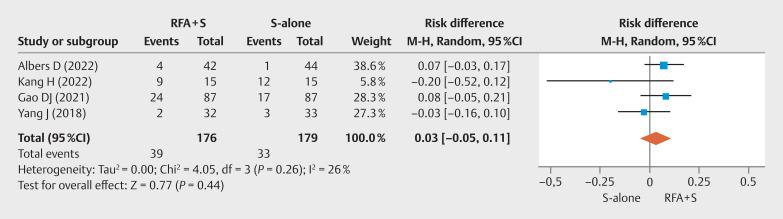
Recurrent biliary stent occlusion and tumor ingrowth remain a major concern among patients with malignant biliary obstruction (MBO) with significant impact on patient morbidity and survival. Intraductal radiofrequency ablation (RFA) has emerged as a promising treatment that seeks to extend stent patency. This study aimed to evaluate the impact of RFA on overall survival (OS) and stent patency among patients with unresectable MBO. A comprehensive search of electronic databases was performed for randomized controlled trials (RCTs) comparing RFA plus biliary stent (RFA+S) versus biliary stent alone (S-alone). Outcomes assessed included overall survival, stent patency, and adverse events (AEs) with mean difference (MD) calculated from pooled proportions. Subgroup analyses were performed for hilar strictures and cholangiocarcinoma (CCA). Six RCTs (n=439 patients) were included and demonstrated improved survival among patients who received RFA+S (MD 85.80 days; 95% confidence interval [CI] 35.02-136.58; I =97%; <0.0009). The pooled MD for total stent patency was 22.25 days (95% CI 17.38-61.87; I =97%; =0.27). There was no difference in AEs between RFA+S vs S-alone ( >0.05). On subgroup analyses, RFA+S was associated with improved stent patency (MD 76.73 days; 95% CI 50.11-103.34; I =67%; <0.01) and OS (MD 83.14 (95% CI 29.52-136.77; I =97%; <0.01] for CCA. For hilar strictures, stent patency was improved among patients with RFA+S [MD 83.71 days (95% CI 24.85-142.56; I =84%; <0.01]. RFA+S improved OS in the treatment of MBO when compared with S-alone. Moreover, the RFA therapy prolonged stent patency in hilar strictures and CCA, with similar rates of AEs.
复发性胆管支架阻塞和肿瘤长入仍然是恶性胆管梗阻(MBO)患者的主要担忧,对患者的发病率和生存率有重大影响。导管内射频消融(RFA)已成为一种有前景的治疗方法,旨在延长支架通畅时间。本研究旨在评估RFA对不可切除MBO患者总生存期(OS)和支架通畅性的影响。对电子数据库进行全面检索,以查找比较RFA联合胆管支架(RFA+S)与单纯胆管支架(单纯S)的随机对照试验(RCT)。评估的结果包括总生存期、支架通畅性和不良事件(AE),通过合并比例计算平均差(MD)。对肝门部狭窄和胆管癌(CCA)进行亚组分析。纳入了6项RCT(n=439例患者),结果显示接受RFA+S的患者生存期有所改善(MD 85.80天;95%置信区间[CI] 35.02-136.58;I²=97%;P<0.0009)。总支架通畅性的合并MD为22.25天(95% CI 17.38-61.87;I²=97%;P=0.27)。RFA+S与单纯S在AE方面无差异(P>0.05)。亚组分析显示,RFA+S与改善支架通畅性相关(MD 76.73天;95% CI 50.11-103.34;I²=67%;P<0.01),对于CCA患者OS也有改善(MD 83.14(95% CI 29.52-136.77;I²=97%;P<0.01])。对于肝门部狭窄,RFA+S患者的支架通畅性得到改善[MD 83.71天(95% CI 24.85-142.56;I²=84%;P<0.01]。与单纯S相比,RFA+S在治疗MBO时改善了OS。此外,RFA治疗延长了肝门部狭窄和CCA患者的支架通畅时间,AE发生率相似。


 Zotero 插件