Li Xin, Ye Chong, Zhang Wanyi, Jia Miaomiao, Wang Gang
Xi'an Janssen Pharmaceutical Ltd., Chaoyang District, Beijing, China.
The National Clinical Research Center for Mental Disorders and Beijing Key Laboratory of Mental Disorders, Beijing Anding Hospital, Capital Medical University, Xicheng District, 5 Ankang Hutong, Beijing, 100088, China.
CNS Drugs. 2024 Jan;38(1):55-65. doi: 10.1007/s40263-023-01056-x. Epub 2024 Jan 8.
Identifying key factors for a successful transition from once-monthly paliperidone palmitate (PP1M) to three-monthly paliperidone palmitate (PP3M) is crucial for improving treatment outcomes, enhancing patient adherence, and reducing relapse risk in patients with schizophrenia. Providing region-specific insights for evidence-based clinical decisions can aid clinicians in optimizing transition strategies for Chinese patients with schizophrenia. Therefore, the objective of this post hoc analysis of a double-blind parallel-group multicenter phase 3 study (NCT01515423) was to identify factors related to the disease stabilization that may allow for a successful transition from PP1M to PP3M in the treatment of Chinese patients with schizophrenia.
Adults (18-70 years) diagnosed with schizophrenia using the Diagnostic and Statistical Manual of Mental Disorders, fourth edition text revision, for over 1 year and with a baseline Positive and Negative Syndrome Scale (PANSS) total score between 70 and 120 were entered into an open-label (OL) phase receiving PP1M for 17 weeks. After the 17-week OL phase, patients who met the criteria necessary for stabilization were randomized (1:1) to PP1M (fixed-dose, 50, 75, 100, or 150 mg eq.) or PP3M (fixed-dose, 175, 263, 350, or 525 mg eq.) in a 48-week double-blind phase. Stabilization was defined as a PANSS total score < 70, PANSS item (P1, P2, P3, P6, P7, G8, G14) scores ≤ 4, and a reduction in Clinical Global Impression Severity (CGI-S) score of ≥ 1 from OL baseline. This post hoc analysis evaluated changes and trends in symptom severity using PANSS, changes in mental states using CGI-S, and changes in personal and social functioning using Personal and Social Performance (PSP) scores from baseline to the endpoint of the OL phase in patients who either met or did not meet the stabilization criteria (stabilized versus non-stabilized group). Comparison of changes and trends in the clinical scores between the stabilized group and non-stabilized group were conducted using linear mixed model and Mann-Kendall trend analysis, respectively. Univariate and multivariate logistic regression analyses were conducted to explore factors associated with stabilization status for transition.
Of 296 patients enrolled, 210 achieved disease stabilization (106 patients and 104 patients were randomized to PP1M and PP3M, respectively). Significant downward trends in the PANSS and CGI-S scores were detected in the stabilized patients (n = 210, Z = -2.21, p = 0.028; Z = -2.21, p = 0.028) but not in the non-stabilized patients (n = 86). No significant trends in the PSP scores were observed in either group. The factors significantly associated with disease stabilization were the CGI-S score at baseline [odds ratio (OR) = 0.22, 95% confidence interval (CI): 0.09, 0.5), reduction of the PANSS score at week 13 (OR = 1.11, 95% CI: 1.06, 1.17), and reduction of CGI-S score at week 13 (OR = 2.27, 95% CI: 1.03, 5.02).
A lower CGI-S total score at baseline and greater reductions in PANSS and CGI-S scores at week 13 were associated with patients achieving disease stabilization, that may allow for a successful transition. Evidence from this study indicates that better disease condition at baseline, early functional improvement and symptomatic relief were the key factors associated with disease stabilization. The findings may guide clinicians to identify suitable patients for transition from PP1M to PP3M and further optimize the use of PP3M in China.
EudraCT number: 2011-004889-15 and ClinicalTrials.gov (identifier: NCT01515423) for the original double-blind randomized study.
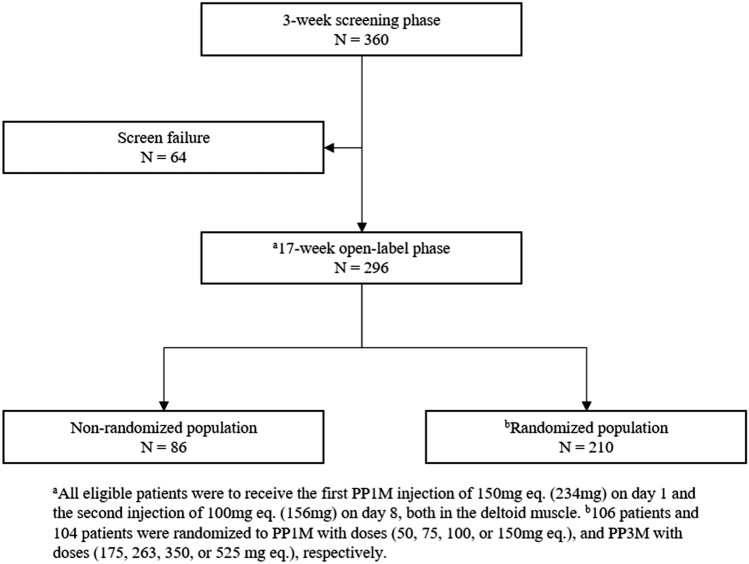
确定从每月一次棕榈酸帕利哌酮(PP1M)成功转换为每三个月一次棕榈酸帕利哌酮(PP3M)的关键因素,对于改善精神分裂症患者的治疗效果、提高患者依从性以及降低复发风险至关重要。提供针对特定地区的见解以支持循证临床决策,有助于临床医生为中国精神分裂症患者优化转换策略。因此,这项对一项双盲平行组多中心3期研究(NCT01515423)的事后分析的目的,是确定与疾病稳定相关的因素,这些因素可能有助于中国精神分裂症患者在治疗中从PP1M成功转换为PP3M。
使用《精神障碍诊断与统计手册》第四版文本修订版诊断为精神分裂症超过1年且基线阳性与阴性症状量表(PANSS)总分在70至120之间的成年人(18 - 70岁)进入一个开放标签(OL)阶段,接受PP1M治疗17周。在17周的OL阶段之后,符合病情稳定所需标准的患者被随机分组(1:1),在48周的双盲阶段接受PP1M(固定剂量,50、75、100或150 mg当量)或PP3M(固定剂量,175、263、350或525 mg当量)。病情稳定定义为PANSS总分 < 70,PANSS项目(P1、P2、P3、P6、P7、G8、G14)得分≤4,以及临床总体印象严重程度(CGI - S)评分较OL基线降低≥1。这项事后分析评估了符合或不符合病情稳定标准的患者(稳定组与非稳定组)从基线到OL阶段终点使用PANSS的症状严重程度变化和趋势、使用CGI - S的精神状态变化以及使用个人与社会表现(PSP)评分的个人和社会功能变化。分别使用线性混合模型和Mann - Kendall趋势分析对稳定组和非稳定组之间临床评分的变化和趋势进行比较。进行单因素和多因素逻辑回归分析以探索与转换的病情稳定状态相关的因素。
在296名入组患者中,210名实现了疾病稳定(分别有106名患者和104名患者被随机分配至PP1M和PP3M组)。在稳定患者中(n = 210,Z = -2.21,p = 0.028;Z = -2.21,p = 0.028)检测到PANSS和CGI - S评分有显著下降趋势,但在非稳定患者中(n = 86)未检测到。两组中PSP评分均未观察到显著趋势。与疾病稳定显著相关的因素是基线时的CGI - S评分[比值比(OR)= 0.22,95%置信区间(CI):0.09,0.5]、第13周时PANSS评分的降低(OR = 1.11,95% CI:1.06,1.17)以及第13周时CGI - S评分的降低(OR = 2.27,95% CI:1.03,5.02)。
基线时较低的CGI - S总分以及第13周时PANSS和CGI - S评分的更大降低与患者实现疾病稳定相关,这可能有助于成功转换。本研究的证据表明,基线时更好的病情状况、早期功能改善和症状缓解是与疾病稳定相关的关键因素。这些发现可能指导临床医生识别适合从PP1M转换为PP3M的患者,并进一步优化中国PP3M的使用。
原始双盲随机研究的欧盟临床试验注册号:2011 - 004889 - 15以及ClinicalTrials.gov(标识符:NCT01515423)


