
转移性胃癌治疗格局演变的叙述性综述:靶向治疗的作用
A narrative review of the evolving landscape of the management of metastatic gastric cancer: the role of targeted therapies.
作者信息
Delgado-Ramos Glenda M, Fitzsimons Jack, Dhanarajan Asha
机构信息
Division of Hematology and Oncology, UT Southwestern Medical Center, Dallas, TX, USA.
Department of Medicine, Loyola University Medical Center, Chicago, IL, USA.
出版信息
J Gastrointest Oncol. 2023 Dec 31;14(6):2600-2616. doi: 10.21037/jgo-23-464. Epub 2023 Dec 14.
BACKGROUND AND OBJECTIVE
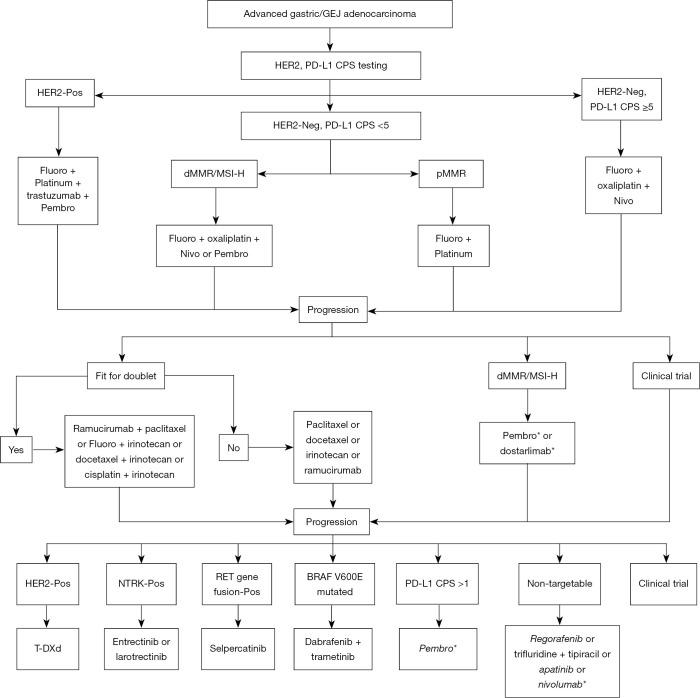
Gastric cancer is the fifth most common cancer worldwide and the fourth leading cause of cancer-related death. Unfortunately, patients often present with advanced disease at diagnosis, which is directly related to its high mortality. Numerous trials, as early as the 1980's, have shown that cytotoxic chemotherapy improves survival. This review will focus on targeted therapies and immunotherapies which have emerged as treatment options for metastatic gastric cancer, often used in conjunction with cytotoxic chemotherapy. Here we will review the relevant clinical trials of targeted therapies and immunotherapies in the treatment of metastatic gastric cancer.
METHODS
We performed an extensive review of articles in the PubMed database pertaining to targeted therapies and immunotherapies in the treatment of metastatic gastric cancer. Additionally, updated guidelines from the National Comprehensive Cancer Network (NCCN) and European Society for Medical Oncology (ESMO) were reviewed.
KEY CONTENT AND FINDINGS
Cytotoxic chemotherapy remains the backbone of treatment of metastatic gastric cancer, but the development of targeted therapies and immunotherapy have revolutionized its treatment with improved survival and outcomes. Therapies have been developed which target human epidermal growth factor receptor 2 (HER2), vascular endothelial growth factor receptor-2 (VEGFR-2), and tyrosine kinase pathways. Novel targeted therapies are currently being investigated with promising results thus far. Immunotherapy, specifically immune checkpoint inhibitors (ICIs), has proven to be a significant advancement in the treatment of gastric cancer.
CONCLUSIONS
Targeted therapies and immunotherapies have improved survival and outcomes in metastatic gastric cancer, however more research is needed to make even greater strides.
背景与目的
胃癌是全球第五大常见癌症,也是癌症相关死亡的第四大主要原因。不幸的是,患者在确诊时往往已处于疾病晚期,这直接导致了其高死亡率。早在20世纪80年代,众多试验就已表明细胞毒性化疗可提高生存率。本综述将聚焦于已成为转移性胃癌治疗选择的靶向治疗和免疫治疗,这些治疗常与细胞毒性化疗联合使用。在此,我们将回顾靶向治疗和免疫治疗在转移性胃癌治疗中的相关临床试验。
方法
我们对PubMed数据库中有关转移性胃癌治疗的靶向治疗和免疫治疗的文章进行了广泛综述。此外,还查阅了美国国立综合癌症网络(NCCN)和欧洲医学肿瘤学会(ESMO)的最新指南。
关键内容与发现
细胞毒性化疗仍然是转移性胃癌治疗的基石,但靶向治疗和免疫治疗的发展彻底改变了其治疗方式,提高了生存率和治疗效果。已开发出针对人表皮生长因子受体2(HER2)、血管内皮生长因子受体-2(VEGFR-2)和酪氨酸激酶途径的疗法。目前正在研究新型靶向治疗,迄今为止已取得了有前景的结果。免疫治疗,特别是免疫检查点抑制剂(ICI),已被证明是胃癌治疗的一项重大进展。
结论
靶向治疗和免疫治疗改善了转移性胃癌的生存率和治疗效果,然而仍需要更多研究以取得更大进展。


 Zotero 插件