Jiangxi Provincial Engineering Research Center for Seed- breeding and Utilization of Camphor Trees, Nanchang Institute of Technology, Nanchang, 330099, China.
Soil and Fertilizer & Resources and Environment Institute, Jiangxi Academy of Agricultural Sciences, Nanchang, 330200, China.
BMC Microbiol. 2024 Jan 10;24(1):18. doi: 10.1186/s12866-023-03170-8.
Cinnamomum camphora (L.) Presl (C. camphora) is an evergreen broad-leaved tree cultivated in subtropical China. The use of C. camphora as clonal cuttings for coppice management has become popular recently. However, little is known about the relationship between soil core microbiota and ecosystem multi-functionality under tree planting. Particularly, the effects of soil core microbiota on maintaining ecosystem multi-functionality under C. camphora coppice planting remained unclear.
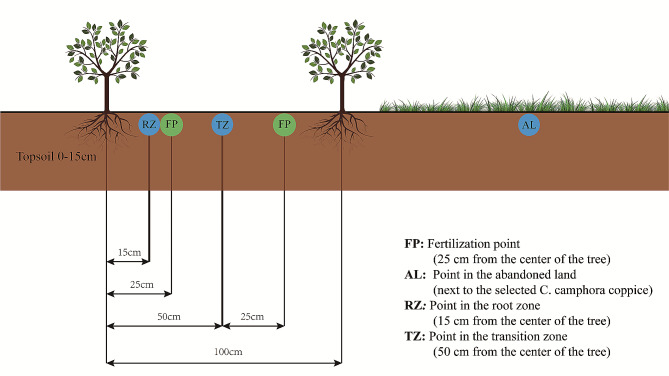
In this study, we collected soil samples from three points (i.e., the abandoned land, the root zone, and the transition zone) in the C. camphora coppice planting to investigate whether core microbiota influences ecosystem multi-functions.
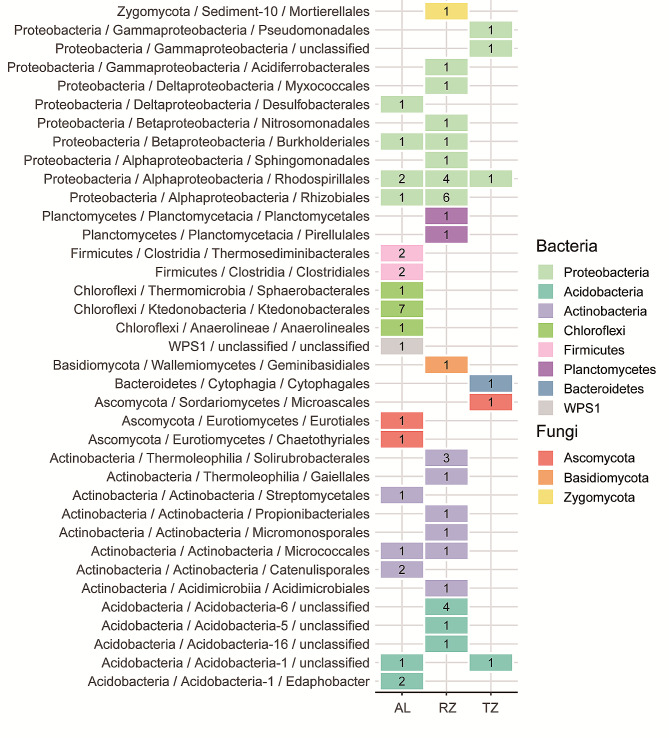
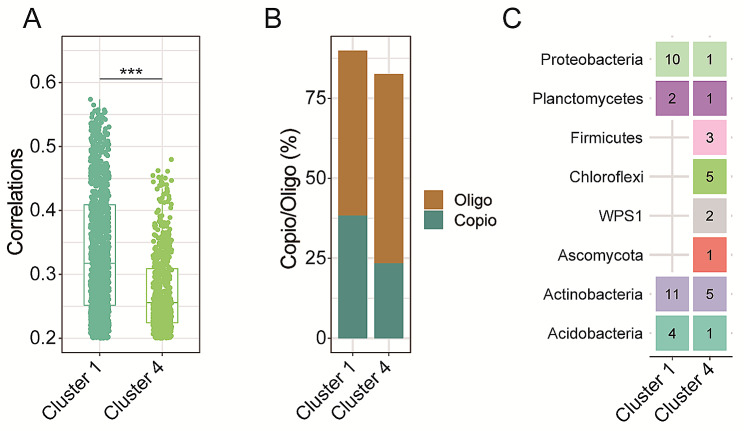
The result showed a significant difference in soil core microbiota community between the abandoned land (AL), root zone (RZ), and transition zone (TZ), and soil ecosystem multi-functionality of core microbiota in RZ had increased significantly (by 230.8%) compared to the AL. Soil core microbiota played a more significant influence on ecosystem multi-functionality than the non-core microbiota. Moreover, the co-occurrence network demonstrated that the soil ecosystem network consisted of five major ecological clusters. Soil core microbiota within cluster 1 were significantly higher than in cluster 4, and there is also a higher Copiotrophs/Oligotrophs ratio in cluster 1. Our results corroborated that soil core microbiota is crucial for maintaining ecosystem multi-functionality. Especially, the core taxa within the clusters of networks under tree planting, with the same ecological preferences, had a significant contribution to ecosystem multi-functionality.
Overall, our results provide further insight into the linkage between core taxa and ecosystem multi-functionality. This enables us to predict how ecosystem functions respond to the environmental changes in areas under the C. camphora coppice planting. Thus, conserving the soil microbiota, especially the core taxa, is essential to maintaining the multiple ecosystem functions under the C. camphora coppice planting.
樟(Cinnamomum camphora (L.) Presl)是中国亚热带地区广泛种植的常绿阔叶树种。最近,樟的克隆插条用于萌生林管理的应用越来越受欢迎。然而,人们对造林下土壤芯微生物群与生态系统多功能性之间的关系知之甚少。特别是,土壤芯微生物群对维持樟萌生林下生态系统多功能性的影响仍不清楚。
本研究从樟萌生林的三个点(废弃地、根区和过渡区)采集土壤样本,以调查核心微生物群是否影响生态系统多功能性。
结果表明,废弃地(AL)、根区(RZ)和过渡区(TZ)之间的土壤芯微生物群群落存在显著差异,与 AL 相比,RZ 土壤芯微生物群的土壤生态系统多功能性显著增加(增加了 230.8%)。土壤芯微生物群对生态系统多功能性的影响大于非芯微生物群。此外,共现网络表明,土壤生态系统网络由五个主要的生态集群组成。集群 1 中的土壤芯微生物群明显高于集群 4,并且在集群 1 中也有更高的 Copiotrophs/Oligotrophs 比值。我们的结果证实,土壤芯微生物群对于维持生态系统多功能性至关重要。特别是,在种植下的网络集群内的核心分类群,具有相同的生态偏好,对生态系统多功能性有显著贡献。
总的来说,我们的结果提供了进一步的深入了解核心分类群与生态系统多功能性之间的联系。这使我们能够预测生态系统功能如何对樟萌生林下的环境变化做出响应。因此,保护土壤微生物群,特别是核心分类群,对于维持樟萌生林下的多种生态系统功能至关重要。