Chitambala Thoniso, Ny Veit, Ceacero Francisco, Bartoň Luděk, Bureš Daniel, Kotrba Radim, Needham Tersia
Department of Animal Science and Food Processing, Faculty of Tropical AgriSciences, Czech University of Life Sciences Prague, 16500 Prague, Czech Republic.
Department of Cattle Breeding, Institute of Animal Science, 10400 Prague, Czech Republic.
Animals (Basel). 2023 Dec 28;14(1):115. doi: 10.3390/ani14010115.
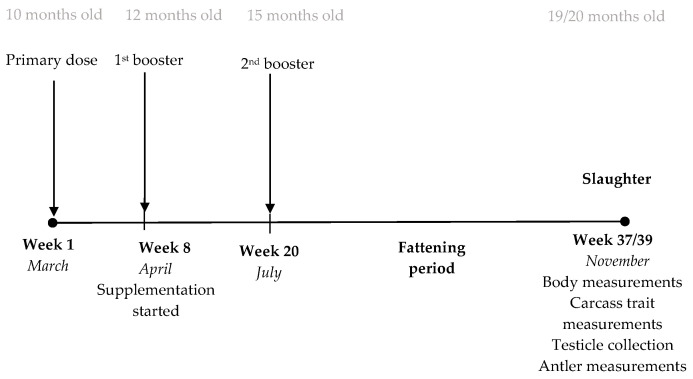
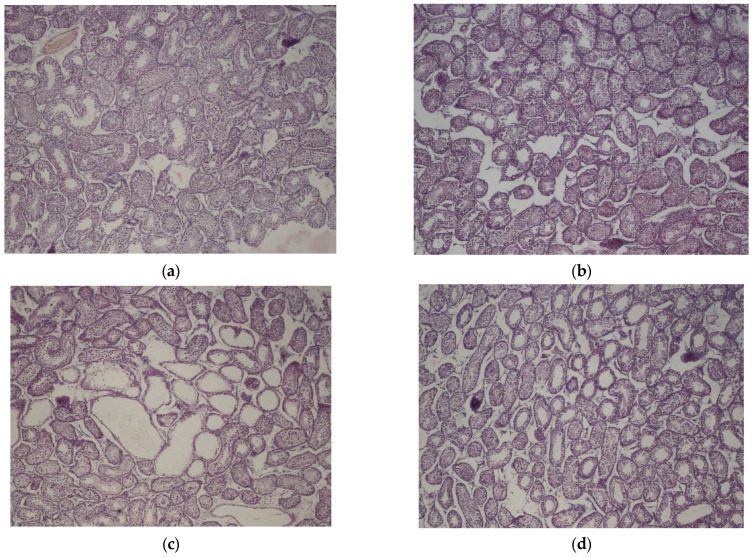
Forty-four fallow deer bucks (10 months old; 22.9 ± 2.4 kg) were utilized to investigate the effects of immunocastration and amino acid supplementation on testes development. Immunocastrated bucks were administered Improvac at weeks 1, 8, and 20 of this study (control group: intact males). Starting at week 8, half of each sex received rumen-protected lysine and methionine (3:1) supplementation. At slaughter (week 37/39), body size, internal fat deposits, antler size parameters, testes weight, testes surface color, cauda epididymal sperm viability and morphology, and seminiferous tubule circumference and epithelium thickness were determined. Animals with larger body sizes, greater forequarter development, and antler growth also had greater testes development. Whilst the result of immunocastration on testes size is unexpected, testes tissue showed impaired development (atrophied seminiferous tubules), decreased sperm viability, and normal morphology. Testes tissue from immunocastrated deer was less red, possibly indicating reduced blood supply. Conversely, amino acid supplementation increased testes' redness and sperm viability, and intact males fed amino acids showed the greatest seminiferous tubule development. Thus, immunocastration may be a welfare-friendly alternative for venison production. Whilst the results support findings from the literature that testes size is not a reliable indicator of immunocastration success, this warrants further investigation in deer over different physiological development stages.
44只成年雄鹿(10个月大;体重22.9±2.4千克)被用于研究免疫去势和补充氨基酸对睾丸发育的影响。在本研究的第1、8和20周,对免疫去势的雄鹿注射Improvac(对照组:未去势的雄性)。从第8周开始,每组中的一半动物接受瘤胃保护型赖氨酸和蛋氨酸(比例为3:1)的补充。在屠宰时(第37/39周),测定动物的体型、体内脂肪沉积、鹿角大小参数、睾丸重量、睾丸表面颜色、附睾尾精子活力和形态,以及曲细精管周长和上皮厚度。体型较大、前躯发育较好且有鹿角生长的动物,其睾丸发育也较好。虽然免疫去势对睾丸大小的影响出乎意料,但睾丸组织显示出发育受损(曲细精管萎缩)、精子活力下降和形态正常。免疫去势鹿的睾丸组织颜色较浅,可能表明血液供应减少。相反,补充氨基酸可增加睾丸的红色程度和精子活力,且喂食氨基酸的未去势雄性动物的曲细精管发育最好。因此,免疫去势可能是一种有利于鹿肉生产的福利友好型替代方法。虽然这些结果支持了文献中的发现,即睾丸大小不是免疫去势成功的可靠指标,但这需要在不同生理发育阶段的鹿身上进行进一步研究。