Villalba-Orero María, Contreras-Aguilar María Dolores, Cerón Jose Joaquín, Fuentes-Romero Beatriz, Valero-González Marta, Martín-Cuervo María
Hospital Clínico Veterinario Complutense, Departamento de Medicina y Cirugía Animal, Facultad de Veterinaria, Universidad Complutense de Madrid, 28040 Madrid, Spain.
Interdisciplinary Laboratory of Clinical Analysis of the University of Murcia (Interlab-UMU), Department of Animal Medicine and Surgery, Veterinary School, Regional Campus of International Excellence Mare Nostrum, Campus de Espinardo, University of Murcia, 30100 Murcia, Spain.
Animals (Basel). 2024 Jan 4;14(1):164. doi: 10.3390/ani14010164.
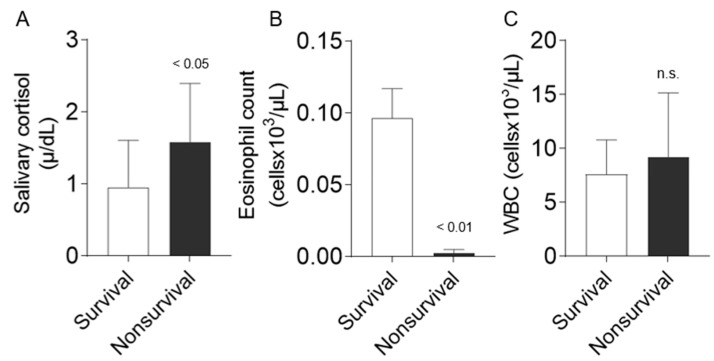
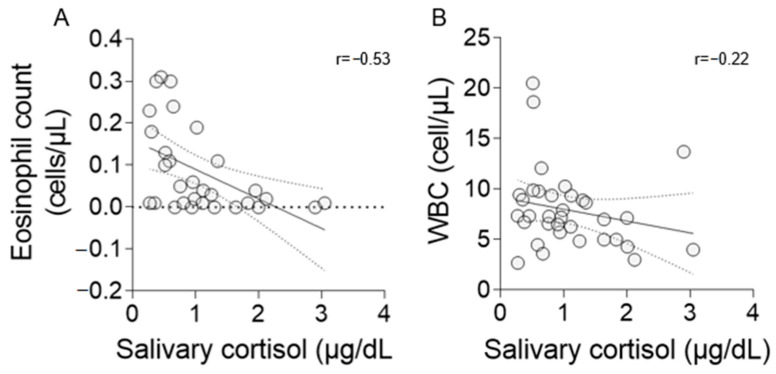
Stress leukogram includes eosinopenia as one of its main markers (neutrophilia, eosinopenia, lymphopenia, and mild monocytosis). Cortisol is the main stress biomarker, which is also strongly correlated with the severity of gastrointestinal diseases. This study aimed to determine the relationship between salivary cortisol and the eosinophil cell count (EC) in equids with abdominal pain. To do this, 39 horses with abdominal pain referred to an emergency service were included. All samples were taken on admission, and several parameters and clinical data were included. Equids were classified according to the outcome as survivors and non-survivors. Non-surviving equids presented higher salivary cortisol concentrations (Non-Survivors: 1.580 ± 0.816 µg/dL; Survivors 0.988 ± 0.653 µg/dL; < 0.05) and lower EC (Non-Survivors: 0.0000 × 10/µL (0.000/0.0075); Survivors: 0.0450 × 10/µL (0.010/0.1825); < 0.01). In addition, the relationship between salivary cortisol concentration, EC, and the WBC was determined. Only a strong correlation (negative) was observed between cortisol and EC (r = -0.523, < 0.01). Since cortisol is not an analyte that can be measured routinely in clinical settings such as emergencies, the EC could be a good alternative. While the results are promising, further studies are needed before EC can be used confidently in routine practice to predict survival in cases of abdominal pain.
应激白细胞象包括嗜酸性粒细胞减少作为其主要标志物之一(中性粒细胞增多、嗜酸性粒细胞减少、淋巴细胞减少和轻度单核细胞增多)。皮质醇是主要的应激生物标志物,它也与胃肠道疾病的严重程度密切相关。本研究旨在确定腹痛马属动物唾液皮质醇与嗜酸性粒细胞计数(EC)之间的关系。为此,纳入了39匹转诊至急诊服务的腹痛马。所有样本均在入院时采集,并纳入了几个参数和临床数据。马属动物根据结局分为存活者和非存活者。非存活马属动物的唾液皮质醇浓度较高(非存活者:1.580±0.816µg/dL;存活者:0.988±0.653µg/dL;P<0.05),而EC较低(非存活者:0.0000×10/µL(0.000/0.0075);存活者:0.0450×10/µL(0.010/0.1825);P<0.01)。此外,还确定了唾液皮质醇浓度、EC和白细胞之间的关系。仅观察到皮质醇与EC之间存在强相关性(负相关)(r=-0.523,P<0.01)。由于皮质醇不是在急诊等临床环境中可以常规测量的分析物,EC可能是一个很好的替代指标。虽然结果很有前景,但在EC能够可靠地用于常规实践以预测腹痛病例的存活情况之前,还需要进一步的研究。