Medina Natália d'Ottaviano, de Carvalho-Ferreira Joana Pereira, Beghini Julia, da Cunha Diogo Thimoteo
Laboratório Multidisciplinar em Alimentos e Saúde, Faculdade de Ciências Aplicadas, Universidade Estadual de Campinas, Sao Paulo 13083-872, Brazil.
Foods. 2023 Dec 22;13(1):52. doi: 10.3390/foods13010052.
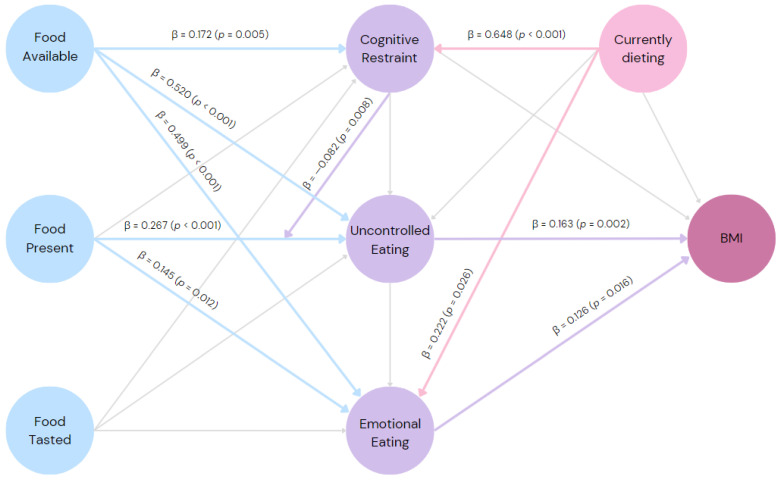
This study aimed to investigate the role of the psychological impact of environments rich in palatable foods on three aspects of eating behavior: cognitive restraint (CR), uncontrolled eating (UE), and emotional eating (EE). The hypotheses were as follows: (a) The psychological impact (i.e., motivation to eat) of an environment rich in palatable foods will positively predict CR, UE, and EE; (b) dieting will predict CR, UE, and EE; and (c) CR, UE, and EE will positively predict body mass index (BMI). This study had a cross-sectional design in which data were collected online from 413 subjects. The psychological impact of food-rich environments (food available, food present, and food tasted) was assessed using the Power of Food Scale (PFS), and CR, UE, and EE were assessed using the Three-Factor Eating Questionnaire (TFEQ-R18). Both instruments were tested for confirmatory factor analysis. The relationship between constructs was measured using partial least-square structural equation modeling (PLS-SEM). "Food available" positively predicted all TFEQ-R18 factors ( < 0.01). "Food present" positively predicted UE ( < 0.001) and EE ( = 0.01). People currently on a diet showed higher levels of CR ( < 0.001) and EE ( = 0.02). UE and EE positively predicted BMI. Thus, CR, UE, and EE were positively predicted by the motivation to consume palatable foods in varying proximity, suggesting that the presence of food and, more importantly, its general availability may be important determinants of eating behavior, particularly UE and EE. Health strategies should consider the influence of the food environment to prevent and better manage impairments in eating behavior. Sex differences suggest that special attention should be paid to women. Furthermore, dieting was associated with higher levels of EE, which in turn was associated with higher BMI. Weight loss interventions should consider this vulnerability.
认知抑制(CR)、无节制饮食(UE)和情绪化饮食(EE)。假设如下:(a)富含美味食物的环境的心理影响(即进食动机)将正向预测CR、UE和EE;(b)节食将预测CR、UE和EE;(c)CR、UE和EE将正向预测体重指数(BMI)。本研究采用横断面设计,从413名受试者在线收集数据。使用食物力量量表(PFS)评估富含食物的环境(有食物、看到食物和品尝食物)的心理影响,使用三因素饮食问卷(TFEQ-R18)评估CR、UE和EE。对这两种工具都进行了验证性因素分析。使用偏最小二乘结构方程模型(PLS-SEM)测量各构念之间的关系。“有食物”正向预测所有TFEQ-R18因子(<0.01)。“看到食物”正向预测UE(<0.001)和EE(=0.01)。目前正在节食的人表现出更高水平的CR(<0.001)和EE(=0.02)。UE和EE正向预测BMI。因此,CR、UE和EE在不同程度上被食用美味食物的动机正向预测,这表明食物的存在,更重要的是其普遍可得性可能是饮食行为的重要决定因素,尤其是UE和EE。健康策略应考虑食物环境的影响,以预防和更好地管理饮食行为障碍。性别差异表明应特别关注女性。此外,节食与更高水平的EE相关,而EE又与更高的BMI相关。减肥干预措施应考虑到这种易感性。