Łukaszewicz-Zając Marta, Mroczko Barbara
Department of Biochemical Diagnostics, Medical University, Waszyngtona 15 a, 15-269 Bialystok, Poland.
Department of Neurodegeneration Diagnostics, Medical University, 15-269 Bialystok, Poland.
Cancers (Basel). 2023 Dec 28;16(1):152. doi: 10.3390/cancers16010152.
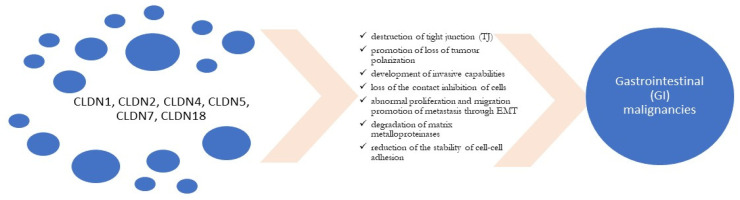
Despite recent() improvements in diagnostic ability() and treatment() strategies for patients() with neoplastic disease(), gastrointestinal (GI) cancers(), such() as colorectal, gastric, pancreatic, and oesophageal cancers(), are still common() malignancies and the leading() cause() of cancer() deaths worldwide(), with a high frequency of recurrence and metastasis as well as poor patient() prognosis. There is a link() between the secretion of proteolytic enzymes that degrade the extracellular matrix and the pathogenesis of GI tumours. Recent() findings have focused() on the potential() significance() of selected claudins (CLDNs) in the pathogenesis and prognosis of GI cancers(). Tight junctions (TJs) have been proven to play an important role() in maintaining cell() polarity and permeability. A number of authors have recently() revealed that TJ proteins, particularly() selected CLDNs, are related() to inflammation and the development() of various tumours, including GI malignancies. This review() presents general() characteristics and the involvement() of selected CLDNs in the progression() of GI malignancies, with a focus() on the potential() application() of these proteins in the diagnosis() and prognosis of colorectal cancer() (CRC), gastric cancer() (GC), pancreatic cancer() (PC), and oesophageal cancer() (EC). Our review() indicates that selected CLDNs, particularly() CLDN1, 2, 4, 7, and 18, play a significant() role() in the development() of GI tumours and in patient() prognosis. Furthermore, selected CLDNs may be of value() in the design() of therapeutic() strategies for the treatment() of recurrent tumours.
尽管近期肿瘤疾病患者的诊断能力和治疗策略有所改善,但胃肠道(GI)癌症,如结直肠癌、胃癌、胰腺癌和食管癌,仍然是常见的恶性肿瘤,也是全球癌症死亡的主要原因,复发和转移频率高,患者预后差。蛋白水解酶的分泌与细胞外基质降解之间的联系与胃肠道肿瘤的发病机制有关。最近的研究结果集中在特定claudin(CLDN)蛋白在胃肠道癌症发病机制和预后中的潜在意义。紧密连接(TJ)已被证明在维持细胞极性和通透性方面发挥重要作用。许多作者最近发现,TJ蛋白,特别是特定的CLDN蛋白,与炎症和包括胃肠道恶性肿瘤在内的各种肿瘤的发展有关。本综述介绍了特定CLDN蛋白的一般特征及其在胃肠道恶性肿瘤进展中的作用,重点关注这些蛋白在结直肠癌(CRC)、胃癌(GC)、胰腺癌(PC)和食管癌(EC)诊断和预后中的潜在应用。我们的综述表明,特定的CLDN蛋白,特别是CLDN1、2、4、7和18,在胃肠道肿瘤的发展和患者预后中发挥重要作用。此外,特定的CLDN蛋白可能在复发性肿瘤治疗策略的设计中具有价值。