Itou Takashi, Ishibashi Yu, Oguri Yasuko, Hashimura Miki, Yokoi Ako, Harada Yohei, Fukagawa Naomi, Hayashi Misato, Ono Mototsugu, Kusano Chika, Saegusa Makoto
Department of Pathology, Kitasato University School of Medicine, 1-15-1 Kitasato, Minami-ku, Sagamihara 252-0374, Kanagawa, Japan.
Department of Gastroenterology, Kitasato University School of Medicine, 1-15-1 Kitasato, Minami-ku, Sagamihara 252-0374, Kanagawa, Japan.
Cancers (Basel). 2023 Dec 29;16(1):183. doi: 10.3390/cancers16010183.
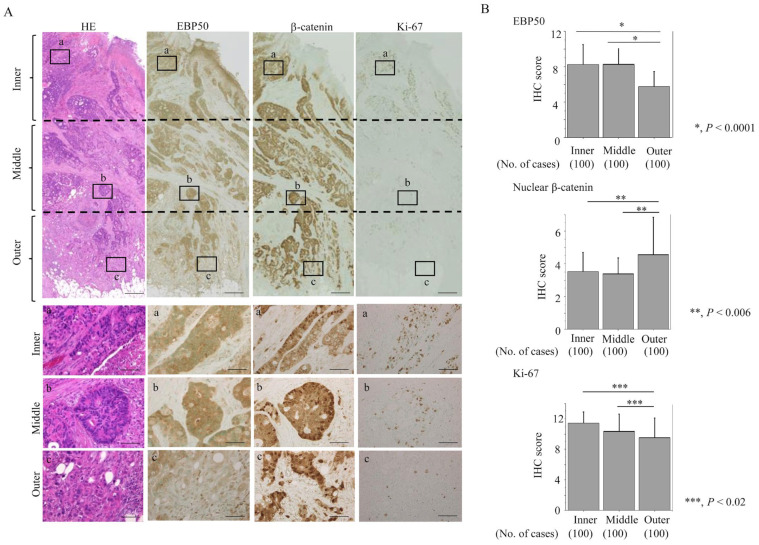
Ezin-radixin-moesin-binding phosphoprotein 50 (EBP50) is a scaffold protein that interacts with several partner molecules including β-catenin. Here, we examined the crosstalk between EBP50 and nuclear catenin during colorectal carcinoma (CRC) progression. In clinical samples, there were no correlations between the subcellular location of EBP50 and any clinicopathological factors. However, EBP50 expression was significantly lower specifically in the outer areas of tumor lesions, in regions where tumor budding (BD) was observed. Low EBP50 expression was also significantly associated with several unfavorable prognostic factors, suggesting that EBP50 depletion rather than its overexpression or subcellular distribution plays an important role in CRC progression. In CRC cell lines, knockout of EBP50 induced epithelial-mesenchymal transition (EMT)-like features, decreased proliferation, accelerated migration capability, and stabilized nuclear β-catenin due to disruption of the interaction between EBP50 and β-catenin at the plasma membrane. In addition, Slug expression was significantly higher in outer lesions, particularly in BD areas, and was positively correlated with nuclear β-catenin status, consistent with β-catenin-driven transactivation of the Slug promoter. Together, our data suggest that EBP50 depletion releases β-catenin from the plasma membrane in outer tumor lesions, allowing β-catenin to accumulate and translocate to the nucleus, where it transactivates the Slug gene to promote EMT. This in turn triggers tumor budding and contributes to the progression of CRC to a more aggressive phase.
埃兹蛋白-根蛋白-膜突蛋白结合磷蛋白50(EBP50)是一种支架蛋白,可与包括β-连环蛋白在内的多种伴侣分子相互作用。在此,我们研究了结直肠癌(CRC)进展过程中EBP50与核连环蛋白之间的相互作用。在临床样本中,EBP50的亚细胞定位与任何临床病理因素之间均无相关性。然而,EBP50的表达在肿瘤病变的外周区域,即观察到肿瘤芽生(BD)的区域显著降低。低EBP50表达也与一些不良预后因素显著相关,这表明EBP50的缺失而非其过表达或亚细胞分布在CRC进展中起重要作用。在CRC细胞系中,敲除EBP50会诱导上皮-间质转化(EMT)样特征,降低增殖能力,加速迁移能力,并由于EBP50与β-连环蛋白在质膜上的相互作用被破坏而使核β-连环蛋白稳定。此外,Slug的表达在外周病变中显著更高,尤其是在BD区域,并且与核β-连环蛋白状态呈正相关,这与β-连环蛋白驱动的Slug启动子反式激活一致。总之,我们的数据表明,EBP50的缺失使肿瘤外周病变质膜上的β-连环蛋白释放出来,使β-连环蛋白积累并转运至细胞核,在细胞核中它反式激活Slug基因以促进EMT。这反过来会触发肿瘤芽生,并促使CRC进展至更具侵袭性的阶段。