Cieplińska Katarzyna, Niedziela Emilia, Kowalska Aldona
Department of Tumor Markers, Holy Cross Cancer Center, 25-734 Kielce, Poland.
Collegium Medicum, Jan Kochanowski University in Kielce, 25-317 Kielce, Poland.
J Clin Med. 2023 Dec 22;13(1):72. doi: 10.3390/jcm13010072.
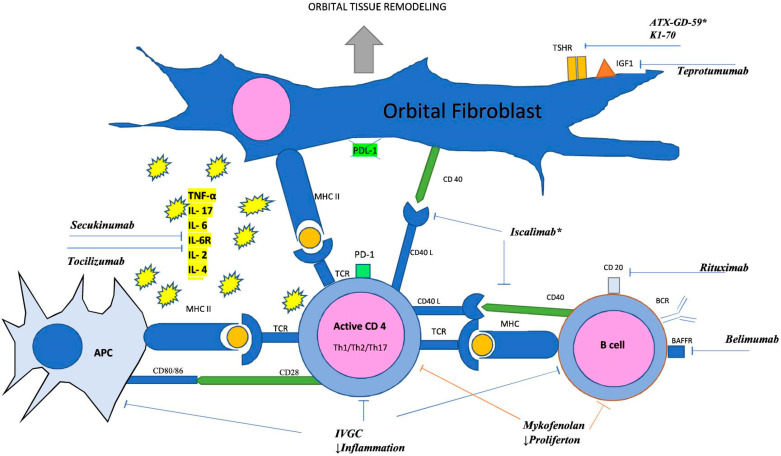
Thyroid eye disease (TED) is an extrathyroidal manifestation of Graves' disease (GD). Similar to GD, TED is caused by an autoimmune response. TED is an autoimmune inflammatory disorder of the orbit and periorbital tissues, characterized by upper eyelid retraction, swelling, redness, conjunctivitis, and bulging eyes. The pathophysiology of TED is complex, with the infiltration of activated T lymphocytes and activation of orbital fibroblasts (OFs) and autoantibodies against the common autoantigen of thyroid and orbital tissues. Better understanding of the multifactorial pathogenesis of TED contributes to the development of more effective therapies. In this review, we present current and potential drug targets. The ideal treatment should slow progression of the disease with as little interference with patient immunity as possible. In the future, TED treatment will target the immune mechanism involved in the disease and will be based on a strategy of restoring tolerance to autoantigens.
甲状腺眼病(TED)是格雷夫斯病(GD)的一种甲状腺外表现。与GD相似,TED由自身免疫反应引起。TED是一种眼眶和眶周组织的自身免疫性炎症性疾病,其特征为上睑退缩、肿胀、发红、结膜炎和眼球突出。TED的病理生理学很复杂,有活化T淋巴细胞浸润、眼眶成纤维细胞(OFs)活化以及针对甲状腺和眼眶组织共同自身抗原的自身抗体。更好地理解TED的多因素发病机制有助于开发更有效的治疗方法。在本综述中,我们介绍了当前和潜在的药物靶点。理想的治疗应在尽可能少干扰患者免疫的情况下减缓疾病进展。未来,TED治疗将针对该疾病涉及的免疫机制,并将基于恢复对自身抗原耐受性的策略。