Key Laboratory for Forest Resources Conservation and Utilization in the Southwest Mountains of China, Ministry of Education, Southwest Forestry University, Kunming 650224, China.
Int J Mol Sci. 2023 Dec 20;25(1):92. doi: 10.3390/ijms25010092.
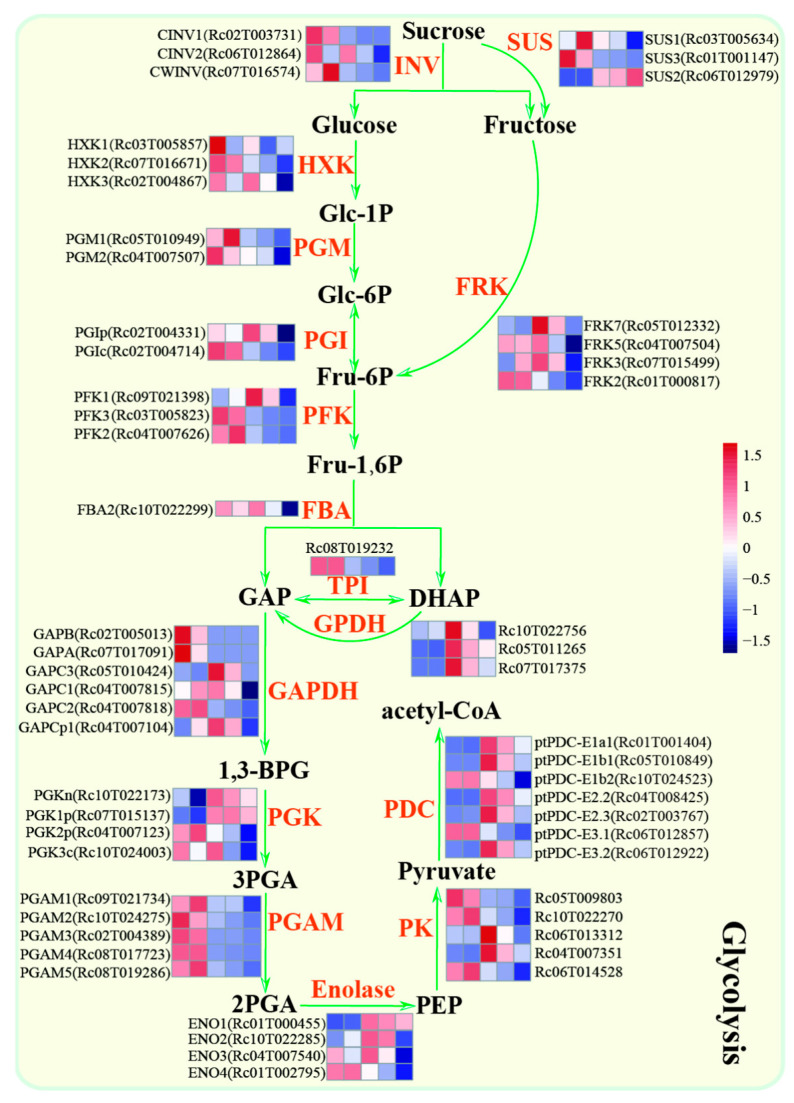
Castor ( L.) seeds produce abundant ricinoleic acid during seed maturation, which is important for plant development and human demands. Ricinoleic acid, as a unique hydroxy fatty acid (HFA), possesses a distinct bond structure that could be used as a substitute for fossil fuels. Here, we identified all homologous genes related to glycolysis, hydroxy fatty acid biosynthesis, and triacylglycerol (TAG) accumulation in castor seeds. Furthermore, we investigated their expression patterns globally during five seed development stages. We characterized a total of 66 genes involved in the glycolysis pathway, with the majority exhibiting higher expression levels during the early stage of castor bean seed development. This metabolic process provided abundant acetyl-CoA for fatty acid (FA) biosynthesis. Subsequently, we identified 82 genes involved in the processes of de novo FA biosynthesis and TAG assembly, with the majority exhibiting high expression levels during the middle or late stages. In addition, we examined the expression patterns of the transcription factors involved in carbohydrate and oil metabolism. For instance, and exhibited high expression levels during the early stage, whereas , , and showed relatively higher expression levels during the middle and late stages, indicating their crucial roles in seed development and oil accumulation. Our study suggests that the high HFA production in castor seeds is attributed to the interaction of multiple genes from sugar transportation to lipid droplet packaging. Therefore, this research comprehensively characterizes all the genes related to glycolysis, fatty acid biosynthesis, and triacylglycerol (TAG) accumulation in the castor and provides novel insight into exploring the genetic mechanisms underlying seed oil accumulation in the endosperm of castor beans.
蓖麻种子在成熟过程中会产生丰富的蓖麻酸,这对植物的发育和人类的需求都很重要。蓖麻酸作为一种独特的羟基脂肪酸(HFA),具有独特的键结构,可以替代化石燃料。在这里,我们鉴定了与糖酵解、羟基脂肪酸生物合成和三酰基甘油(TAG)积累相关的所有同源基因。此外,我们还在五个种子发育阶段全面研究了它们的表达模式。我们总共鉴定了 66 个与糖酵解途径相关的基因,其中大多数在蓖麻种子发育的早期表达水平较高。这个代谢过程为脂肪酸(FA)生物合成提供了丰富的乙酰辅酶 A。随后,我们鉴定了 82 个参与从头脂肪酸生物合成和 TAG 组装的基因,其中大多数在中期或晚期表达水平较高。此外,我们还检查了参与碳水化合物和油脂代谢的转录因子的表达模式。例如,和在早期表达水平较高,而、和在中期和晚期表达水平相对较高,表明它们在种子发育和油脂积累中起着关键作用。我们的研究表明,蓖麻种子中高 HFA 的产生归因于从糖运输到脂质滴包装的多个基因的相互作用。因此,本研究全面描述了蓖麻中与糖酵解、脂肪酸生物合成和三酰基甘油(TAG)积累相关的所有基因,为探索蓖麻胚乳中种子油脂积累的遗传机制提供了新的见解。