Lucas-Herald Angela K, Alkanhal Khalid I, Caney Emma, Malik Iman, Alimussina Malika, McNeilly Jane D, Bradnock Timothy, Lee Boma, Steven Mairi, Flett Martyn, O'Toole Stuart, McGowan Ruth, Faisal Ahmed S
Developmental Endocrinology Research Group, University of Glasgow, Royal Hospital for Children, Glasgow G51 4TF, UK.
Obesity and Endocrine Metabolism Center, King Fahad Medical City, 58046 Riyady 11525, Saudi Arabia.
J Endocr Soc. 2023 Dec 12;8(2):bvad153. doi: 10.1210/jendso/bvad153. eCollection 2024 Jan 5.
Bilateral undescended testes (BUDT) may be a marker of an underlying condition that affects sex development or maturation.
To describe the extent of gonadal dysfunction in cases of BUDT who had systematic endocrine and genetic evaluation at a single tertiary pediatric center.
A retrospective review was conducted of all boys with BUDT who had endocrine evaluation between 2008 and 2021 at the Royal Hospital for Children, Glasgow (RHCG). Continuous variables were analyzed using Mann-Whitney U and non-continuous variables using Fisher's exact, via Graphpad Prism v 8.0. Multivariable logistic regression was used to identify any associations between groups. A < .05 was considered statistically significant.
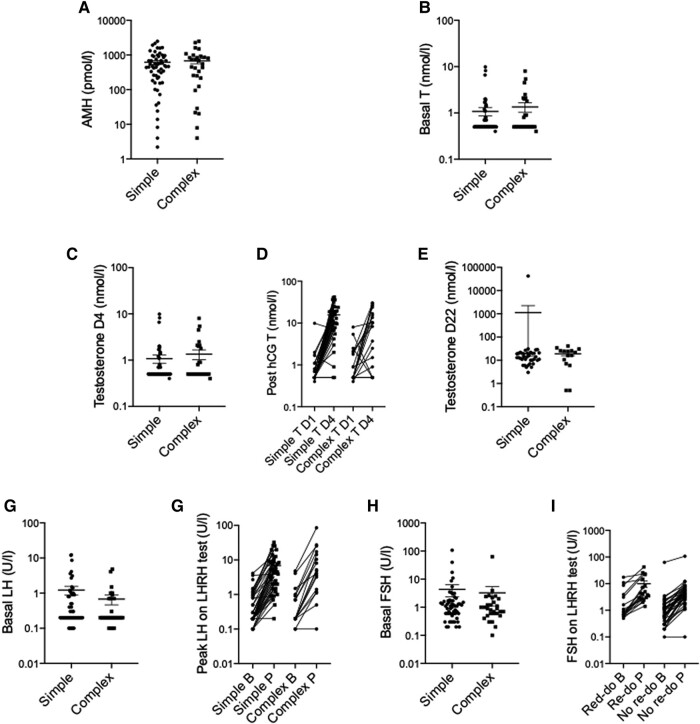
A total of 243 bilateral orchidopexies were performed at RHCG between 2008 and 2021. Of these 130 (53%) boys were seen by the endocrine team. The median (range) age at first orchidopexy was 1 year (0.2, 18.0) with 16 (12%) requiring re-do orchidopexy. The median External Masculinization Score of the group was 10 (2, 11) with 33 (25%) having additional genital features. Of the 130 boys, 71 (55%) had extragenital anomalies. Of the 70 who were tested, a genetic abnormality was detected in 38 (54%), most commonly a chromosomal variant in 16 (40%). Of the 100 who were tested, endocrine dysfunction was identified in 38 (38%).
Genetic findings and evidence of gonadal dysfunction are common in boys who are investigated secondary to presentation with BUDT. Endocrine and genetic evaluation should be part of routine clinical management of all cases of BUDT.
双侧隐睾(BUDT)可能是影响性发育或成熟的潜在疾病的一个标志。
描述在一家单一的三级儿科中心接受系统内分泌和基因评估的BUDT病例中性腺功能障碍的程度。
对2008年至2021年期间在格拉斯哥皇家儿童医院(RHCG)接受内分泌评估的所有BUDT男孩进行回顾性研究。连续变量采用Mann-Whitney U检验分析,非连续变量采用Fisher精确检验分析,通过Graphpad Prism v 8.0软件进行。多变量逻辑回归用于确定各组之间的任何关联。P <.05被认为具有统计学意义。
2008年至2021年期间,RHCG共进行了243例双侧睾丸固定术。其中130名(53%)男孩接受了内分泌团队的诊治。首次睾丸固定术的中位(范围)年龄为1岁(0.2,18.0),16名(12%)需要再次进行睾丸固定术。该组的中位外部男性化评分是10(2,11),33名(25%)有额外的生殖器特征。在130名男孩中,71名(55%)有生殖器外异常。在接受检测的70名男孩中,38名(54%)检测到基因异常,最常见的是16名(40%)的染色体变异。在接受检测的100名男孩中,38名(38%)发现内分泌功能障碍。
在因BUDT就诊而接受检查的男孩中,基因发现和性腺功能障碍的证据很常见。内分泌和基因评估应成为所有BUDT病例常规临床管理的一部分。