Joshi Ankit, Li Rui, Wu Yulin, Zhang Mengying, Song Guowen
Iowa State University, Ames, IA, 50010, USA.
Heliyon. 2023 Dec 12;10(1):e23596. doi: 10.1016/j.heliyon.2023.e23596. eCollection 2024 Jan 15.
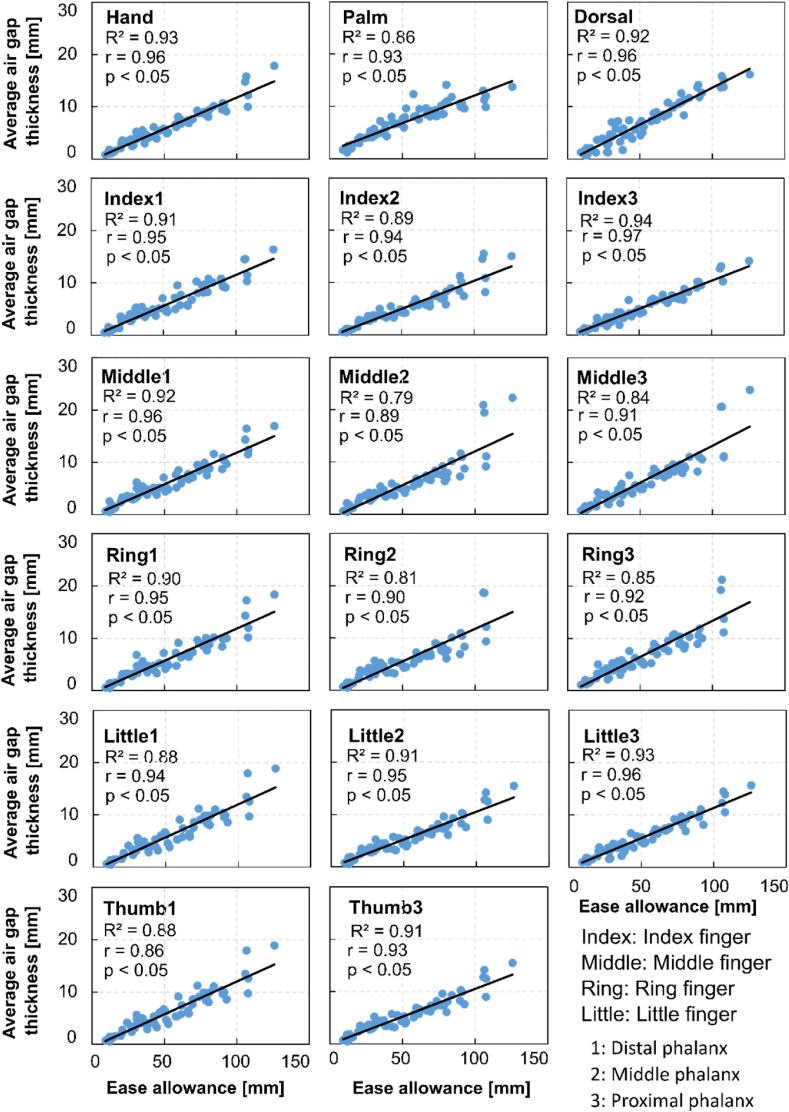
Due to their geometry and thermal physiology, hands are most vulnerable to cold weather injuries and loss of dexterity. Gloves are the most common for hand protection during exposure to extreme thermal and hazardous environments. Although glove microclimate properties such as area factor, air gap thickness, and contact area play a significant role in thermal protection, identifying local (at individual hand segments) glove microclimate properties is still a research gap. For the first time, the glove-microclimate properties for 16 hand segments at high spatial resolution were analyzed by employing state-of-the-art hand-held 3D scanner and post-processing techniques for different glove types. Our results clearly indicate that the glove area factor for distal phalanges is significantly higher (by 49.8 %) than that for other hand segments, which increases the heat transfer from distal phalanges. In contrast, average air gap thickness was relatively uniform across all hand segments. The glove type had a pronounced effect on glove microclimate properties, e.g., bulky and heavy cold weather protective gloves had a larger average air gap thickness and glove area factor. Regression models are also developed to estimate the glove microclimate properties from simple measurement (i.e., ease allowance). Overall, this study provides essential information for the design and development of protective gloves that can help improve safety, comfort, and dexterity. Methods and mathematical models developed in this study also contribute to facilitating extremity (e.g., hand) focused thermoregulation modeling, hazard simulation, injury prediction, ergonomic design, optimum performance (dexterity and tactility) along with thermal protection.
由于手部的几何形状和热生理特性,手部最容易受到寒冷天气伤害以及灵活性丧失的影响。在暴露于极端热环境和危险环境时,手套是最常用的手部防护用品。尽管手套的微气候特性,如面积系数、气隙厚度和接触面积,在热防护中起着重要作用,但确定局部(在手部各个节段)手套微气候特性仍然是一个研究空白。首次通过使用最先进的手持式3D扫描仪和针对不同手套类型的后处理技术,以高空间分辨率分析了16个手部节段的手套微气候特性。我们的结果清楚地表明,远端指骨的手套面积系数明显高于其他手部节段(高49.8%),这增加了远端指骨的热传递。相比之下,所有手部节段的平均气隙厚度相对均匀。手套类型对手套微气候特性有显著影响,例如,厚实且沉重的防寒手套平均气隙厚度和手套面积系数更大。还开发了回归模型,以便根据简单测量(即宽松量)来估计手套微气候特性。总体而言,本研究为防护手套的设计和开发提供了重要信息,有助于提高安全性、舒适性和灵活性。本研究中开发的方法和数学模型也有助于促进针对四肢(如手部)的体温调节建模、危险模拟、损伤预测、人体工程学设计、最佳性能(灵活性和触感)以及热防护。