Livne-Bar Izhar, Maurya Shubham, Gronert Karsten, Sivak Jeremy M
Department of Vision Sciences, Donald K Johnson Eye Institute, Krembil Research Institute, University Health Network, Krembil Discovery Tower, 60 Leonard Avenue, Toronto, ON, M5T 0S8, Canada.
Department of Ophthalmology and Vision Science, University of Toronto School of Medicine, Toronto, Canada.
J Neuroinflammation. 2024 Jan 11;21(1):18. doi: 10.1186/s12974-024-03010-0.
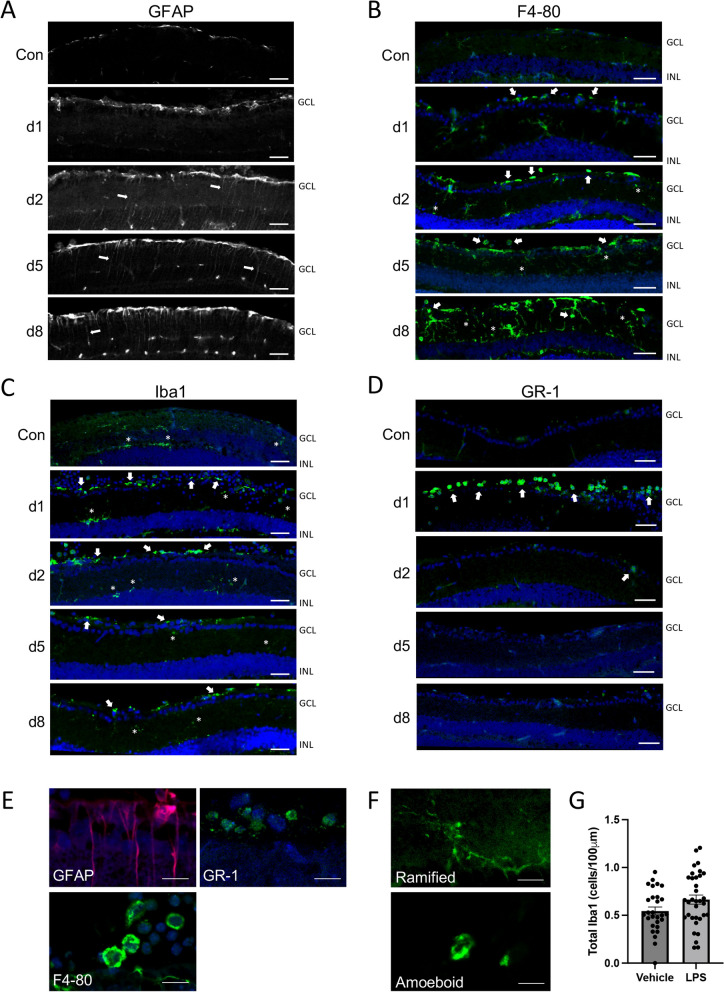
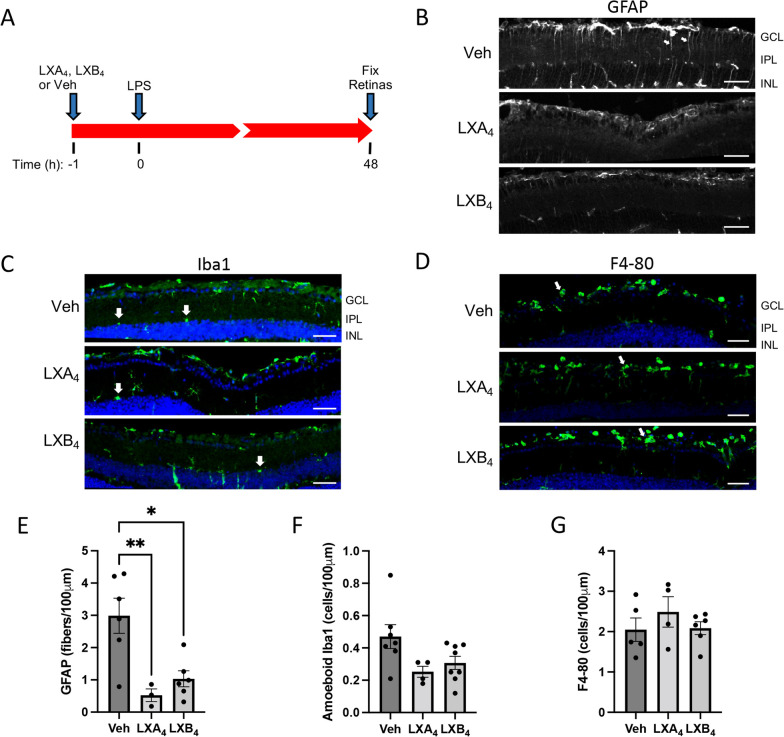
Lipoxins are small lipids that are potent endogenous mediators of systemic inflammation resolution in a variety of diseases. We previously reported that Lipoxins A and B (LXA and LXB) have protective activities against neurodegenerative injury. Yet, lipoxin activities and downstream signaling in neuroinflammatory processes are not well understood. Here, we utilized a model of posterior uveitis induced by lipopolysaccharide endotoxin (LPS), which results in rapid retinal neuroinflammation primarily characterized by activation of resident macroglia (astrocytes and Müller glia), and microglia. Using this model, we observed that each lipoxin reduces acute inner retinal inflammation by affecting endogenous glial responses in a cascading sequence beginning with astrocytes and then microglia, depending on the timing of exposure; prophylactic or therapeutic. Subsequent analyses of retinal cytokines and chemokines revealed inhibition of both CXCL9 (MIG) and CXCL10 (IP10) by each lipoxin, compared to controls, following LPS injection. CXCL9 and CXCL10 are common ligands for the CXCR3 chemokine receptor, which is prominently expressed in inner retinal astrocytes and ganglion cells. We found that CXCR3 inhibition reduces LPS-induced neuroinflammation, while CXCR3 agonism alone induces astrocyte reactivity. Together, these data uncover a novel lipoxin-CXCR3 pathway to promote distinct anti-inflammatory and proresolution cascades in endogenous retinal glia.
脂氧素是一类小分子脂质,在多种疾病中是全身炎症消退的强效内源性介质。我们之前报道过脂氧素A和B(LXA和LXB)对神经退行性损伤具有保护作用。然而,脂氧素在神经炎症过程中的活性和下游信号传导尚不清楚。在此,我们利用脂多糖内毒素(LPS)诱导的后葡萄膜炎模型,该模型会导致快速的视网膜神经炎症,其主要特征是驻留的大胶质细胞(星形胶质细胞和米勒胶质细胞)和小胶质细胞的激活。使用该模型,我们观察到,根据暴露时间(预防性或治疗性),每种脂氧素通过影响内源性胶质细胞反应,以从星形胶质细胞开始然后是小胶质细胞的级联序列来减轻急性视网膜内层炎症。随后对视网膜细胞因子和趋化因子的分析显示,与对照组相比,LPS注射后每种脂氧素都能抑制CXCL9(MIG)和CXCL10(IP10)。CXCL9和CXCL10是趋化因子受体CXCR3的常见配体,CXCR3在视网膜内层星形胶质细胞和神经节细胞中显著表达。我们发现抑制CXCR3可减轻LPS诱导的神经炎症,而单独的CXCR3激动剂会诱导星形胶质细胞反应。总之,这些数据揭示了一条新的脂氧素-CXCR3途径,以促进内源性视网膜胶质细胞中不同的抗炎和促消退级联反应。