Division of Hematology and Transfusion Medicine, Department of Laboratory Medicine, Lund University and Clinical Immunology and Transfusion Medicine, Skåne University Hospital, Lund, Sweden.
Nephrology, Department of Clinical Sciences Lund, Lund University, Skåne University Hospital, Lund, Sweden.
J Immunol Res. 2024 Jan 3;2024:6648265. doi: 10.1155/2024/6648265. eCollection 2024.
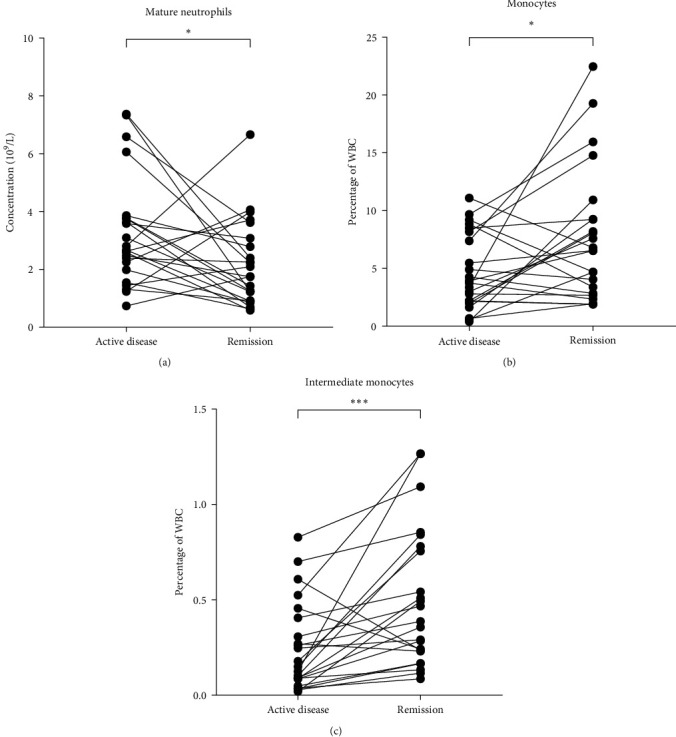
Antineutrophil cytoplasmic antibody (ANCA)-associated vasculitis (AAV) is a group of autoimmune diseases with inflammation affecting small blood vessels and includes granulomatosis with polyangiitis (GPA) and microscopic polyangiitis (MPA). In this study, we investigated granulocyte and monocyte subsets in a large cohort of AAV patients with emphasis on disease activity and tendency to relapse. A cohort of 105 patients with GPA or MPA and 126 healthy controls (HCs) were included. Clinical and laboratory data were collected for all patients, including disease activity, tendency to relapse, and pharmacological treatment. Using flow cytometry, circulating eosinophils, basophils, neutrophils, and monocytes were assessed. The monocytes were subdivided into classical (CD14CD16), intermediate (CD14CD16), and nonclassical (CD14CD16) monocytes. Mature (CD16) or newly released (CD16) neutrophils were defined, as well as the frequency of CD177 neutrophils. AAV patients displayed increased frequencies of intermediate monocytes, mature and newly released neutrophils, and an expanded population of CD177 neutrophils compared to HC. MPA patients differed from GPA patients in terms of lower frequency of classical monocytes. No differences in cell frequencies regarding ANCA phenotype were observed. Paired data from 23 patients demonstrated that active disease was associated with an increased frequency of mature neutrophils and a decreased frequency of monocytes, in particular intermediate monocytes. Moreover, GPA patients with a tendency to relapse displayed an increased frequency of mature neutrophils with increased expression of CD177. Relapsing MPA patients, on the other hand, showed decreased frequency of intermediate monocytes. Finally, rituximab treatment was associated with increased frequencies of classical and intermediate monocytes. In conclusion, AAV patients exhibit a skewing of different neutrophil and monocyte subpopulations that are associated with disease subtypes, disease activity, rituximab treatment, and propensity to relapse. These changes may contribute to the inflammatory process and could potentially be used as biomarkers for relapse prediction.
抗中性粒细胞胞浆抗体(ANCA)相关性血管炎(AAV)是一组自身免疫性疾病,炎症影响小血管,包括肉芽肿性多血管炎(GPA)和显微镜下多血管炎(MPA)。在这项研究中,我们调查了大量 AAV 患者的粒细胞和单核细胞亚群,重点关注疾病活动度和复发倾向。我们纳入了 105 例 GPA 或 MPA 患者和 126 名健康对照者(HCs)。对所有患者均采集了临床和实验室数据,包括疾病活动度、复发倾向和药物治疗。使用流式细胞术评估循环嗜酸性粒细胞、嗜碱性粒细胞、中性粒细胞和单核细胞。将单核细胞进一步细分为经典型(CD14CD16)、中间型(CD14CD16)和非经典型(CD14CD16)单核细胞。定义成熟(CD16)或新释放(CD16)中性粒细胞以及 CD177 中性粒细胞的频率。与 HC 相比,AAV 患者显示中间型单核细胞、成熟和新释放中性粒细胞以及 CD177 中性粒细胞的扩展群体频率增加。与 GPA 患者相比,MPA 患者的经典型单核细胞频率较低。关于 ANCA 表型,细胞频率无差异。来自 23 例患者的配对数据表明,活动期疾病与成熟中性粒细胞频率增加和单核细胞,特别是中间型单核细胞频率降低有关。此外,有复发倾向的 GPA 患者表现出成熟中性粒细胞频率增加,CD177 表达增加。另一方面,复发的 MPA 患者表现出中间型单核细胞频率降低。最后,利妥昔单抗治疗与经典型和中间型单核细胞频率增加相关。总之,AAV 患者表现出不同中性粒细胞和单核细胞亚群的倾斜,与疾病亚型、疾病活动度、利妥昔单抗治疗和复发倾向有关。这些变化可能有助于炎症过程,并可能被用作复发预测的生物标志物。