Department of Hepatobiliary Surgery, Innovative Institute of Tumor Immunity and Medicine (ITIM), Anhui Province Key Laboratory of Tumor Immune Microenvironment and Immunotherapy, The First Affiliated Hospital of Anhui Medical University, Hefei, 230022, China.
Department of Hepatobiliary Surgery, The Affiliated Drum Tower Hospital of Nanjing University Medical School, Nanjing, 210008, China.
Oncogene. 2024 Feb;43(9):682-692. doi: 10.1038/s41388-023-02935-9. Epub 2024 Jan 12.
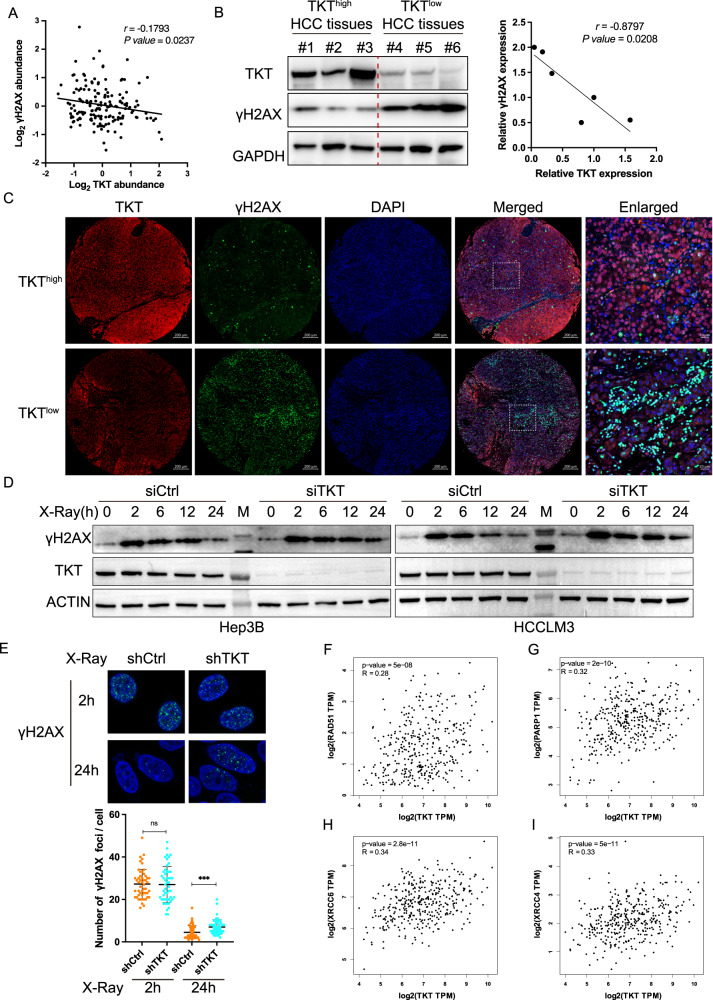
Hepatocellular carcinoma (HCC) stands as the fifth most prevalent malignant tumor on a global scale and presents as the second leading cause of cancer-related mortality. DNA damage-based radiotherapy (RT) plays a pivotal role in the treatment of HCC. Nevertheless, radioresistance remains a primary factor contributing to the failure of radiation therapy in HCC patients. In this study, we investigated the functional role of transketolase (TKT) in the repair of DNA double-strand breaks (DSBs) in HCC. Our research unveiled that TKT is involved in DSB repair, and its depletion significantly reduces both non-homologous end joining (NHEJ) and homologous recombination (HR)-mediated DSB repair. Mechanistically, TKT interacts with PARP1 in a DNA damage-dependent manner. Furthermore, TKT undergoes PARylation by PARP1, resulting in the inhibition of its enzymatic activity, and TKT can enhance the auto-PARylation of PARP1 in response to DSBs in HCC. The depletion of TKT effectively mitigates the radioresistance of HCC, both in vitro and in mouse xenograft models. Moreover, high TKT expression confers resistance of RT in clinical HCC patients, establishing TKT as a marker for assessing the response of HCC patients who received cancer RT. In summary, our findings reveal a novel mechanism by which TKT contributes to the radioresistance of HCC. Overall, we identify the TKT-PARP1 axis as a promising potential therapeutic target for improving RT outcomes in HCC.
肝细胞癌(HCC)是全球第五大常见恶性肿瘤,也是癌症相关死亡的第二大主要原因。基于 DNA 损伤的放射治疗(RT)在 HCC 的治疗中起着关键作用。然而,放射抵抗仍然是导致 HCC 患者放射治疗失败的主要因素。在这项研究中,我们研究了转酮醇酶(TKT)在 HCC 中 DNA 双链断裂(DSB)修复中的功能作用。我们的研究揭示了 TKT 参与 DSB 修复,其耗竭显著降低非同源末端连接(NHEJ)和同源重组(HR)介导的 DSB 修复。在机制上,TKT 以 DNA 损伤依赖性的方式与 PARP1 相互作用。此外,TKT 被 PARP1 进行 PAR 化,导致其酶活性受到抑制,并且 TKT 可以响应 HCC 中的 DSB 增强 PARP1 的自身 PAR 化。TKT 的耗竭可有效减轻 HCC 的放射抵抗性,无论是在体外还是在小鼠异种移植模型中。此外,TKT 的高表达赋予了临床 HCC 患者对 RT 的抵抗性,这表明 TKT 可作为评估接受癌症 RT 的 HCC 患者反应的标志物。总之,我们的研究结果揭示了 TKT 促进 HCC 放射抵抗性的新机制。总体而言,我们确定了 TKT-PARP1 轴作为改善 HCC 中 RT 结果的有前途的潜在治疗靶点。