Zoellner Lori A, Feeny Norah C, Angula Dega A, Aideed Mohamed H, Liban Essa N, Egeh Muumin H, Awke Abdisalan I, Ismail Ahmed S, Kunle Mohamed A, Ali Eesha, Levin Carol E, Burant Christopher J, Bentley Jacob A
University of Washington, Department of Psychology, Seattle, WA, USA.
Case Western Reserve University, Department of Psychological Sciences, Cleveland OH, USA.
Contemp Clin Trials Commun. 2023 Dec 10;37:101237. doi: 10.1016/j.conctc.2023.101237. eCollection 2024 Feb.
Somalia has long been in a state of humanitarian crisis; trauma-related mental health needs are extremely high. Access to state-of-the-art mental health care is limited. Islamic Trauma Healing (ITH) is a manualized mosque-based, lay-led group intervention aimed at healing the individual and communal mental wounds of war and refugee trauma. The 6-session intervention combines Islamic principles with empirically-supported exposure and cognitive restructuring principles for posttraumatic stress disorder (PTSD). ITH reduces training time, uses a train the trainers (TTT) model, and relies on local partnerships embedded within the strong communal mosque infrastructure.
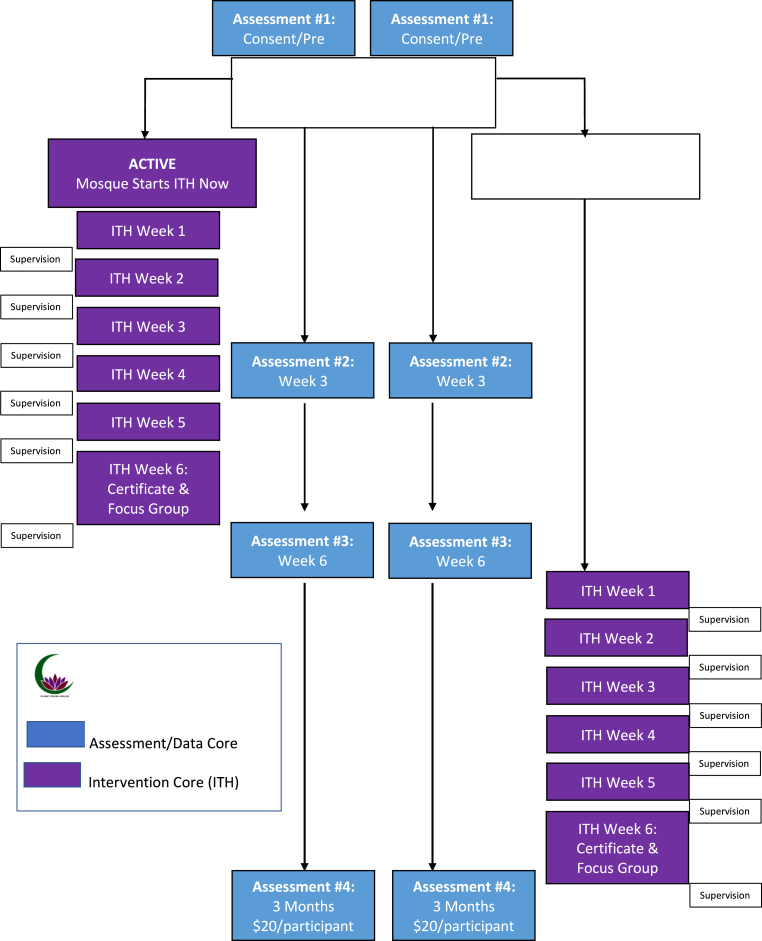
We will conduct a hybrid effectiveness-implementation randomized control trial (RCT) in the Somaliland, with implementation in the cities of Hargeisa, Borama, and Burao. In this study, a lay-led, mosque-based intervention, Islamic Trauma Healing (ITH), to promote mental health and reconciliation will be examined in 200 participants, randomizing mosques to either immediate ITH or a delayed (waitlist; WL) ITH conditions. Participants will be assessed by assessors masked to condition at pre, 3 weeks, 6 weeks, and 3-month follow-up. Primary outcome will be assessor-rated posttraumatic stress symptoms (PTSD), with secondary outcomes of depression, somatic symptoms, and well-being. A TTT model will be tested, examining the implementation outcomes. Additional measures include potential mechanisms of change and cost effectiveness.
This trial has the potential to provide effectiveness and implementation data for an empirically-based principle trauma healing program for the larger Islamic community who may not seek mental health care or does not have access to such care.
ClinicalTrials.gov NCT05890482.
See Supplemental Appendix 1.
索马里长期处于人道主义危机状态;与创伤相关的心理健康需求极高。获得先进心理健康护理的机会有限。伊斯兰创伤愈合疗法(ITH)是一种基于清真寺、由非专业人员主导的团体干预方法,旨在治愈战争和难民创伤给个人和社区造成的心理创伤。该为期6节的干预措施将伊斯兰原则与创伤后应激障碍(PTSD)的经验支持暴露疗法及认知重构原则相结合。ITH减少了培训时间,采用培训培训师(TTT)模式,并依赖于强大的社区清真寺基础设施内的当地合作伙伴关系。
我们将在索马里兰进行一项混合效果-实施随机对照试验(RCT),在哈尔格萨、博拉马和布尔奥等城市实施。在本研究中,将对200名参与者进行一项由非专业人员主导、基于清真寺的干预措施——伊斯兰创伤愈合疗法(ITH),以促进心理健康与和解,将清真寺随机分为立即接受ITH组或延迟(等待名单;WL)ITH组。参与者将在干预前、3周、6周和3个月随访时由对分组情况不知情的评估人员进行评估。主要结局将是评估人员评定的创伤后应激症状(PTSD),次要结局包括抑郁、躯体症状和幸福感。将测试TTT模式,检查实施效果。其他措施包括潜在的变化机制和成本效益。
该试验有可能为更大的可能不寻求心理健康护理或无法获得此类护理的伊斯兰社区提供基于经验原则的创伤愈合计划的有效性和实施数据。
ClinicalTrials.gov NCT05890482。
见补充附录1。