Department of Psychiatry, University of British Columbia, Vancouver, British Columbia, Canada.
Djavad Mowafaghian Centre for Brain Health, University of British Columbia, Vancouver, British Columbia, Canada.
Hum Brain Mapp. 2024 Jan;45(1):e26553. doi: 10.1002/hbm.26553.
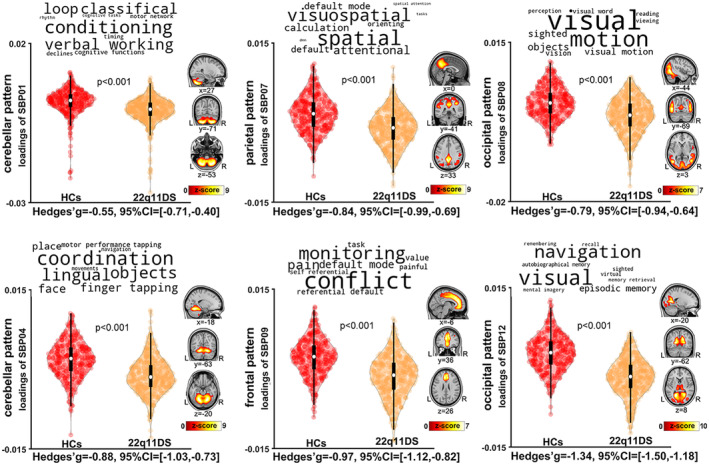
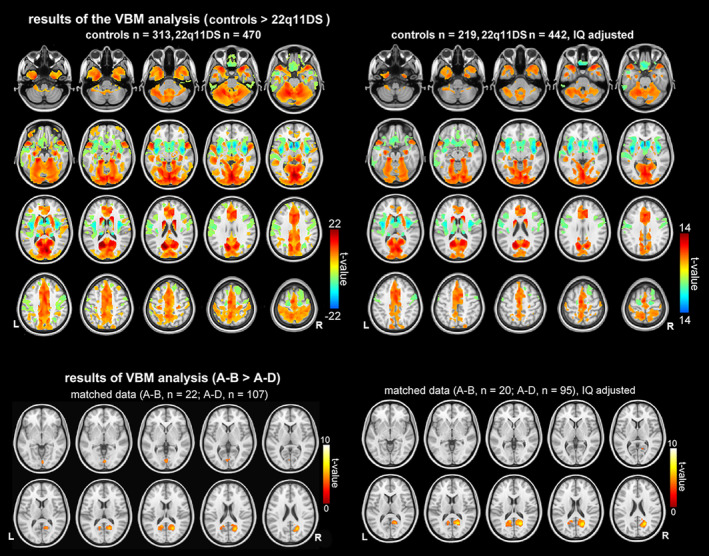
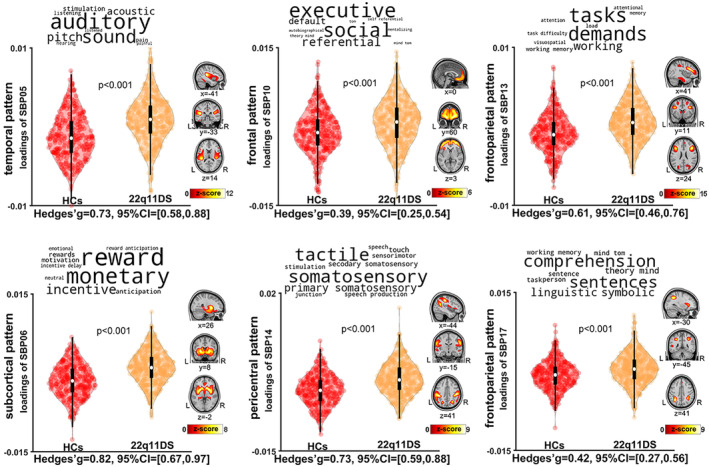
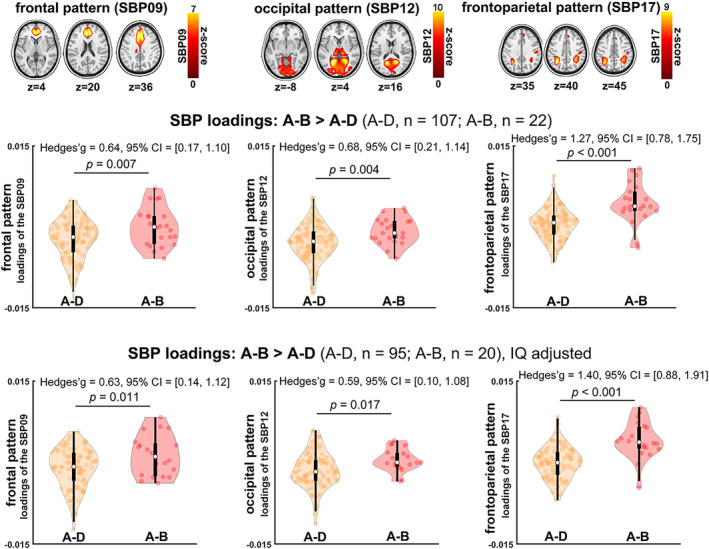
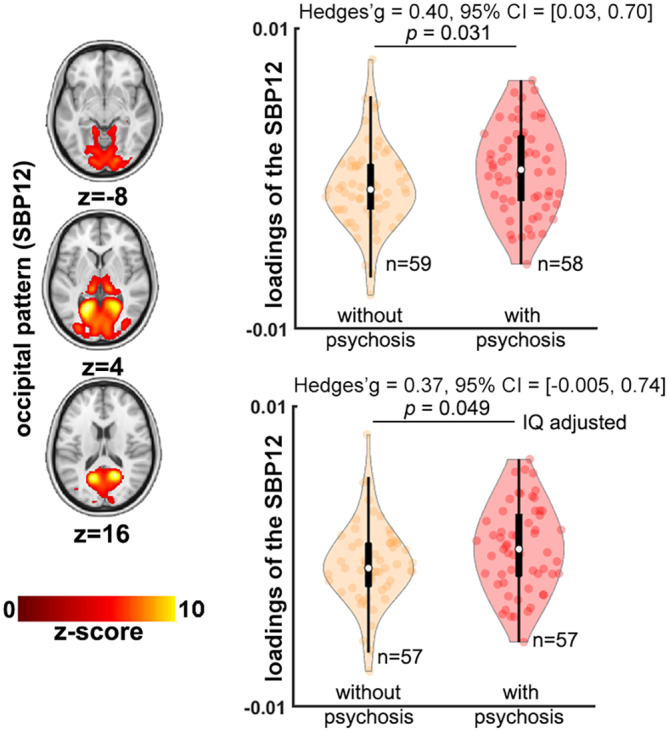
22q11.2 deletion syndrome (22q11DS) is the most frequently occurring microdeletion in humans. It is associated with a significant impact on brain structure, including prominent reductions in gray matter volume (GMV), and neuropsychiatric manifestations, including cognitive impairment and psychosis. It is unclear whether GMV alterations in 22q11DS occur according to distinct structural patterns. Then, 783 participants (470 with 22q11DS: 51% females, mean age [SD] 18.2 [9.2]; and 313 typically developing [TD] controls: 46% females, mean age 18.0 [8.6]) from 13 datasets were included in the present study. We segmented structural T1-weighted brain MRI scans and extracted GMV images, which were then utilized in a novel source-based morphometry (SBM) pipeline (SS-Detect) to generate structural brain patterns (SBPs) that capture co-varying GMV. We investigated the impact of the 22q11.2 deletion, deletion size, intelligence quotient, and psychosis on the SBPs. Seventeen GMV-SBPs were derived, which provided spatial patterns of GMV covariance associated with a quantitative metric (i.e., loading score) for analysis. Patterns of topographically widespread differences in GMV covariance, including the cerebellum, discriminated individuals with 22q11DS from healthy controls. The spatial extents of the SBPs that revealed disparities between individuals with 22q11DS and controls were consistent with the findings of the univariate voxel-based morphometry analysis. Larger deletion size was associated with significantly lower GMV in frontal and occipital SBPs; however, history of psychosis did not show a strong relationship with these covariance patterns. 22q11DS is associated with distinct structural abnormalities captured by topographical GMV covariance patterns that include the cerebellum. Findings indicate that structural anomalies in 22q11DS manifest in a nonrandom manner and in distinct covarying anatomical patterns, rather than a diffuse global process. These SBP abnormalities converge with previously reported cortical surface area abnormalities, suggesting disturbances of early neurodevelopment as the most likely underlying mechanism.
22q11.2 缺失综合征(22q11DS)是人类中最常发生的微缺失。它与大脑结构有显著影响有关,包括灰质体积(GMV)明显减少,以及认知障碍和精神病等神经精神表现。目前尚不清楚 22q11DS 的 GMV 改变是否遵循不同的结构模式。然后,本研究纳入了来自 13 个数据集的 783 名参与者(470 名 22q11DS:51%为女性,平均年龄[标准差]18.2[9.2];313 名典型发育[TD]对照组:46%为女性,平均年龄 18.0[8.6])。我们对结构 T1 加权脑 MRI 扫描进行了分割,并提取了 GMV 图像,然后利用一种新的基于源的形态测量学(SBM)管道(SS-Detect)生成结构脑模式(SBP),以捕捉 GMV 的协变。我们研究了 22q11.2 缺失、缺失大小、智商和精神病对 SBP 的影响。得出了 17 个 GMV-SBP,提供了与定量指标(即负荷得分)相关的 GMV 协方差的空间模式进行分析。小脑等拓扑广泛的 GMV 协方差差异模式的出现,将 22q11DS 个体与健康对照组区分开来。揭示 22q11DS 个体与对照组之间差异的 SBP 的空间范围与基于体素的单变量形态测量分析的结果一致。较大的缺失大小与额部和枕部 SBP 中 GMV 显著降低有关;然而,精神病病史与这些协变模式没有很强的关系。22q11DS 与包括小脑在内的拓扑 GMV 协方差模式的独特结构异常有关。研究结果表明,22q11DS 的结构异常以非随机的方式表现,并以不同的协同解剖模式出现,而不是弥漫的全局过程。这些 SBP 异常与之前报道的皮质表面积异常相吻合,表明早期神经发育障碍是最有可能的潜在机制。