• 文献检索
  • 文档翻译
  • 深度研究
  • 学术资讯
  • Suppr Zotero 插件Zotero 插件
  • 邀请有礼
  • 套餐&价格
  • 历史记录
应用&插件
Suppr Zotero 插件Zotero 插件浏览器插件Mac 客户端Windows 客户端微信小程序
定价
高级版会员购买积分包购买API积分包
服务
文献检索文档翻译深度研究API 文档MCP 服务
关于我们
关于 Suppr公司介绍联系我们用户协议隐私条款
关注我们

Suppr 超能文献

核心技术专利:CN118964589B侵权必究
粤ICP备2023148730 号-1Suppr @ 2026

文献检索

告别复杂PubMed语法,用中文像聊天一样搜索,搜遍4000万医学文献。AI智能推荐,让科研检索更轻松。

立即免费搜索

文件翻译

保留排版,准确专业,支持PDF/Word/PPT等文件格式,支持 12+语言互译。

免费翻译文档

深度研究

AI帮你快速写综述,25分钟生成高质量综述,智能提取关键信息,辅助科研写作。

立即免费体验

机器学习驱动的肾移植患者虚拟活检系统。

A Machine Learning-Driven Virtual Biopsy System For Kidney Transplant Patients.

机构信息

Université Paris Cité, INSERM U970 PARCC, Paris Institute for Transplantation and Organ Regeneration, F-75015, Paris, France.

Kidney Transplant Department, Saint-Louis Hospital, Assistance Publique - Hôpitaux de Paris, Paris, France.

出版信息

Nat Commun. 2024 Jan 16;15(1):554. doi: 10.1038/s41467-023-44595-z.

DOI:
10.1038/s41467-023-44595-z
PMID:38228634
原文链接:https://pmc.ncbi.nlm.nih.gov/articles/PMC10791605/
Abstract

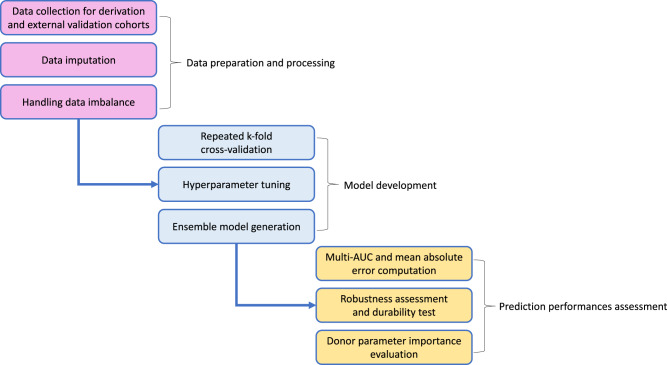
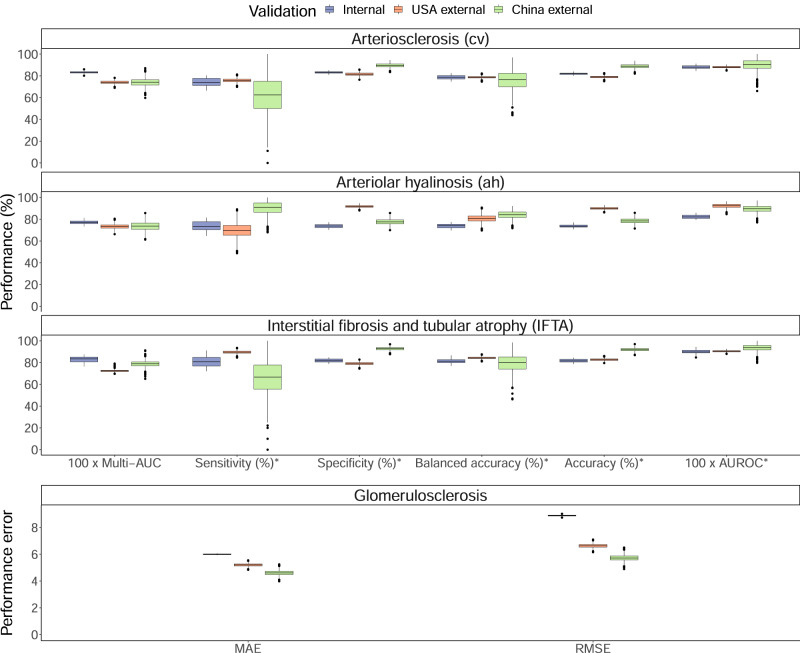
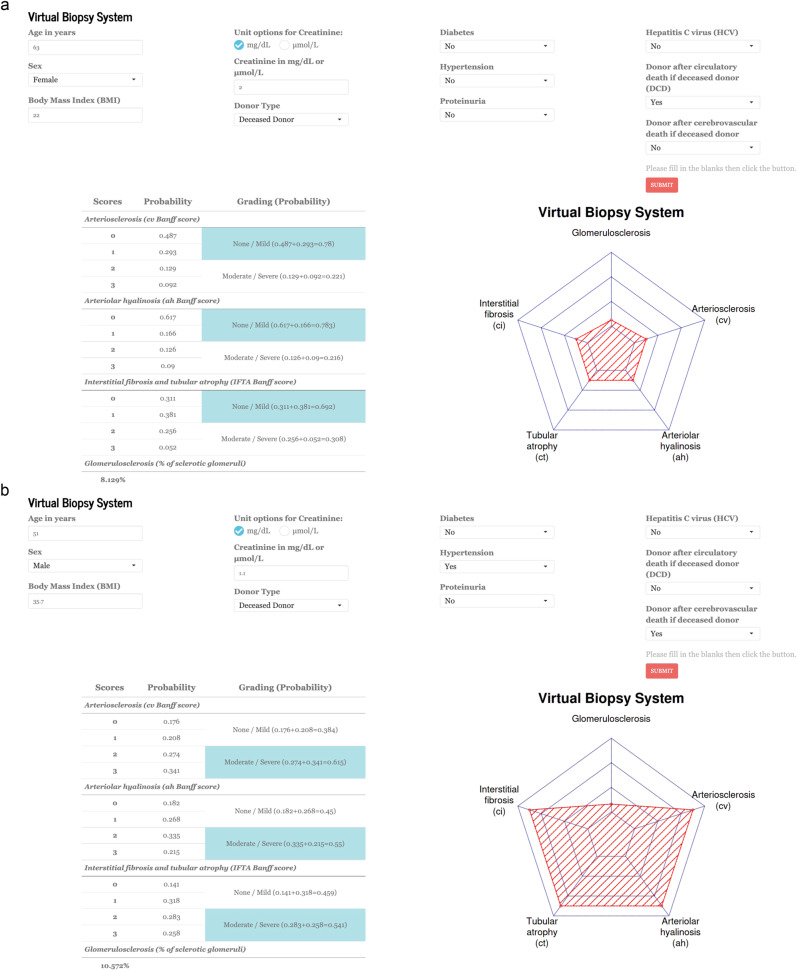
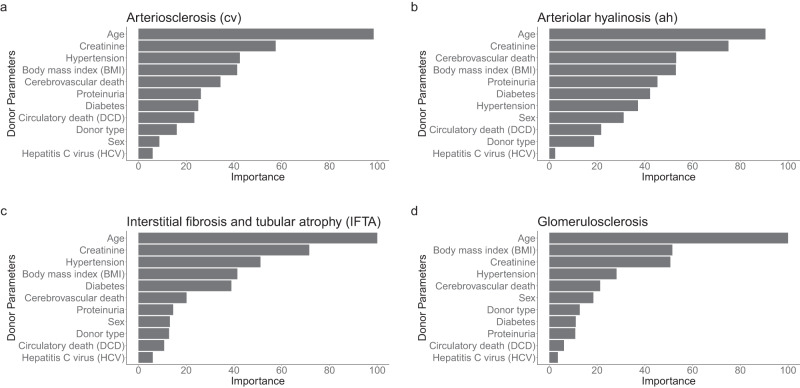
In kidney transplantation, day-zero biopsies are used to assess organ quality and discriminate between donor-inherited lesions and those acquired post-transplantation. However, many centers do not perform such biopsies since they are invasive, costly and may delay the transplant procedure. We aim to generate a non-invasive virtual biopsy system using routinely collected donor parameters. Using 14,032 day-zero kidney biopsies from 17 international centers, we develop a virtual biopsy system. 11 basic donor parameters are used to predict four Banff kidney lesions: arteriosclerosis, arteriolar hyalinosis, interstitial fibrosis and tubular atrophy, and the percentage of renal sclerotic glomeruli. Six machine learning models are aggregated into an ensemble model. The virtual biopsy system shows good performance in the internal and external validation sets. We confirm the generalizability of the system in various scenarios. This system could assist physicians in assessing organ quality, optimizing allograft allocation together with discriminating between donor derived and acquired lesions post-transplantation.

摘要

在肾移植中,使用零天活检来评估器官质量,并区分供体遗传病变和移植后获得的病变。然而,许多中心不进行此类活检,因为它们具有侵入性、昂贵,并且可能会延迟移植手术。我们旨在使用常规收集的供体参数生成一种非侵入性的虚拟活检系统。通过使用来自 17 个国际中心的 14,032 份零天肾脏活检,我们开发了一种虚拟活检系统。使用 11 个基本供体参数来预测四种 Banff 肾脏病变:动脉硬化、小动脉玻璃样变性、间质纤维化和肾小管萎缩以及肾小球硬化的百分比。将 6 个机器学习模型聚合到一个集成模型中。虚拟活检系统在内部和外部验证集中表现出良好的性能。我们在各种情况下确认了系统的可泛化性。该系统可以帮助医生评估器官质量,与移植后获得的病变一起优化同种异体移植的分配。
https://cdn.ncbi.nlm.nih.gov/pmc/blobs/9f0f/10791605/2b003b291610/41467_2023_44595_Fig4_HTML.jpg
https://cdn.ncbi.nlm.nih.gov/pmc/blobs/9f0f/10791605/d0f5a49b4609/41467_2023_44595_Fig1_HTML.jpg
https://cdn.ncbi.nlm.nih.gov/pmc/blobs/9f0f/10791605/520803f23eaf/41467_2023_44595_Fig2_HTML.jpg
https://cdn.ncbi.nlm.nih.gov/pmc/blobs/9f0f/10791605/d9f32969f3f7/41467_2023_44595_Fig3_HTML.jpg
https://cdn.ncbi.nlm.nih.gov/pmc/blobs/9f0f/10791605/2b003b291610/41467_2023_44595_Fig4_HTML.jpg
https://cdn.ncbi.nlm.nih.gov/pmc/blobs/9f0f/10791605/d0f5a49b4609/41467_2023_44595_Fig1_HTML.jpg
https://cdn.ncbi.nlm.nih.gov/pmc/blobs/9f0f/10791605/520803f23eaf/41467_2023_44595_Fig2_HTML.jpg
https://cdn.ncbi.nlm.nih.gov/pmc/blobs/9f0f/10791605/d9f32969f3f7/41467_2023_44595_Fig3_HTML.jpg
https://cdn.ncbi.nlm.nih.gov/pmc/blobs/9f0f/10791605/2b003b291610/41467_2023_44595_Fig4_HTML.jpg

相似文献

1
A Machine Learning-Driven Virtual Biopsy System For Kidney Transplant Patients.机器学习驱动的肾移植患者虚拟活检系统。
Nat Commun. 2024 Jan 16;15(1):554. doi: 10.1038/s41467-023-44595-z.
2
Histopathologic Findings on Implantation Renal Allograft Biopsies Correlate With Kidney Donor Profile Index and 30-Day Serum Creatinine.植入式肾移植活检的组织病理学发现与肾脏供体特征指数及30天血清肌酐相关。
Transplant Proc. 2019 Apr;51(3):639-646. doi: 10.1016/j.transproceed.2018.12.027. Epub 2019 Jan 10.
3
Predictors of renal transplant histology at three months.肾移植术后三个月组织学的预测因素
Transplantation. 1999 May 15;67(9):1222-30. doi: 10.1097/00007890-199905150-00005.
4
Biopsy of marginal donor kidneys: correlation of histologic findings with graft dysfunction.边缘供肾活检:组织学结果与移植物功能障碍的相关性
Transplantation. 2000 Apr 15;69(7):1352-7. doi: 10.1097/00007890-200004150-00024.
5
On the influence of sample size on the prognostic accuracy and reproducibility of renal transplant biopsy.样本量对肾移植活检预后准确性和可重复性的影响
Nephrol Dial Transplant. 1998 Jan;13(1):165-72. doi: 10.1093/ndt/13.1.165.
6
Living donor kidney transplants: a biopsy study 1 year after transplantation, compared with baseline changes and correlation to kidney function at 1 and 3 years.活体供肾肾移植:移植后1年的活检研究,与基线变化及1年和3年时肾功能的相关性
Nephrol Dial Transplant. 1999 Oct;14(10):2445-54. doi: 10.1093/ndt/14.10.2445.
7
Changes in Glomerular Volume, Sclerosis, and Ischemia at 5 Years after Kidney Transplantation: Incidence and Correlation with Late Graft Failure.移植后 5 年肾小球体积、硬化和缺血的变化:发生率与晚期移植物失功的相关性。
J Am Soc Nephrol. 2023 Feb 1;34(2):346-358. doi: 10.1681/ASN.2022040418. Epub 2022 Nov 17.
8
Circulating donor-specific anti-HLA antibodies are a major factor in premature and accelerated allograft fibrosis.循环供体特异性抗 HLA 抗体是导致移植物早期和加速纤维化的主要因素。
Kidney Int. 2017 Sep;92(3):729-742. doi: 10.1016/j.kint.2017.03.033. Epub 2017 May 26.
9
The impact of time-zero biopsy on early graft outcomes after living donor kidney transplantation.零时间活检对活体供肾移植术后早期移植肾结局的影响。
Transplant Proc. 2013 Oct;45(8):2937-40. doi: 10.1016/j.transproceed.2013.08.081.
10
Does Histopathology of Implanted Kidney According to Banff 07 Help Predict Long-term Transplantation Outcome?根据Banff 07标准的植入肾组织病理学能否帮助预测长期移植结局?
Transplant Proc. 2018 Jul-Aug;50(6):1765-1768. doi: 10.1016/j.transproceed.2018.02.150. Epub 2018 Mar 14.

引用本文的文献

1
Preimplantation Histopathologic Assessment of Deceased Donor Kidneys: Recommendations from the Banff Time-Zero Biopsy Working Group.deceased供体肾脏的植入前组织病理学评估:班夫零时间活检工作组的建议
J Am Soc Nephrol. 2025 Jul 14. doi: 10.1681/ASN.0000000820.
2
Kidney and Bladder Transplantation: Advances, Barriers, and Emerging Solutions.肾脏与膀胱移植:进展、障碍及新出现的解决方案
Medicina (Kaunas). 2025 Jun 5;61(6):1045. doi: 10.3390/medicina61061045.
3
Development and Validation in Porcine and Human Models of a Bioimpedance Spectroscopy System for the Objective Assessment of Kidney Graft Viability.

本文引用的文献

1
Evaluating tubulointerstitial compartments in renal biopsy specimens using a deep learning-based approach for classifying normal and abnormal tubules.使用深度学习方法评估肾活检标本中的肾小管间质隔室,用于分类正常和异常肾小管。
PLoS One. 2022 Jul 11;17(7):e0271161. doi: 10.1371/journal.pone.0271161. eCollection 2022.
2
Predicting the risk of developing diabetic retinopathy using deep learning.利用深度学习预测糖尿病视网膜病变的风险。
Lancet Digit Health. 2021 Jan;3(1):e10-e19. doi: 10.1016/S2589-7500(20)30250-8. Epub 2020 Nov 26.
3
Transplant outcomes using kidneys from high KDPI acute kidney injury donors.
用于客观评估肾移植存活率的生物电阻抗光谱系统在猪和人类模型中的开发与验证
Sensors (Basel). 2025 May 2;25(9):2871. doi: 10.3390/s25092871.
4
Artificial intelligence-enhanced interpretation of kidney transplant biopsy: focus on rejection.人工智能增强的肾移植活检解读:聚焦于排斥反应。
Curr Opin Organ Transplant. 2025 Jun 1;30(3):201-207. doi: 10.1097/MOT.0000000000001213. Epub 2025 Apr 1.
5
Machine learning-based model for predicting all-cause mortality in severe pneumonia.基于机器学习的重症肺炎全因死亡率预测模型。
BMJ Open Respir Res. 2025 Mar 22;12(1):e001983. doi: 10.1136/bmjresp-2023-001983.
6
Research on the development of an intelligent prediction model for blood pressure variability during hemodialysis.血液透析期间血压变异性智能预测模型的开发研究。
BMC Nephrol. 2025 Feb 17;26(1):82. doi: 10.1186/s12882-025-03959-x.
7
Advancements in Artificial Intelligence for Kidney Transplantology: A Comprehensive Review of Current Applications and Predictive Models.肾脏移植学中人工智能的进展:当前应用与预测模型的全面综述
J Clin Med. 2025 Feb 3;14(3):975. doi: 10.3390/jcm14030975.
8
AI Thinking: a framework for rethinking artificial intelligence in practice.人工智能思维:一个在实践中重新思考人工智能的框架。
R Soc Open Sci. 2025 Jan 8;12(1):241482. doi: 10.1098/rsos.241482. eCollection 2025 Jan.
9
A prognostic molecular signature of hepatic steatosis is spatially heterogeneous and dynamic in human liver.肝脂肪变性的预后分子特征在人类肝脏中具有空间异质性且是动态变化的。
Cell Rep Med. 2024 Dec 17;5(12):101871. doi: 10.1016/j.xcrm.2024.101871. Epub 2024 Dec 9.
10
Reply to: Machine learning-driven virtual biopsy system may increase organ discards at aggressive kidney transplant centers.回复:机器学习驱动的虚拟活检系统可能会增加激进的肾移植中心的器官丢弃率。
Nat Commun. 2024 Nov 29;15(1):10324. doi: 10.1038/s41467-024-53703-6.
使用 KDPI 较高的急性肾损伤供者的肾脏进行移植的结果。
Clin Transplant. 2021 May;35(5):e14279. doi: 10.1111/ctr.14279. Epub 2021 Mar 31.
4
Comparison of Multivariable Logistic Regression and Other Machine Learning Algorithms for Prognostic Prediction Studies in Pregnancy Care: Systematic Review and Meta-Analysis.多变量逻辑回归与其他机器学习算法在孕期护理预后预测研究中的比较:系统评价与荟萃分析
JMIR Med Inform. 2020 Nov 17;8(11):e16503. doi: 10.2196/16503.
5
Using machine-learning risk prediction models to triage the acuity of undifferentiated patients entering the emergency care system: a systematic review.使用机器学习风险预测模型对进入急诊护理系统的未分化患者的 acuity 进行分诊:一项系统综述。 (注:这里“acuity”在医学语境中可能有“ acuity of illness 病情严重程度”等含义,具体需结合上下文准确理解,但按照要求不添加解释。)
Diagn Progn Res. 2020 Oct 2;4:16. doi: 10.1186/s41512-020-00084-1. eCollection 2020.
6
Prediction of lung cancer risk at follow-up screening with low-dose CT: a training and validation study of a deep learning method.低剂量 CT 随访筛查中肺癌风险的预测:深度学习方法的训练和验证研究。
Lancet Digit Health. 2019 Nov;1(7):e353-e362. doi: 10.1016/S2589-7500(19)30159-1. Epub 2019 Oct 17.
7
Histopathological distinction of non-invasive and invasive bladder cancers using machine learning approaches.基于机器学习方法的非浸润性膀胱癌和浸润性膀胱癌的组织病理学鉴别。
BMC Med Inform Decis Mak. 2020 Jul 17;20(1):162. doi: 10.1186/s12911-020-01185-z.
8
Machine Learning in Medicine.医学中的机器学习
N Engl J Med. 2019 Apr 4;380(14):1347-1358. doi: 10.1056/NEJMra1814259.
9
Antibody-Mediated Rejection of Solid-Organ Allografts.抗体介导的实体器官同种异体移植排斥反应
N Engl J Med. 2018 Sep 20;379(12):1150-1160. doi: 10.1056/NEJMra1802677.
10
A 2018 Reference Guide to the Banff Classification of Renal Allograft Pathology.2018 年肾移植病理的班夫分类参考指南。
Transplantation. 2018 Nov;102(11):1795-1814. doi: 10.1097/TP.0000000000002366.