Department of Pharmacology, Feinberg School of Medicine, Northwestern University, Chicago, IL, USA.
Center for Genetic Medicine, Feinberg School of Medicine, Northwestern University, Chicago, IL, USA.
Genome Med. 2024 Jan 16;16(1):13. doi: 10.1186/s13073-024-01284-w.
Sudden unexpected death in children is a tragic event. Understanding the genetics of sudden death in the young (SDY) enables family counseling and cascade screening. The objective of this study was to characterize genetic variation in an SDY cohort using whole genome sequencing.
The SDY Case Registry is a National Institutes of Health/Centers for Disease Control and Prevention surveillance effort to discern the prevalence, causes, and risk factors for SDY. The SDY Case Registry prospectively collected clinical data and DNA biospecimens from SDY cases < 20 years of age. SDY cases were collected from medical examiner and coroner offices spanning 13 US jurisdictions from 2015 to 2019. The cohort included 211 children (median age 0.33 year; range 0-20 years), determined to have died suddenly and unexpectedly and from whom DNA biospecimens for DNA extractions and next-of-kin consent were ascertained. A control cohort consisted of 211 randomly sampled, sex- and ancestry-matched individuals from the 1000 Genomes Project. Genetic variation was evaluated in epilepsy, cardiomyopathy, and arrhythmia genes in the SDY and control cohorts. American College of Medical Genetics/Genomics guidelines were used to classify variants as pathogenic or likely pathogenic. Additionally, pathogenic and likely pathogenic genetic variation was identified using a Bayesian-based artificial intelligence (AI) tool.
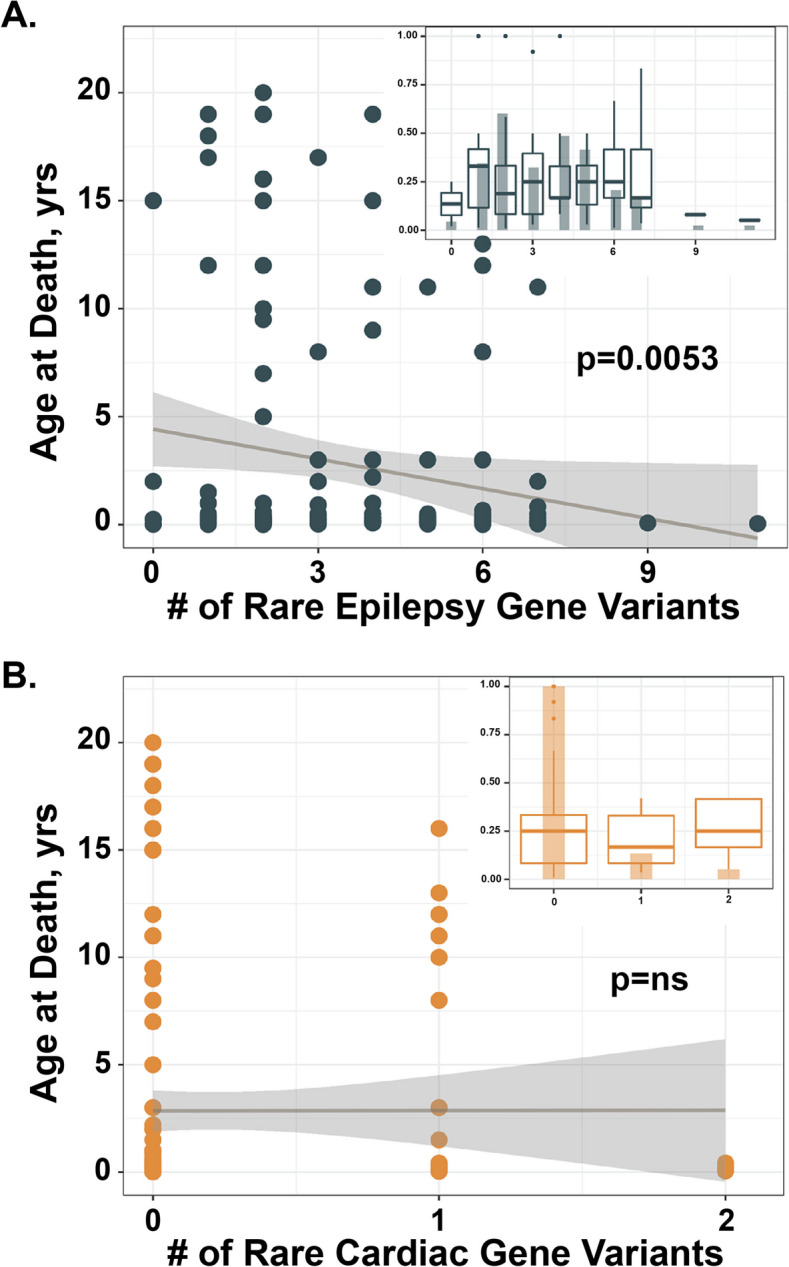
The SDY cohort was 43% European, 29% African, 3% Asian, 16% Hispanic, and 9% with mixed ancestries and 39% female. Six percent of the cohort was found to harbor a pathogenic or likely pathogenic genetic variant in an epilepsy, cardiomyopathy, or arrhythmia gene. The genomes of SDY cases, but not controls, were enriched for rare, potentially damaging variants in epilepsy, cardiomyopathy, and arrhythmia-related genes. A greater number of rare epilepsy genetic variants correlated with younger age at death.
While damaging cardiomyopathy and arrhythmia genes are recognized contributors to SDY, we also observed an enrichment in epilepsy-related genes in the SDY cohort and a correlation between rare epilepsy variation and younger age at death. These findings emphasize the importance of considering epilepsy genes when evaluating SDY.
儿童猝死是一件悲惨的事情。了解儿童猝死 (SDY) 的遗传学可以为家庭咨询和级联筛查提供帮助。本研究的目的是使用全基因组测序来描述 SDY 队列中的遗传变异。
SDY 病例登记处是美国国立卫生研究院/疾病控制与预防中心的一项监测工作,旨在查明 SDY 的患病率、原因和危险因素。SDY 病例登记处前瞻性地从 2015 年至 2019 年期间来自 13 个美国司法管辖区的法医和验尸官办公室收集 SDY 病例的临床数据和 DNA 生物样本。该队列包括 211 名(中位数年龄 0.33 岁;范围 0-20 岁)被确定为突然意外死亡的儿童,并且从他们那里获得了用于 DNA 提取和近亲同意的 DNA 生物样本。对照组由来自 1000 基因组计划的 211 名随机抽样的、性别和祖源匹配的个体组成。评估了 SDY 和对照组中的癫痫、心肌病和心律失常基因中的遗传变异。使用美国医学遗传学/基因组学学院指南将变异分类为致病性或可能致病性。此外,还使用基于贝叶斯的人工智能 (AI) 工具识别致病性和可能致病性遗传变异。
SDY 队列中 43%为欧洲人,29%为非洲人,3%为亚洲人,16%为西班牙裔,9%为混合血统,39%为女性。发现该队列中有 6%的人在癫痫、心肌病或心律失常基因中携带致病性或可能致病性的遗传变异。SDY 病例的基因组,而不是对照组的基因组,富含癫痫、心肌病和心律失常相关基因中的罕见、潜在有害变异。更多的罕见癫痫遗传变异与死亡年龄较小相关。
虽然已知破坏性心肌病和心律失常基因是 SDY 的重要原因,但我们在 SDY 队列中也观察到癫痫相关基因的富集,并且罕见癫痫变异与死亡年龄较小之间存在相关性。这些发现强调了在评估 SDY 时考虑癫痫基因的重要性。