Park Jaeyoung, Zhong Xiang, Miley Emilie N, Rutledge Rachel S, Kakalecik Jaquelyn, Johnson Matthew C, Gray Chancellor F
Booth School of Business, University of Chicago, Chicago, IL, USA.
Department of Industrial and Systems Engineering, University of Florida, Gainesville, FL, USA.
Arthroplast Today. 2023 Dec 28;25:101308. doi: 10.1016/j.artd.2023.101308. eCollection 2024 Feb.
The Centers for Medicare & Medicaid Services currently incentivizes hospitals to reduce postdischarge adverse events such as unplanned hospital readmissions for patients who underwent total joint arthroplasty (TJA). This study aimed to predict 90-day TJA readmissions from our comprehensive electronic health record data and routinely collected patient-reported outcome measures.
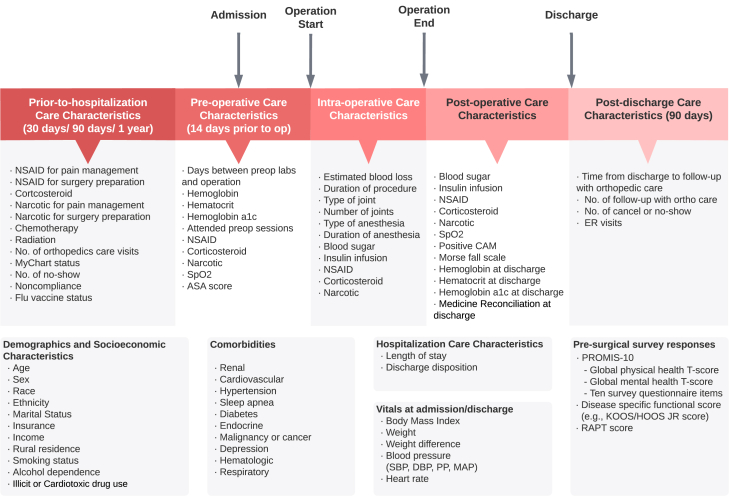
We retrospectively queried all TJA-related readmissions in our tertiary care center between 2016 and 2019. A total of 104-episode care characteristics and preoperative patient-reported outcome measures were used to develop several machine learning models for prediction performance evaluation and comparison. For interpretability, a logistic regression model was built to investigate the statistical significance, magnitudes, and directions of associations between risk factors and readmission.
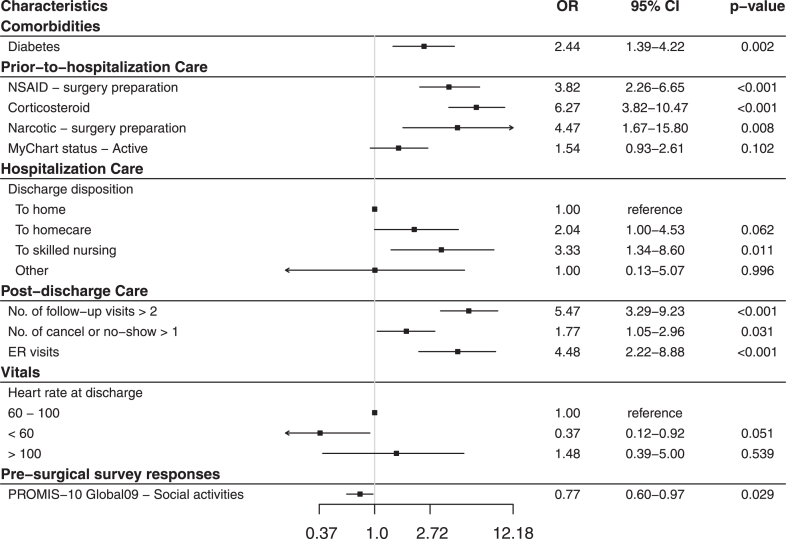
Given the significant imbalanced outcome (5.8% of patients were readmitted), our models robustly predicted the outcome, yielding areas under the receiver operating characteristic curves over 0.8, recalls over 0.5, and precisions over 0.5. In addition, the logistic regression model identified risk factors predicting readmission: diabetes, preadmission medication prescriptions (ie, nonsteroidal anti-inflammatory drug, corticosteroid, and narcotic), discharge to a skilled nursing facility, and postdischarge care behaviors within 90 days. Notably, low self-reported confidence to carry out social activities accurately predicted readmission.
A machine learning model can help identify patients who are at substantially increased risk of a readmission after TJA. This finding may allow for health-care providers to increase resources targeting these patients. In addition, a poor response to the "social activities" question may be a useful indicator that predicts a significant increased risk of readmission after TJA.
医疗保险和医疗补助服务中心目前鼓励医院减少出院后不良事件,如全关节置换术(TJA)患者的非计划住院再入院情况。本研究旨在根据我们全面的电子健康记录数据和常规收集的患者报告结局指标来预测TJA术后90天的再入院情况。
我们回顾性查询了2016年至2019年期间我们三级医疗中心所有与TJA相关的再入院情况。共使用104项护理特征和术前患者报告结局指标来开发多个机器学习模型,以评估和比较预测性能。为了便于解释,构建了一个逻辑回归模型来研究风险因素与再入院之间关联的统计显著性、大小和方向。
鉴于结局存在显著的不平衡(5.8%的患者再次入院),我们的模型能够稳健地预测结局,受试者操作特征曲线下面积超过0.8,召回率超过0.5,精确率超过0.5。此外,逻辑回归模型确定了预测再入院的风险因素:糖尿病、入院前用药处方(即非甾体抗炎药、皮质类固醇和麻醉药)、出院至专业护理机构以及90天内的出院后护理行为。值得注意的是,自我报告的进行社交活动的信心较低可准确预测再入院情况。
机器学习模型有助于识别TJA术后再入院风险大幅增加的患者。这一发现可能使医疗保健提供者能够增加针对这些患者的资源投入。此外对“社交活动”问题回答不佳可能是预测TJA术后再入院风险显著增加的一个有用指标。