
基于微凝胶的载体在骨关节炎治疗中增强骨骼干细胞重编程为免疫调节表型。
Microgel-based carriers enhance skeletal stem cell reprogramming towards immunomodulatory phenotype in osteoarthritic therapy.
作者信息
Li Pei-Lin, Chen Da-Fu, Li Xiao-Tong, Hao Rui-Cong, Zhao Zhi-Dong, Li Zhi-Ling, Yin Bo-Feng, Tang Jie, Luo Yu-Wen, Wu Chu-Tse, Nie Jing-Jun, Zhu Heng
机构信息
Department of Stem Cells and Regenerative Medicine, Beijing Institute of Radiation Medicine, Road Taiping 27, Beijing, 100850, PR China.
Beijing Key Laboratory for Radiobiology, Beijing Institute of Radiation Medicine, Beijing, 100850, PR China.
出版信息
Bioact Mater. 2023 Dec 28;34:204-220. doi: 10.1016/j.bioactmat.2023.12.022. eCollection 2024 Apr.
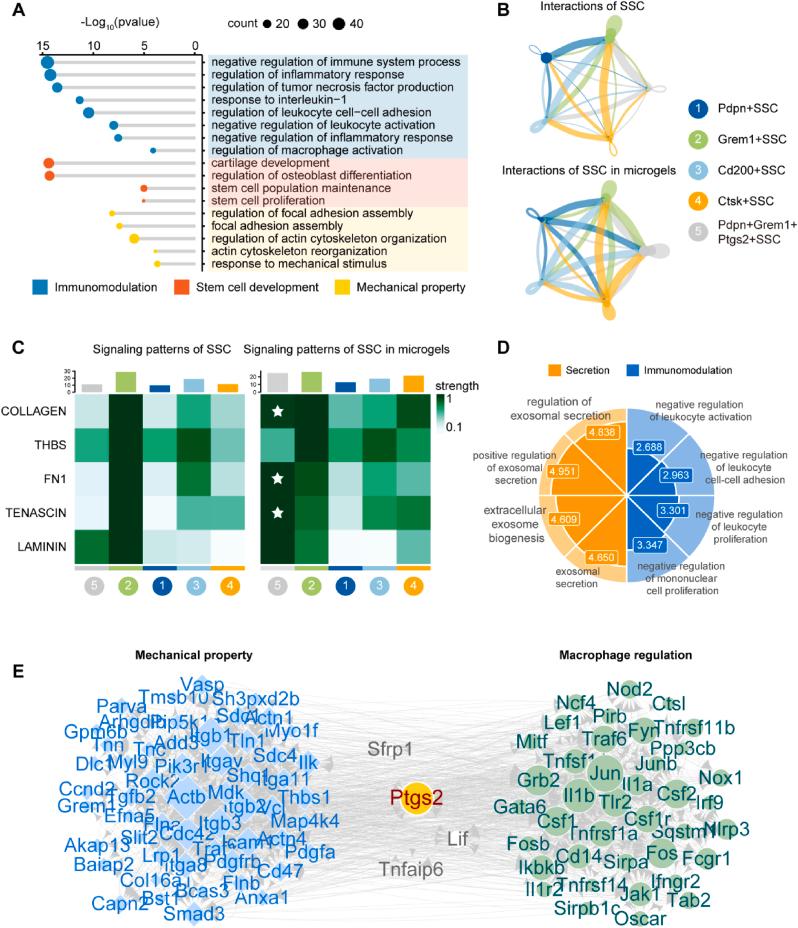
Skeletal stem cells (SSC) have gained attentions as candidates for the treatment of osteoarthritis due to their osteochondrogenic capacity. However, the immunomodulatory properties of SSC, especially under delivery operations, have been largely ignored. In the study, we found that Pdpn and Grem1 SSC subpopulations owned immunoregulatory potential, and the single-cell RNA sequencing (scRNA-seq) data suggested that the mechanical activation of microgel carriers on SSC induced the generation of PdpnGrem1Ptgs2 SSC subpopulation, which was potent at suppressing macrophage inflammation. The microgel carriers promoted the YAP nuclear translocation, and the activated YAP protein was necessary for the increased expression of Ptgs2 and PGE in microgels-delivered SSC, which further suppressed the expression of TNF-ɑ, IL-1β and promoted the expression of IL-10 in macrophages. SSC delivered with microgels yielded better preventive effects on articular lesions and macrophage activation in osteoarthritic rats than SSC without microgels. Chemically blocking the YAP and Ptgs2 in microgels-delivered SSC partially abolished the enhanced protection on articular tissues and suppression on osteoarthritic macrophages. Moreover, microgel carriers significantly prolonged SSC retention time without increasing SSC implanting into osteoarthritic joints. Together, our study demonstrated that microgel carriers enhanced SSC reprogramming towards immunomodulatory phenotype to regulate macrophage phenotype transformation for effectively osteoarthritic therapy by promoting YAP protein translocation into nucleus. The study not only complement and perfect the immunological mechanisms of SSC-based therapy at the single-cell level, but also provide new insight for microgel carriers in stem cell-based therapy.
骨骼干细胞(SSC)因其骨软骨生成能力而成为治疗骨关节炎的候选细胞,受到了广泛关注。然而,SSC的免疫调节特性,尤其是在递送操作过程中的免疫调节特性,在很大程度上被忽视了。在本研究中,我们发现Pdpn和Grem1 SSC亚群具有免疫调节潜力,单细胞RNA测序(scRNA-seq)数据表明,微凝胶载体对SSC的机械激活诱导了PdpnGrem1Ptgs2 SSC亚群的产生,该亚群具有强大的抑制巨噬细胞炎症的能力。微凝胶载体促进了YAP核转位,而活化的YAP蛋白对于微凝胶递送的SSC中Ptgs2和PGE表达的增加是必需的,这进一步抑制了巨噬细胞中TNF-ɑ、IL-1β的表达,并促进了IL-10的表达。与未使用微凝胶的SSC相比,使用微凝胶递送的SSC对骨关节炎大鼠的关节损伤和巨噬细胞激活具有更好的预防效果。化学阻断微凝胶递送的SSC中的YAP和Ptgs2可部分消除对关节组织的增强保护作用以及对骨关节炎巨噬细胞的抑制作用。此外,微凝胶载体显著延长了SSC的保留时间,而不会增加SSC植入骨关节炎关节的数量。总之,我们的研究表明,微凝胶载体通过促进YAP蛋白转位入核,增强了SSC向免疫调节表型的重编程,从而调节巨噬细胞表型转化,有效治疗骨关节炎。该研究不仅在单细胞水平上补充和完善了基于SSC治疗的免疫机制,也为微凝胶载体在基于干细胞的治疗中提供了新的见解。



 Zotero 插件