Kari Kamaliah Azzma, Wan Muhd Shukeri Wan Fadzlina, Yaacob Najib Majdi, Li Andrew Yunkai, Zaini Rhendra Hardy, Mazlan Mohd Zulfakar
Department of Anaesthesiology and Intensive Care, School of Medical Sciences, Universiti Sains Malaysia, Kelantan, Malaysia.
Department of Anaesthesiology and Intensive Care, Hospital Universiti Sains Malaysia, Kelantan, Malaysia.
Malays J Med Sci. 2023 Dec;30(6):120-132. doi: 10.21315/mjms2023.30.6.12. Epub 2023 Dec 19.
Sepsis and septic shock are the leading causes of critical care-related mortality worldwide. This study aimed to determine the prevalence of sepsis, its intensive care unit (ICU) mortality rate and the factors associated with both ICU mortality and prolonged stay.
A prospective cohort study was conducted from January 2019 to December 2019 with adult patients presenting evidence of sepsis who were admitted to the ICU. Parameters were assessed in the ICU to determine the association with all-cause ICU mortality and prolonged stay.
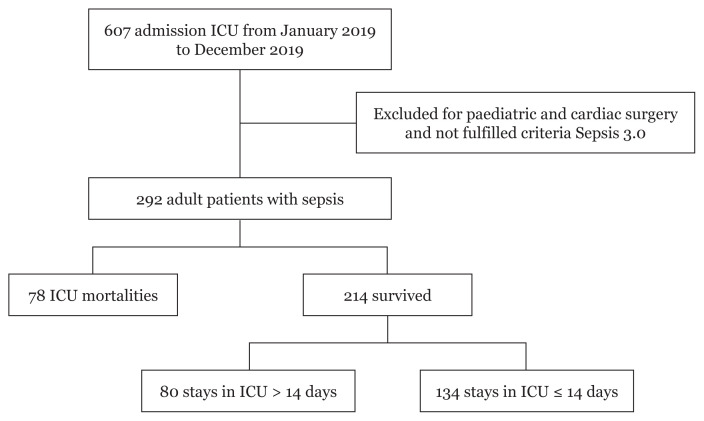
Out of 607 adults, 292 with sepsis were admitted to the ICU in 2019, with a mean age of 50.98 (standard deviation [SD] = 17.75) years old. There was, thus, a 48% incidence of sepsis. Mortality was observed in 78 patients (mortality rate = 26.7%) (95% confidence interval [CI]: 21.7, 32.2). Patients with higher Glasgow coma scale (GCS) scores had lower odds of ICU mortality (adjusted odds ratio [OR] = 0.90; 95% CI: 0.82, 0.98; = 0.019), while patients with higher sequential organ failure assessment (SOFA) scores had higher odds (adjusted OR = 1.22; 95% CI: 1.11, 1.35; < 0.001). Eighty patients (37.4%) who survived had prolonged ICU stays (95% CI: 30.9, 44.2). Patients with higher albumin levels had lower odds of a prolonged ICU stay (adjusted OR = 0.94; 95% CI: 0.90, 0.98; = 0.006) and patients on renal replacement therapy had higher odds of a prolonged ICU stay (adjusted OR = 1.25; 95% CI: 1.74, 7.12; < 0.001).
Our study identified a sepsis prevalence of 48% and an ICU mortality rate of 26.7% among adult patients admitted to the ICU. GCS and SOFA scores were the most important factors associated with ICU mortality.
脓毒症和脓毒性休克是全球危重症相关死亡的主要原因。本研究旨在确定脓毒症的患病率、其在重症监护病房(ICU)的死亡率以及与ICU死亡率和延长住院时间相关的因素。
对2019年1月至2019年12月入住ICU且有脓毒症证据的成年患者进行了一项前瞻性队列研究。在ICU中评估各项参数,以确定其与全因ICU死亡率和延长住院时间的关联。
在607名成年人中,292例脓毒症患者于2019年入住ICU,平均年龄为50.98岁(标准差[SD]=17.75)。因此,脓毒症的发病率为48%。78例患者死亡(死亡率=26.7%)(95%置信区间[CI]:21.7,32.2)。格拉斯哥昏迷量表(GCS)评分较高的患者ICU死亡率较低(调整后的优势比[OR]=0.90;95%CI:0.82,0.98;P=0.019),而序贯器官衰竭评估(SOFA)评分较高的患者死亡率较高(调整后的OR=1.22;95%CI:1.11,1.35;P<0.001)。80例存活患者(37.4%)的ICU住院时间延长(95%CI:30.9,44.2)。白蛋白水平较高的患者ICU住院时间延长的几率较低(调整后的OR=0.94;95%CI:0.90,0.98;P=0.006),接受肾脏替代治疗的患者ICU住院时间延长的几率较高(调整后的OR=1.25;95%CI:1.74,7.12;P<0.001)。
我们的研究发现,在入住ICU的成年患者中,脓毒症患病率为48%,ICU死亡率为26.7%。GCS和SOFA评分是与ICU死亡率相关的最重要因素。