Mahn Robert, Glüer Oscar André, Sadeghlar Farsaneh, Möhring Christian, Zhou Taotao, Anhalt Thomas, Monin Malte Benedikt, Kania Alexander, Glowka Tim R, Feldmann Georg, Brossart Peter, Kalff Joerg C, Schmidt-Wolf Ingo G H, Strassburg Christian P, Gonzalez-Carmona Maria A
Department of Internal Medicine I, University Hospital of Bonn, Bonn, Germany.
Department of Surgery, University Hospital of Bonn, Bonn, Germany.
J Hepatocell Carcinoma. 2024 Jan 13;11:81-94. doi: 10.2147/JHC.S432948. eCollection 2024.
There are several existing systemic 1st- line therapies for advanced hepatocellular carcinoma (HCC), including atezolizumab/bevacizumab (Atez/Bev), sorafenib and lenvatinib. This study aims to compare the effectiveness of these three 1st-line systemic treatments in a real-world setting for HCC, focusing on specific patient subgroups analysis.
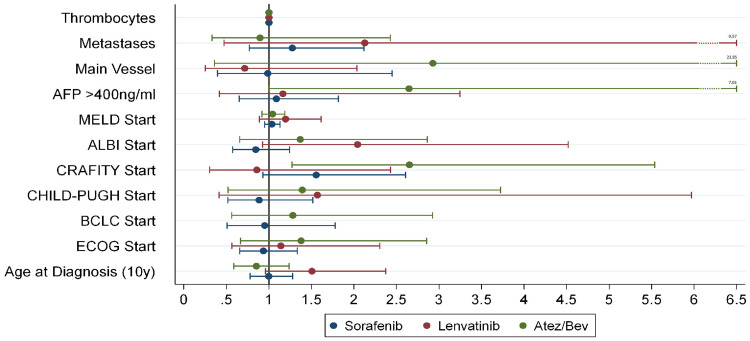
A total of 177 patients with advanced HCC treated with Atez/Bev (n = 38), lenvatinib (n = 21) or sorafenib (n = 118) as 1st line systemic therapy were retrospectively analyzed and compared. Primary endpoints included objective response rate (ORR), progression-free survival (PFS) and 15-month overall survival (15-mo OS). Subgroups regarding liver function, etiology, previous therapy and toxicity were analyzed.
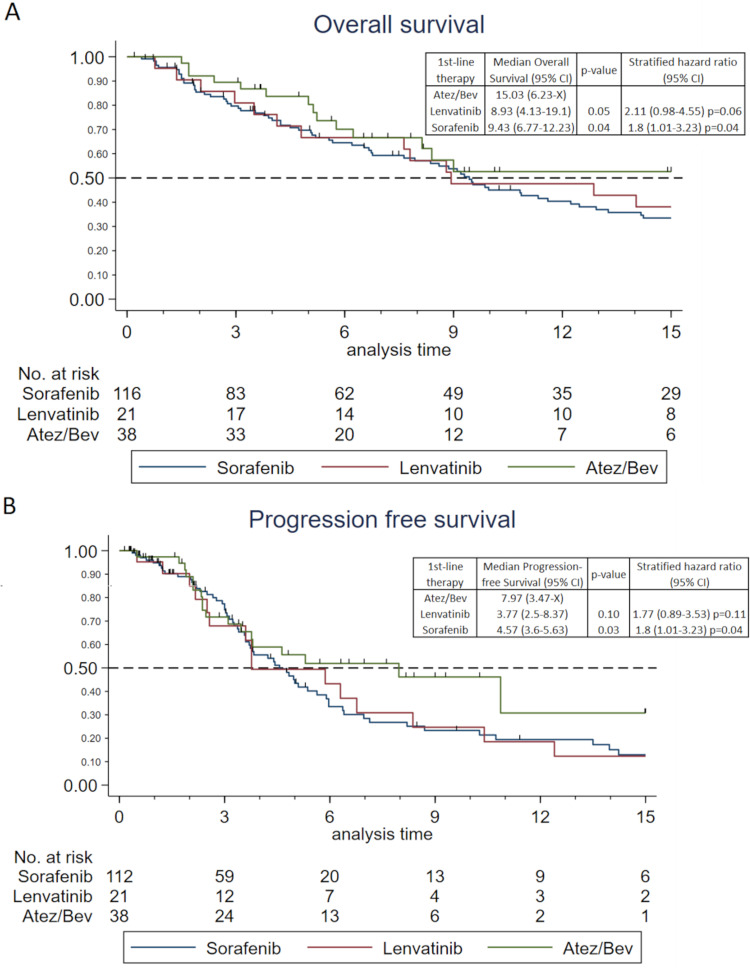
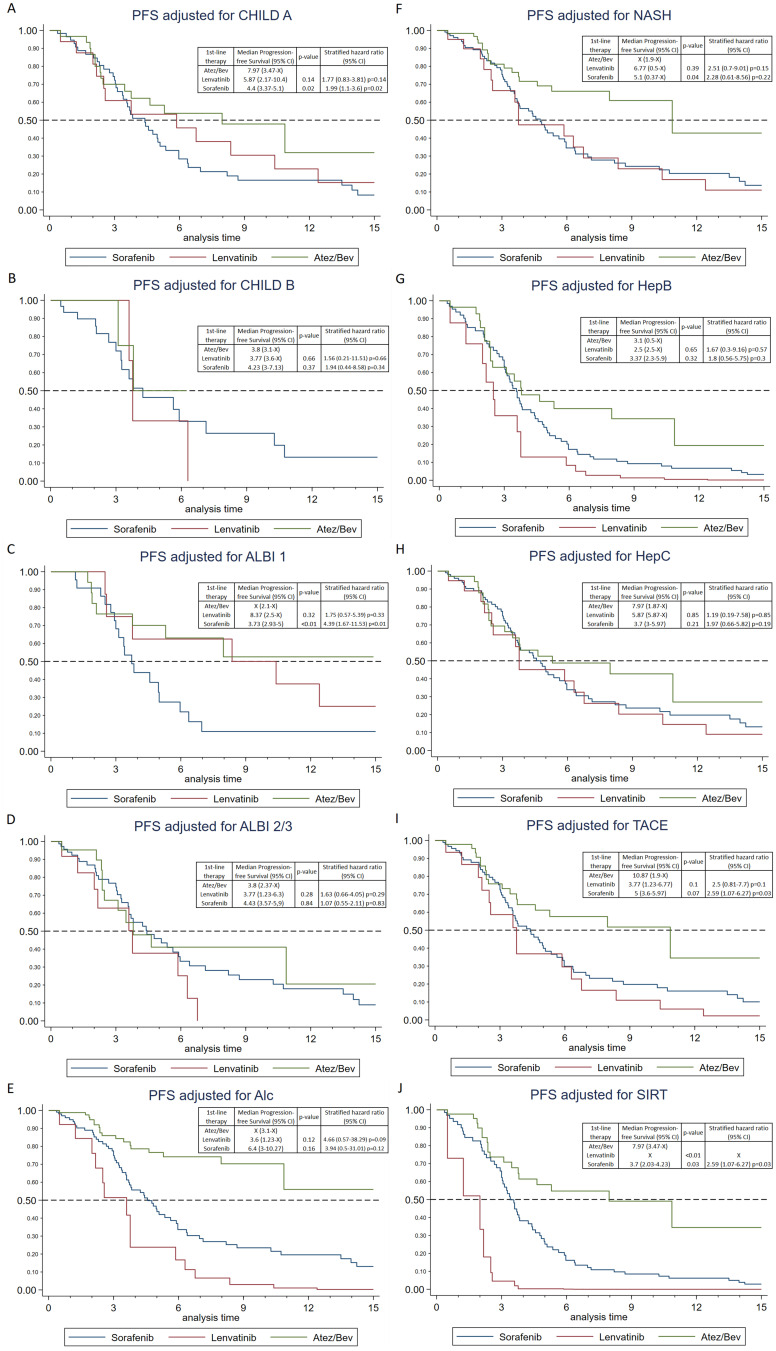
Atez/Bev demonstrated significantly longer median 15-month OS with 15.03 months compared to sorafenib with 9.43 months (p = 0.04) and lenvatinib with 8.93 months (p = 0.05). Similarly, it had highest ORR of 31.6% and longest median PFS with 7.97 months, independent of etiology. However, significantly superiority was observed only compared to sorafenib (ORR: 4.2% (p < 0.001); PFS: 4.57 months (p = 0.03)), but not comparing to lenvatinib (ORR: 28.6% (p = 0.87); PFS: 3.77 months (p = 0.10)). Atez/Bev also resulted in the longest PFS in patients with Child-Pugh A and ALBI 1 score and interestingly in those previously treated with SIRT. Contrary, sorafenib was non inferior in patients with impaired liver function.
Atez/Bev achieved longest median PFS and 15-mo OS independent of etiology and particularly in patients with stable liver function or prior SIRT treatment. Regarding therapy response lenvatinib was non-inferior to Atez/Bev. Finally, sorafenib seemed to perform best for patients with deteriorated liver function.
对于晚期肝细胞癌(HCC),目前有几种一线全身治疗方法,包括阿替利珠单抗/贝伐珠单抗(阿替利珠单抗/贝伐单抗)、索拉非尼和仑伐替尼。本研究旨在比较这三种一线全身治疗方法在HCC真实世界中的疗效,重点进行特定患者亚组分析。
回顾性分析并比较了177例接受阿替利珠单抗/贝伐珠单抗(n = 38)、仑伐替尼(n = 21)或索拉非尼(n = 118)作为一线全身治疗的晚期HCC患者。主要终点包括客观缓解率(ORR)、无进展生存期(PFS)和15个月总生存期(15个月OS)。对肝功能、病因、既往治疗和毒性等亚组进行了分析。
阿替利珠单抗/贝伐珠单抗的中位15个月OS显著长于索拉非尼(9.43个月,p = 0.04)和仑伐替尼(8.93个月,p = 0.05),为15.03个月。同样,其ORR最高,为31.6%,中位PFS最长,为7.97个月,与病因无关。然而,仅与索拉非尼相比观察到显著优势(ORR:4.2%(p < 0.001);PFS:4.57个月(p = 0.03)),与仑伐替尼相比未观察到显著优势(ORR:28.6%(p = 0.87);PFS:3.77个月(p = 0.10))。阿替利珠单抗/贝伐珠单抗在Child-Pugh A级和ALBI 1级评分的患者以及有趣的是在先前接受过选择性内放射治疗(SIRT)的患者中也导致了最长的PFS。相反,索拉非尼在肝功能受损的患者中并不逊色。
阿替利珠单抗/贝伐珠单抗实现了最长的中位PFS和15个月OS,与病因无关,尤其在肝功能稳定或先前接受过SIRT治疗的患者中。关于治疗反应,仑伐替尼不劣于阿替利珠单抗/贝伐珠单抗。最后,索拉非尼似乎对肝功能恶化的患者效果最佳。