Pan Xiaobei, Donaghy Paul C, Roberts Gemma, Chouliaras Leonidas, O'Brien John T, Thomas Alan J, Heslegrave Amanda J, Zetterberg Henrik, McGuinness Bernadette, Passmore Anthony P, Green Brian D, Kane Joseph P M
School of Biological Sciences, Queen's University Belfast, Belfast, United Kingdom.
Translational and Clinical Research Institute, Newcastle University, Newcastle upon Tyne, United Kingdom.
Front Aging Neurosci. 2024 Jan 4;15:1326780. doi: 10.3389/fnagi.2023.1326780. eCollection 2023.
In multifactorial diseases, alterations in the concentration of metabolites can identify novel pathological mechanisms at the intersection between genetic and environmental influences. This study aimed to profile the plasma metabolome of patients with dementia with Lewy bodies (DLB) and Alzheimer's disease (AD), two neurodegenerative disorders for which our understanding of the pathophysiology is incomplete. In the clinical setting, DLB is often mistaken for AD, highlighting a need for accurate diagnostic biomarkers. We therefore also aimed to determine the overlapping and differentiating metabolite patterns associated with each and establish whether identification of these patterns could be leveraged as biomarkers to support clinical diagnosis.
A panel of 630 metabolites (Biocrates MxP Quant 500) and a further 232 metabolism indicators (biologically informative sums and ratios calculated from measured metabolites, each indicative for a specific pathway or synthesis; MetaboINDICATOR) were analyzed in plasma from patients with probable DLB ( = 15; age 77.6 ± 8.2 years), probable AD ( = 15; 76.1 ± 6.4 years), and age-matched cognitively healthy controls (HC; = 15; 75.2 ± 6.9 years). Metabolites were quantified using a reversed-phase ultra-performance liquid chromatography column and triple-quadrupole mass spectrometer in multiple reaction monitoring (MRM) mode, or by using flow injection analysis in MRM mode. Data underwent multivariate (PCA analysis), univariate and receiving operator characteristic (ROC) analysis. Metabolite data were also correlated (Spearman r) with the collected clinical neuroimaging and protein biomarker data.
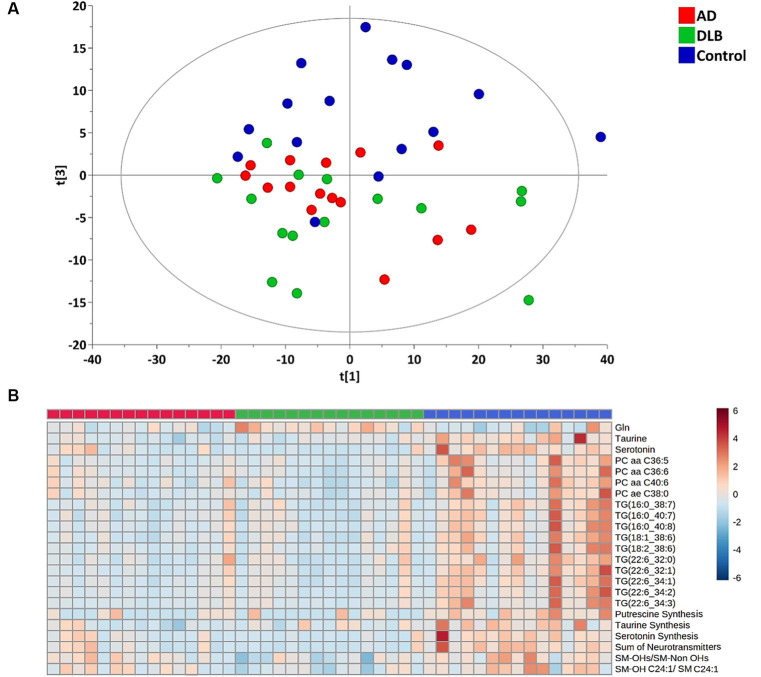
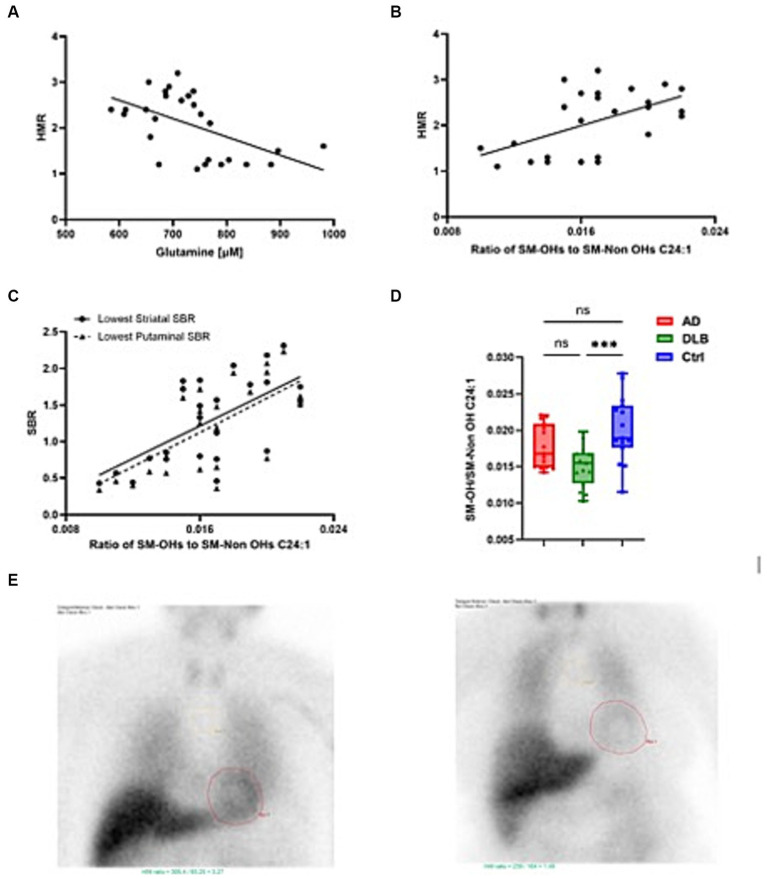
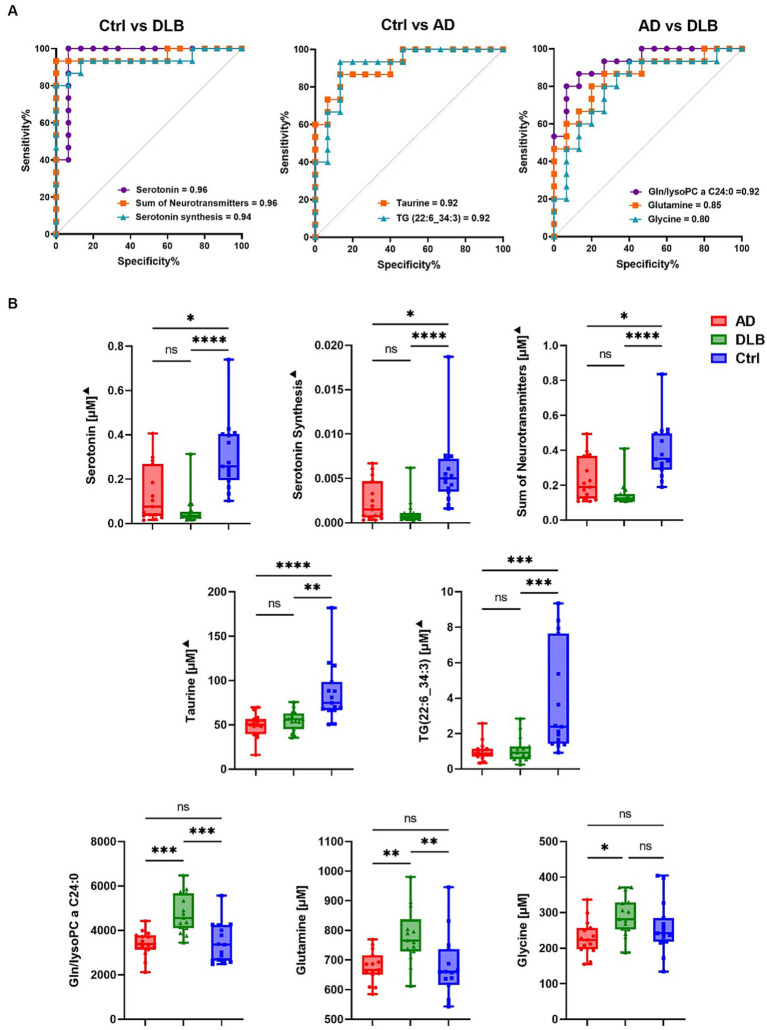
The PCA plot separated DLB, AD and HC groups (R2 = 0.518, Q2 = 0.348). Significant alterations in 17 detected metabolite parameters were identified ( ≤ 0.05), including neurotransmitters, amino acids and glycerophospholipids. Glutamine (Glu; = 0.045) concentrations and indicators of sphingomyelin hydroxylation ( = 0.039) distinguished AD and DLB, and these significantly correlated with semi-quantitative measurement of cardiac sympathetic denervation. The most promising biomarker differentiating AD from DLB was Glu:lysophosphatidylcholine (lysoPC a 24:0) ratio (AUC = 0.92; 95%CI 0.809-0.996; sensitivity = 0.90; specificity = 0.90).
Several plasma metabolomic aberrations are shared by both DLB and AD, but a rise in plasma glutamine was specific to DLB. When measured against plasma lysoPC a C24:0, glutamine could differentiate DLB from AD, and the reproducibility of this biomarker should be investigated in larger cohorts.
在多因素疾病中,代谢物浓度的改变能够在基因与环境影响的交叉点识别出新的病理机制。本研究旨在描绘路易体痴呆(DLB)和阿尔茨海默病(AD)患者的血浆代谢组,这两种神经退行性疾病的病理生理学机制尚未完全明确。在临床环境中,DLB常被误诊为AD,这凸显了对准确诊断生物标志物的需求。因此,我们还旨在确定与每种疾病相关的重叠和差异代谢物模式,并确定这些模式的识别是否可作为支持临床诊断的生物标志物。
对可能患有DLB的患者(n = 15;年龄77.6±8.2岁)、可能患有AD的患者(n = 15;76.1±6.4岁)以及年龄匹配的认知健康对照者(HC;n = 15;75.2±6.9岁)的血浆进行分析,检测一组630种代谢物(Biocrates MxP Quant 500)以及另外232种代谢指标(根据测量的代谢物计算得出的具有生物学意义的总和及比率,每种指标代表特定途径或合成过程;MetaboINDICATOR)。使用反相超高效液相色谱柱和三重四极杆质谱仪在多反应监测(MRM)模式下对代谢物进行定量,或通过在MRM模式下的流动注射分析进行定量。数据进行多变量(主成分分析)、单变量和接受者操作特征(ROC)分析。代谢物数据还与收集的临床神经影像和蛋白质生物标志物数据进行相关性分析(Spearman秩相关系数r)。
主成分分析图将DLB、AD和HC组区分开来(R2 = 0.518,Q2 = 0.348)。确定了17个检测到的代谢物参数有显著改变(p≤0.05),包括神经递质、氨基酸和甘油磷脂。谷氨酰胺(Glu;p = 0.045)浓度和鞘磷脂羟基化指标(p = 0.039)可区分AD和DLB,且这些指标与心脏交感神经去神经化的半定量测量显著相关。区分AD与DLB最有前景的生物标志物是Glu:溶血磷脂酰胆碱(lysoPC a 24:0)比率(AUC = 0.92;95%CI 0.809 - 0.996;敏感性 = 0.90;特异性 = 0.90)。
DLB和AD都存在几种血浆代谢组异常,但血浆谷氨酰胺升高是DLB特有的。当与血浆lysoPC a C24:0进行对比测量时,谷氨酰胺可区分DLB与AD,这种生物标志物的可重复性应在更大的队列中进行研究。