University of Oslo, NO-0316, Oslo, Norway.
Department of Pathology, Vestfold Hospital Trust, NO-3103, Tønsberg, Norway.
Clin Exp Med. 2024 Jan 19;24(1):10. doi: 10.1007/s10238-023-01273-0.
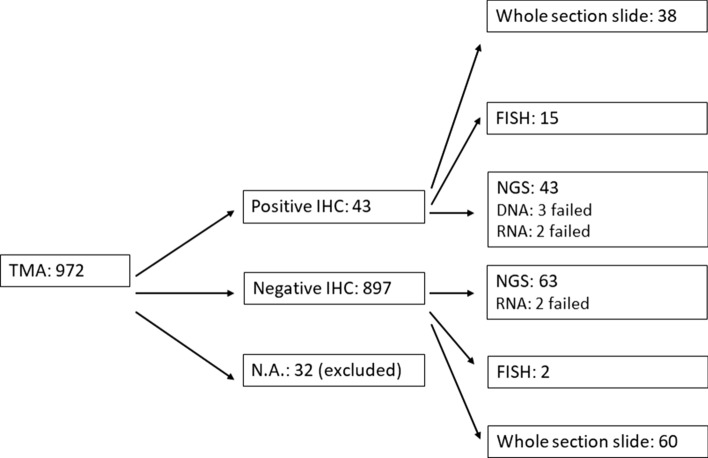
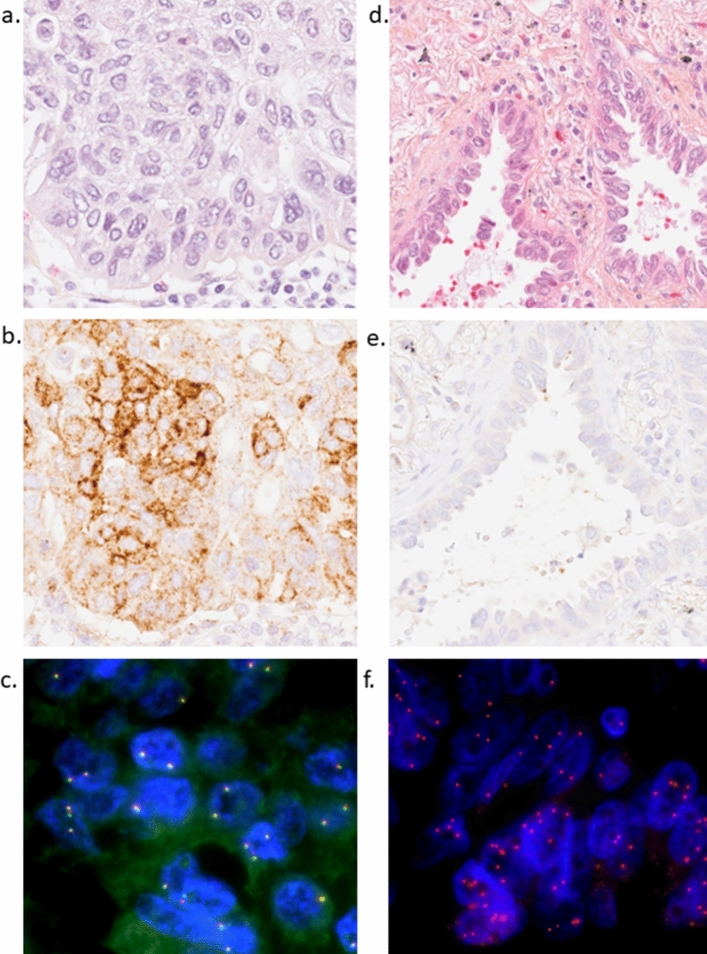
Tropomyosin receptor kinases (TRK) are attractive targets for cancer therapy. As TRK-inhibitors are approved for all solid cancers with detectable fusions involving the Neurotrophic tyrosine receptor kinase (NTRK)-genes, there has been an increased interest in optimizing testing regimes. In this project, we wanted to find the prevalence of NTRK fusions in a cohort of various histopathological types of early-stage lung cancer in Norway and to investigate the association between TRK protein expression and specific histopathological types, including their molecular and epidemiological characteristics. We used immunohistochemistry (IHC) as a screening tool for TRK expression, and next-generation sequencing (NGS) and fluorescence in situ hybridization (FISH) as confirmatory tests for underlying NTRK-fusion. Among 940 cases, 43 (4.6%) had positive TRK IHC, but in none of these could a NTRK fusion be confirmed by NGS or FISH. IHC-positive cases showed various staining intensities and patterns including cytoplasmatic or nuclear staining. IHC-positivity was more common in squamous cell carcinoma (LUSC) (10.3%) and adenoid cystic carcinoma (40.0%), where the majority showed heterogeneous staining intensity. In comparison, only 1.1% of the adenocarcinomas were positive. IHC-positivity was also more common in men, but this association could be explained by the dominance of LUSC in TRK IHC-positive cases. Protein expression was not associated with differences in time to relapse or overall survival. Our study indicates that NTRK fusion is rare in early-stage lung cancer. Due to the high level of false positive cases with IHC, Pan-TRK IHC is less suited as a screening tool for NTRK-fusions in LUSC and adenoid cystic carcinoma.
原肌球蛋白受体激酶(TRK)是癌症治疗的一个有吸引力的靶点。由于 TRK 抑制剂已被批准用于所有实体瘤,这些实体瘤均存在可检测到的神经生长因子受体酪氨酸激酶(NTRK)基因融合,因此人们越来越关注优化检测方案。在本项目中,我们旨在确定挪威早期肺癌不同组织病理学类型中 NTRK 融合的发生率,并研究 TRK 蛋白表达与特定组织病理学类型之间的关联,包括其分子和流行病学特征。我们使用免疫组织化学(IHC)作为 TRK 表达的筛选工具,下一代测序(NGS)和荧光原位杂交(FISH)作为潜在 NTRK 融合的确认测试。在 940 例病例中,有 43 例(4.6%)的 TRK IHC 阳性,但在这些病例中,没有一例可以通过 NGS 或 FISH 确认 NTRK 融合。IHC 阳性病例显示出不同的染色强度和模式,包括细胞质或核染色。在鳞状细胞癌(LUSC)(10.3%)和腺样囊性癌(40.0%)中,IHC 阳性更为常见,其中大多数显示异质性染色强度。相比之下,只有 1.1%的腺癌为阳性。IHC 阳性也更常见于男性,但这种关联可以用 LUSC 在 TRK IHC 阳性病例中的优势来解释。蛋白表达与复发时间或总生存时间无差异相关。我们的研究表明,NTRK 融合在早期肺癌中很少见。由于 IHC 存在大量假阳性病例,因此 Pan-TRK IHC 不太适合作为 LUSC 和腺样囊性癌中 NTRK 融合的筛选工具。