School of Public Health, Hangzhou Normal University, Hangzhou, 311121, Zhejiang, China.
Engineering Research Center of Mobile Health Management System, Ministry of Education, Hangzhou, Zhejiang, China.
BMC Psychol. 2024 Jan 19;12(1):41. doi: 10.1186/s40359-023-01276-2.
The sleep of healthcare students is worth discovering. Mental health and self-rated health are thought to be associated with sleep quality. As such, valid instruments to assess sleep quality in healthcare students are crucial and irreplaceable. This study aimed to investigate the measurement properties of the Sleep Quality Questionnaire (SQQ) for Chinese healthcare students.
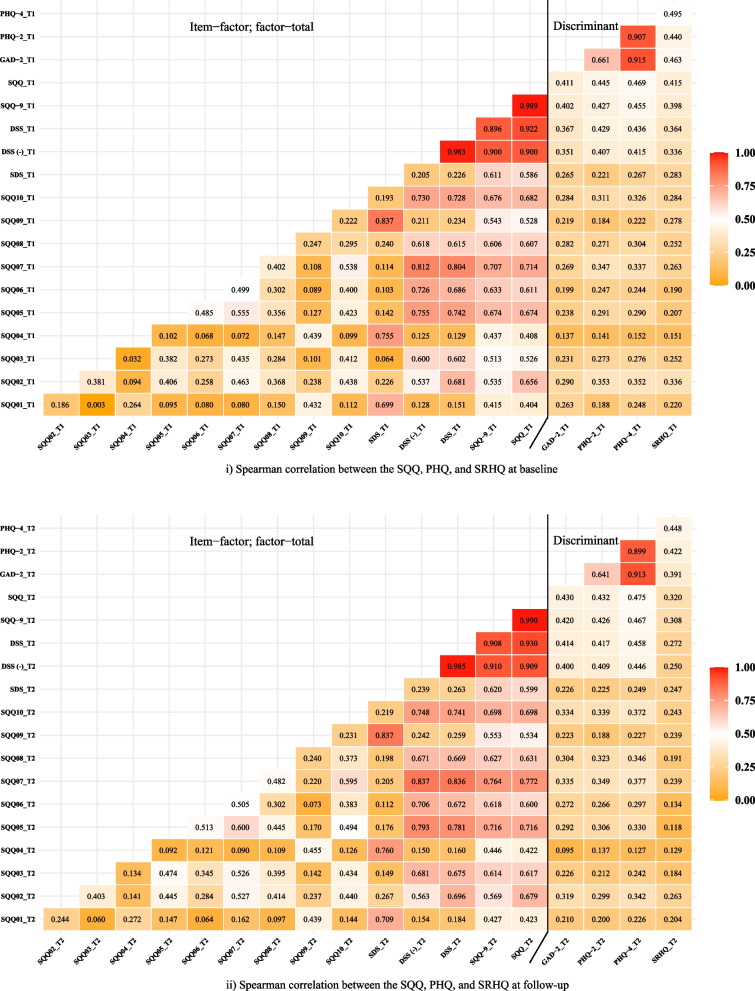
Two longitudinal assessments were undertaken among healthcare students, with a total of 595, between December 2020 and January 2021. Measures include the Chinese version of the SQQ, Patient Health Questionnaire-4 (PHQ-4), Self-Rated Health Questionnaire (SRHQ), and sociodemographic questionnaire. Structural validity through confirmatory factor analysis (CFA) was conducted to examine factor structure of the SQQ. T-tests and ANOVAs were used to examine sociodemographic differences in sleep quality scores. Multi Group CFA and longitudinal CFA were respectively used to assess cross-sectional invariance and longitudinal invariance across two-time interval, i.e., cross-cultural validity. Construct validity, internal consistency, and test-retest reliability were correspondingly examined via Spearman correlation, Cronbach's alpha and McDonald's omega, and intraclass correlation coefficient. Multiple linear regression analysis was performed to examine incremental validity of the SQQ based on the PHQ-4 and SRHQ as indicators of the criterion variables.
CFA results suggested that the two-factor model of the SQQ-9 (item 2 excluded) had the best fit. The SQQ-9 scores differed significantly by age, grade, academic stage, hobby, stress coping strategy, anxiety, depression, and self-rated health subgroups. Measurement invariance was supported in terms of aforesaid subgroups and across two time intervals. In correlation and regression analyses, anxiety, depression, and self-rated health were moderately strong predictors of sleep quality. The SQQ-9 had good internal consistency and test-retest reliability.
Good measurement properties suggest that the SQQ is a promising and practical measurement instrument for assessing sleep quality of Chinese healthcare students.
医护学生的睡眠值得关注。人们认为心理健康和自我健康评估与睡眠质量有关。因此,评估医护学生睡眠质量的有效工具至关重要且不可或缺。本研究旨在调查中文版睡眠质量问卷(SQQ)在医护学生中的测量特性。
2020 年 12 月至 2021 年 1 月期间,对 595 名医护学生进行了两次纵向评估。测量包括 SQQ 的中文版、患者健康问卷-4(PHQ-4)、自我健康评估问卷(SRHQ)和社会人口学问卷。通过验证性因子分析(CFA)进行结构有效性检验,以检验 SQQ 的因子结构。使用 t 检验和方差分析检验睡眠质量得分在社会人口学方面的差异。多组 CFA 和纵向 CFA 分别用于评估两个时间间隔的跨文化不变性和纵向不变性,即跨文化有效性。通过 Spearman 相关系数、Cronbach's alpha 和 McDonald's omega、以及组内相关系数,相应地评估了结构有效性、内部一致性和重测信度。使用多元线性回归分析,根据 PHQ-4 和 SRHQ 作为效标变量,评估 SQQ 的增量有效性。
CFA 结果表明,SQQ-9(排除第 2 项)的两因素模型具有最佳拟合度。SQQ-9 评分在年龄、年级、学业阶段、爱好、压力应对策略、焦虑、抑郁和自我健康评估亚组之间存在显著差异。在上述亚组和两个时间间隔上,测量不变性得到支持。在相关和回归分析中,焦虑、抑郁和自我健康评估是睡眠质量的中等强度预测因子。SQQ-9 具有良好的内部一致性和重测信度。
良好的测量特性表明,SQQ 是评估中国医护学生睡眠质量的一种有前途且实用的测量工具。