Zhu Yihong, Jiang Chen, Yang You, Dzierzewski Joseph M, Spruyt Karen, Zhang Bingren, Huang Mengyi, Ge Hanjie, Rong Yangyang, Ola Bolanle Adeyemi, Liu Tingjie, Ma Haiyan, Meng Runtang
School of Clinical Medicine, Hangzhou Normal University, Hangzhou 311121, China.
School of Public Health, Hangzhou Normal University, Hangzhou 311121, China.
Behav Sci (Basel). 2023 Jan 19;13(2):82. doi: 10.3390/bs13020082.
This study aimed to investigate factors associated with sleep quality in healthcare students and to determine whether depressive and anxiety symptoms may explain some of the associations between sleep quality and self-rated health.
This is a cross-sectional study at wave one.
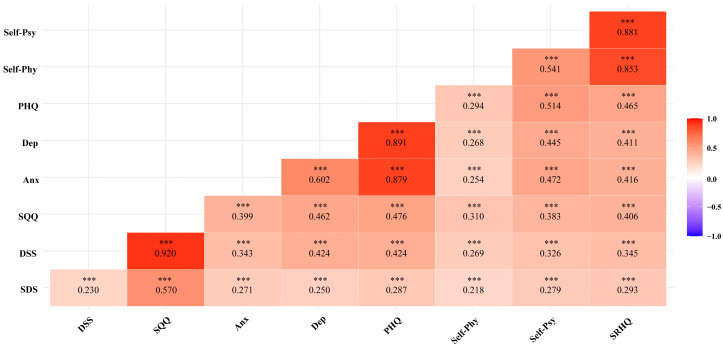
A total of 637 healthcare students were recruited via a stratified random sampling method in Hangzhou, China. The Sleep Quality Questionnaire (SQQ) and the four-item Patient Health Questionnaire (PHQ-4) were used to assess sleep quality and depressive and anxiety symptoms, respectively. Self-rated health was assessed via a self-developed questionnaire of both physical and psychological health. Structural equation modeling was used to examine the direct and indirect effects of sleep quality on self-rated health through depressive and anxiety symptoms.
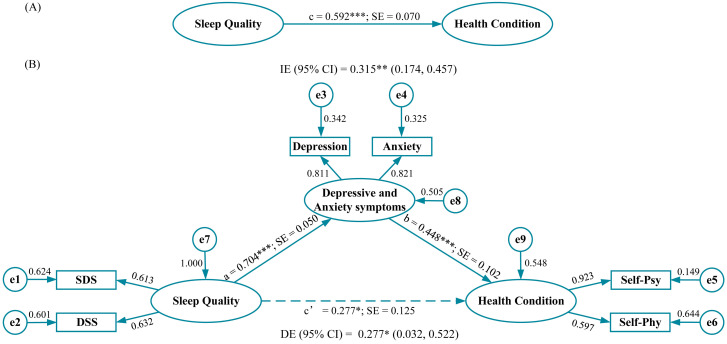
Students engaged in part-time employment ( = 0.022), with poor perceived employment prospects ( = 0.009), and who did not participate in recreational sports ( = 0.008) had worse sleep quality. Structural equation modeling revealed a significant total effect of sleep quality on self-rated health ( = 0.592, < 0.001), a significant direct effect of both sleep quality and depressive and anxiety symptoms on self-rated health ( = 0.277, 95% CI: 0.032-0.522), and a significant indirect effect of sleep quality on self-rated health through depressive and anxiety symptoms ( = 0.315, 95% CI: 0.174-0.457).
Depressive and anxiety symptoms partially explain the association between sleep quality and self-rated health. Intervening upon sleep quality, depressive, and anxiety symptoms may bolster the self-rated health of healthcare students.
本研究旨在调查与医学生睡眠质量相关的因素,并确定抑郁和焦虑症状是否可以解释睡眠质量与自评健康之间的某些关联。
这是一项第一波的横断面研究。
通过分层随机抽样方法在中国杭州招募了637名医学生。分别使用睡眠质量问卷(SQQ)和四项患者健康问卷(PHQ-4)来评估睡眠质量以及抑郁和焦虑症状。通过一份自行编制的身心健康问卷来评估自评健康。采用结构方程模型来检验睡眠质量通过抑郁和焦虑症状对自评健康的直接和间接影响。
从事兼职工作(P = 0.022)、就业前景不佳(P = 0.009)以及不参加休闲运动(P = 0.008)的学生睡眠质量较差。结构方程模型显示睡眠质量对自评健康有显著的总体影响(P = 0.592,P < 0.001),睡眠质量以及抑郁和焦虑症状对自评健康均有显著的直接影响(P = 0.277,95%CI:0.032 - 0.522),并且睡眠质量通过抑郁和焦虑症状对自评健康有显著的间接影响(P = 0.315,95%CI:0.174 - 0.457)。
抑郁和焦虑症状部分解释了睡眠质量与自评健康之间的关联。干预睡眠质量、抑郁和焦虑症状可能会改善医学生的自评健康。