Wang Fang-Ming, Xu Li-Qiang, Zhang Zhong-Chao, Guo Qiang, Du Zhi-Peng, Lei Yue, Han Xu, Wu Chuang-Yan, Zhao Feng, Chen Jiu-Ling
Department of Thoracic Surgery, Union Hospital, Tongji Medical College, Huazhong University of Science and Technology, Wuhan, China.
Department of Cardiothoracic Surgery, Taihe Hospital, Hubei University of Medicine, Shiyan, China.
Aging (Albany NY). 2024 Jan 18;16(2):1605-1619. doi: 10.18632/aging.205446.
Overexpression of solute carrier family 7 member 8 (SLC7A8) has been shown to relate to the survival time and tumor progression in cancer patients. However, the role of in lung adenocarcinoma (LUAD) is still obscure.
The relationships between expression in LUAD tissues and clinical values as well as immune infiltration were explored through bioinformatics. The functions and pathways of in LUAD were investigated using Kyoto Encyclopedia of Genes and Genomes enrichment analysis, Gene Set Enrichment Analysis, Western blotting, and other methods.
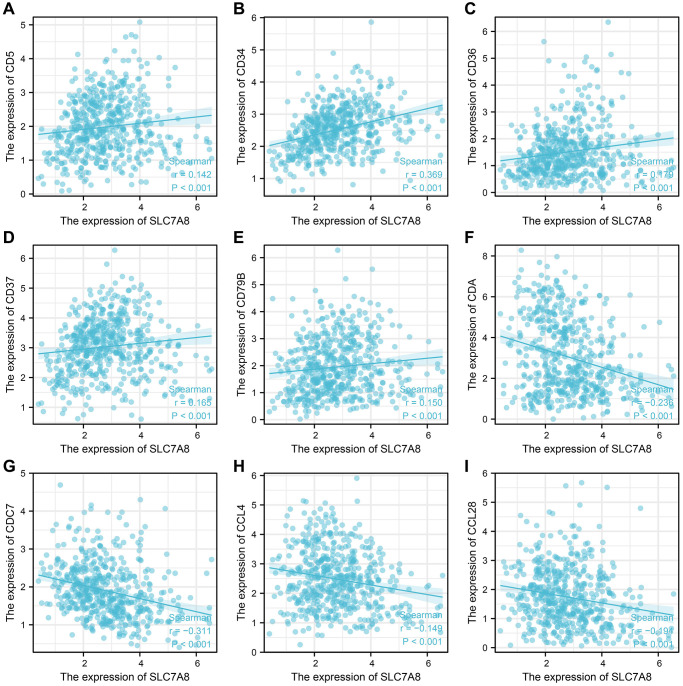
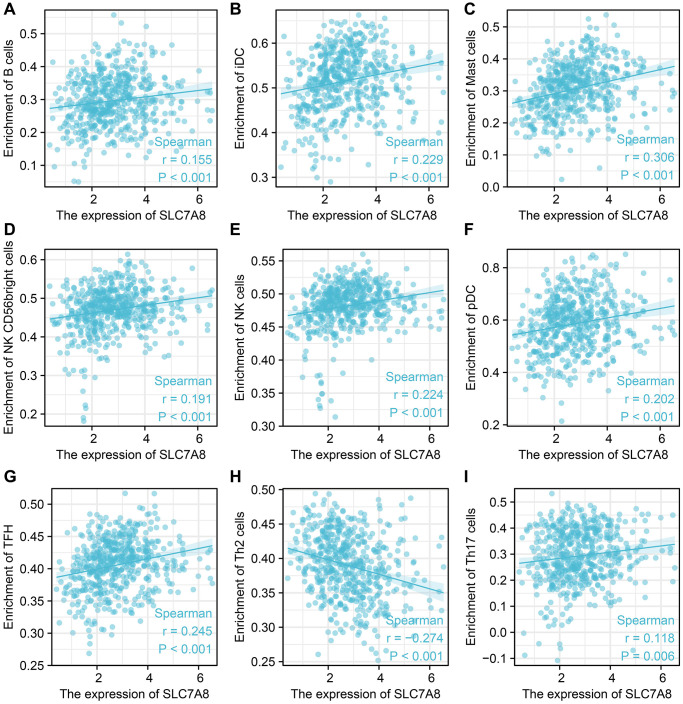
We found that the expression of was decreased significantly in LUAD tissues compared with normal tissues, which was related to the dismal survival time and disease progression. Moreover, it carried diagnostic value in LUAD and was a risk factor for dismal prognosis. Receiver operating characteristic curve analysis indicated that the expression level of carried significant diagnostic value in LUAD. Overexpression of inhibited the proliferation, invasion, and migration of LUAD cells, likely through a mechanism involving the cell cycle. expression in LUAD was significantly correlated with the infiltration of immune cells, especially B cells, interstitial dendritic cells, mast cells, CD56 bright cells, natural killer cells, plasmacytoid dendritic cells, T follicular helper cells, T helper 2 and 17 cells, and immune factors.
The downregulation of was related to a dismal prognosis and immune cell infiltration in LUAD. Increasing the expression of inhibited the growth and migration of LUAD cells, thereby improving the prognosis of patients.
溶质载体家族7成员8(SLC7A8)的过表达已被证明与癌症患者的生存时间和肿瘤进展有关。然而,其在肺腺癌(LUAD)中的作用仍不清楚。
通过生物信息学探索SLC7A8在LUAD组织中的表达与临床指标以及免疫浸润之间的关系。使用京都基因与基因组百科全书富集分析、基因集富集分析、蛋白质免疫印迹法等方法研究SLC7A8在LUAD中的功能和信号通路。
我们发现,与正常组织相比,LUAD组织中SLC7A8的表达显著降低,这与较差的生存时间和疾病进展相关。此外,它在LUAD中具有诊断价值,并且是预后不良的危险因素。受试者工作特征曲线分析表明,SLC7A8的表达水平在LUAD中具有显著的诊断价值。SLC7A8的过表达抑制了LUAD细胞的增殖、侵袭和迁移,可能是通过一种涉及细胞周期的机制。LUAD中SLC7A8的表达与免疫细胞尤其是B细胞、间质树突状细胞、肥大细胞、CD56bright细胞、自然杀伤细胞、浆细胞样树突状细胞、滤泡辅助性T细胞、辅助性T细胞2和17细胞以及免疫因子的浸润显著相关。
SLC7A8的下调与LUAD的不良预后和免疫细胞浸润有关。增加SLC7A8的表达可抑制LUAD细胞的生长和迁移,从而改善患者的预后。