Liu Libao, Xu Shilei, Huang Lei, He Jinyuan, Liu Gang, Ma Shaohong, Weng Yimin, Huang Shaohong
Department of Cardiothoracic Surgery, Third Affiliated Hospital of Sun Yat-sen University, Guangzhou, China.
Department of General Surgery, Third Affiliated Hospital of Sun Yat-sen University, Guangzhou, China.
Transl Cancer Res. 2021 Jun;10(6):2859-2872. doi: 10.21037/tcr-20-2275.
This study applied a complex bioinformatics analysis to explore the hub regulators and immune network to further elucidate the molecular mechanisms of lung adenocarcinoma (LUAD) immune regulation.
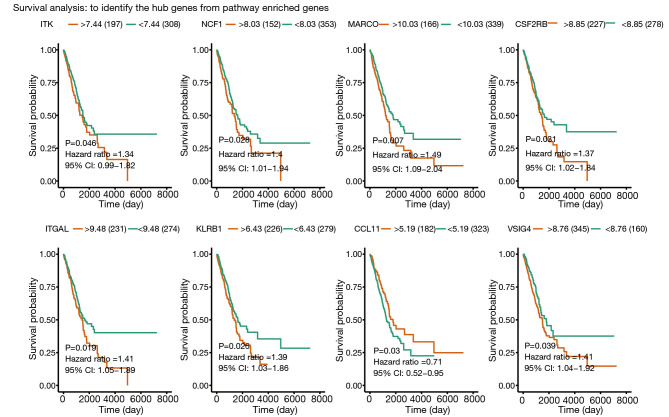
LUAD immunological microenvironment features and microenvironment-related differential expression genes (DEGs) were identified by ESTIMATE algorithm and linear models for microarray analyses (LIMMA), respectively. CIBERSORT and Igraph algorithms were applied to construct the LUAD-related immunocyte infiltration and regulatory network. Kaplan-Meier survival analysis, and univariate and multivariate Cox analysis were used to predict independent risk factors and screen for the hub genes. In addition, hub genes-correlated gene set enrichment analysis (GSEA), tumor mutation burden (TMB), and clinic pathological relation analyses were also performed.
Stromal, immune, and microenvironment comprehensive features (ESTIMATE score) were associated with overall survival (OS) in LUAD patients (all, P<0.05). T-cell activation, chemokine activity, and immune effect or dysfunction gene ontology maps were associated with the LUAD immune microenvironment. The immune infiltration cell subtypes mast cells (masT-cells) resting [The Cancer Genome Atlas (TCGA): P=0.01; Gene Expression Omnibus (GEO): P=1.79e-05] and activated T-cells (CD4 memory) (TCGA: P<0.01; GEO: P=8.52e-05) were found to have an important role in the immune cell regulatory network. Finally, [univariate hazard ratio (HR) =0.80, 95% confidence interval (CI): 0.69-0.93, P<0.01; multivariate HR =0.59, 95% CI: 0.40-0.86, P=0.01] and (univariate HR =0.78, 95% CI: 0.69-0.89, P<0.01; multivariate HR =0.72, 95% CI: 0.58-0.90, P<0.01) were correlated with the T-cell receptor signaling pathway and anaplastic lymphoma kinase (ALK) fusion (: P=0.034; : P=0.050), and were considered as candidate biomarkers. A significant relation between expression level and TMB (P=3.6e-05) was identified, while no relation was detected for (P=0.11).
The T-cell activation and activated T-cell (CD4 memory) pathways were predominantly involved in LUAD immune microenvironment regulation. The expression levels of and were significantly correlated with the T-cell receptor signaling pathway and LUAD TMB, and were independent risk factors for OS.
本研究应用复杂的生物信息学分析来探索核心调节因子和免疫网络,以进一步阐明肺腺癌(LUAD)免疫调节的分子机制。
分别通过ESTIMATE算法和微阵列分析线性模型(LIMMA)鉴定LUAD免疫微环境特征和与微环境相关的差异表达基因(DEG)。应用CIBERSORT和Igraph算法构建与LUAD相关的免疫细胞浸润和调节网络。采用Kaplan-Meier生存分析、单因素和多因素Cox分析来预测独立危险因素并筛选核心基因。此外,还进行了与核心基因相关的基因集富集分析(GSEA)、肿瘤突变负担(TMB)和临床病理关系分析。
基质、免疫和微环境综合特征(ESTIMATE评分)与LUAD患者的总生存期(OS)相关(均P<0.05)。T细胞活化、趋化因子活性以及免疫效应或功能障碍基因本体图谱与LUAD免疫微环境相关。发现免疫浸润细胞亚群静息肥大细胞(masT细胞)[癌症基因组图谱(TCGA):P=0.01;基因表达综合数据库(GEO):P=1.79e-05]和活化T细胞(CD4记忆细胞)(TCGA:P<0.01;GEO:P=8.52e-05)在免疫细胞调节网络中起重要作用。最后发现,[单因素风险比(HR)=0.80,95%置信区间(CI):0.69-0.93,P<0.01;多因素HR =0.59,95%CI:0.40-0.86,P=0.01]和[单因素HR =0.78,95%CI:0.69-0.89,P<0.01;多因素HR =0.72,95%CI:0.58-0.90,P<0.01]与T细胞受体信号通路和间变性淋巴瘤激酶(ALK)融合相关(:P=0.034;:P=0.050),并被视为候选生物标志物。发现表达水平与TMB之间存在显著关系(P=3.6e-05),而未检测到与之间的关系(P=0.11)。
T细胞活化和活化T细胞(CD4记忆细胞)途径主要参与LUAD免疫微环境调节。和的表达水平与T细胞受体信号通路和LUAD TMB显著相关,并且是OS的独立危险因素。