Department of Psychological and Brain Sciences, University of Louisville, Louisville, KY 40292, USA.
College of Education and Human Development, University of Louisville, Louisville, KY 40292, USA.
Int J Environ Res Public Health. 2023 Dec 23;21(1):24. doi: 10.3390/ijerph21010024.
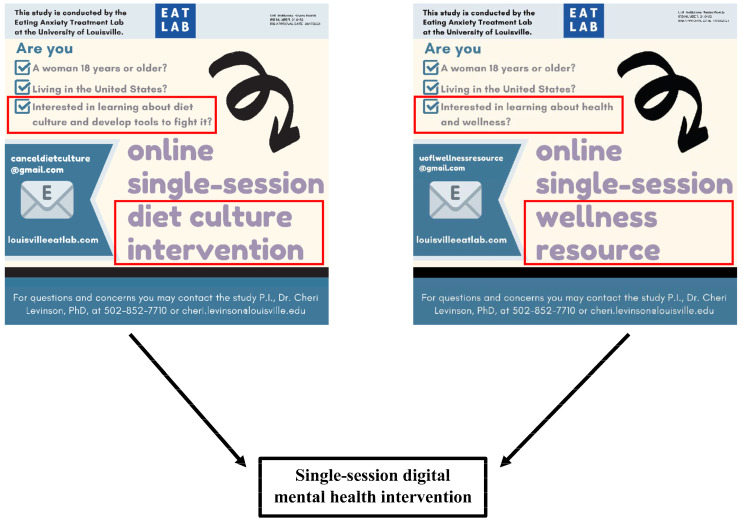
Diet culture is a societal norm that ranks thin bodies as superior to other body types and has been associated with negative outcomes, such as eating disorders. Wellness has evolved into a term that is often used to promote diet culture messages. One possible way to combat diet culture is through single-session, digital mental health interventions (DMHIs), which allow for increased access to brief public health treatments. The framing of DMHIs is critical to ensure that the target population is reached. Participants ( = 397) were enrolled in a single-session DMHI, which was framed as either a ( = 201) or a ( = 196). Baseline group differences in eating disorder pathology, body image, weight stigma concerns, fat acceptance, and demographic characteristics were analyzed. Across groups, participants reported moderately high eating disorder pathology, low-to-moderate levels of body dissatisfaction, moderate levels of fat acceptance, and either very low or very high weight stigma concerns. Participants in the group reported higher levels of fat acceptance than those in the group ( < 0.001). No other framing group differences were identified, though post hoc analyses revealed differences based on recruitment source (i.e., social media versus undergraduate research portal). This study found that framing a DMHI as targeting diet culture or as a Wellness Resource can result in the successful recruitment of individuals at risk of disordered eating. Framing a DMHI as a may increase recruitment of individuals with low levels of fat acceptance, which may be particularly important for dismantling diet culture, disordered eating, and weight stigma concerns. Future research should assess DMHI framing in other populations, such as men and adolescents.
饮食文化是一种社会规范,将瘦体型视为优于其他体型的标准,并与饮食失调等负面结果相关联。健康已演变成一个常用术语,常被用来宣传饮食文化信息。对抗饮食文化的一种可能方法是通过单次、数字化心理健康干预(DMHI),这可以增加获得简短公共卫生治疗的机会。DMHI 的框架设计至关重要,以确保目标人群能够接收到信息。参与者(=397)被纳入单次 DMHI 干预中,该干预被设计为以饮食文化(=201)或健康资源(=196)为框架。分析了饮食失调病理、身体意象、体重污名化关注点、脂肪接受度和人口统计学特征方面的基线组间差异。在所有组中,参与者报告了中度高的饮食失调病理,低至中度的身体不满,中等水平的脂肪接受度,以及极低或极高的体重污名化关注点。与健康资源框架组相比,饮食文化框架组的参与者报告了更高水平的脂肪接受度(<0.001)。虽然事后分析显示了基于招募来源(即社交媒体与大学生研究门户)的差异,但没有发现其他框架组间差异。这项研究发现,将 DMHI 框架设计为针对饮食文化或作为健康资源可以成功招募有饮食失调风险的个体。将 DMHI 框架设计为饮食文化可能会增加对低脂肪接受度个体的招募,这对于打破饮食文化、饮食失调和体重污名化问题可能尤为重要。未来的研究应该在其他人群中评估 DMHI 的框架设计,例如男性和青少年。