Alghamdi Bandar A, Karkousha Rania N, Elgeidi Adham A, Amin Fatma S, Tolba Ahmed M
Orthopedic, Department of Surgery, College of Medicine, Umm Al-Qura University, Al-Qunfudhah, SAU.
Physical Therapy, Basic Science Department, Faculty of Physical Therapy, Cairo University, Cairo, EGY.
Cureus. 2023 Dec 21;15(12):e50893. doi: 10.7759/cureus.50893. eCollection 2023 Dec.
The aim of this study was to determine the effectiveness of combined low-level laser therapy (LLL) and rehabilitation in patients following recent total knee replacement (TKR).
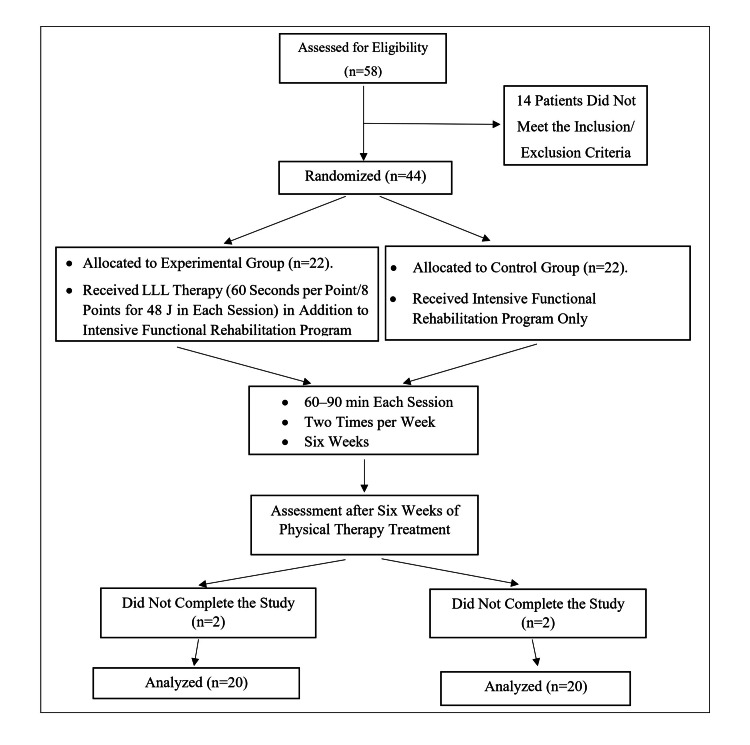
A double-blind randomized controlled study was conducted at the Orthopedic Department of Mansoura University Hospital. Forty-four patients were chosen from a total of 58 patients who met the inclusion criteria and were assigned randomly into control and experimental groups of equal size. Ultimately, 40 patients completed the study (20 from each group). Both groups participated in an intensive functional rehabilitation program, and the experimental group also received LLL therapy around the knee at the incisional line, the medial and lateral intra-articular space, above and below the patella, and at the popliteal fossa at low fluence (6 J/cm, 650 nm continuous wave) and 60 s per point with a total dose of 48 J per session over 12 treatment sessions for six weeks. Knee range of motion (ROM) was measured with a digital goniometer, and functional abilities were assessed with the Arabic version of the Western Ontario and McMaster Universities Osteoarthritis (WOMAC) index.
There were significant differences in all variables pre- and post-treatment within each group. Before treatment, there was no significant difference in any of the measured variables between the groups (>0.05). After treatment, there were significant differences in knee flexion ROM and WOMAC index (<0.05) but no significant difference in knee extension ROM between the groups (>0.05).
The addition of low-level laser therapy to a rehabilitation program post-TKR resulted in substantial enhancements in knee flexion range of motion and the WOMAC index.
本研究旨在确定联合低强度激光治疗(LLL)与康复治疗对近期全膝关节置换术(TKR)患者的有效性。
在曼苏拉大学医院骨科进行了一项双盲随机对照研究。从58例符合纳入标准的患者中选取44例,随机分为两组,每组人数相等。最终,40例患者完成了研究(每组20例)。两组均参加强化功能康复计划,实验组还在膝关节切口线、内外侧关节间隙、髌骨上下及腘窝处接受低强度激光治疗,能量密度为6 J/cm,波长650 nm连续波,每点照射60秒,每次治疗总剂量为48 J,共治疗12次,为期六周。使用数字角度计测量膝关节活动范围(ROM),并使用西安大略和麦克马斯特大学骨关节炎指数(WOMAC)阿拉伯语版评估功能能力。
每组治疗前后所有变量均有显著差异。治疗前,两组间任何测量变量均无显著差异(>0.05)。治疗后,膝关节屈曲ROM和WOMAC指数有显著差异(<0.05),但两组间膝关节伸展ROM无显著差异(>0.05)。
TKR术后康复计划中加入低强度激光治疗可显著提高膝关节屈曲活动范围和WOMAC指数。