He Yun-Yan, Luo Sheng, Jin Liang, Wang Peng-Yu, Xu Jie, Jiao Hong-Liang, Yan Hong-Jun, Wang Yao, Zhai Qiong-Xiang, Ji Jing-Jing, Zhang Weng-Jun, Zhou Peng, Li Hua, Liao Wei-Ping, Lan Song, Xu Lin
Department of Neurology, Women and Children's Hospital, Qingdao University, Qingdao, China.
Department of Neurology, Institute of Neuroscience, Key Laboratory of Neurogenetics and Channelopathies of Guangdong Province and the Ministry of Education of China, The Second Affiliated Hospital, Guangzhou Medical University, Guangzhou, China.
Front Mol Neurosci. 2024 Jan 5;16:1290919. doi: 10.3389/fnmol.2023.1290919. eCollection 2023.
The gene encodes disks large membrane-associated guanylate kinase scaffold protein 3, which plays essential roles in the clustering of N-methyl-D-aspartate receptors (NMDARs) at excitatory synapses. Previously, has been identified as the causative gene of X-linked intellectual developmental disorder-90 (XLID-90; OMIM# 300850). This study aims to explore the phenotypic spectrum of and the genotype-phenotype correlation.
Trios-based whole-exome sequencing was performed in patients with epilepsy of unknown causes. To analyze the genotype-phenotype correlations, previously reported variants were systematically reviewed.
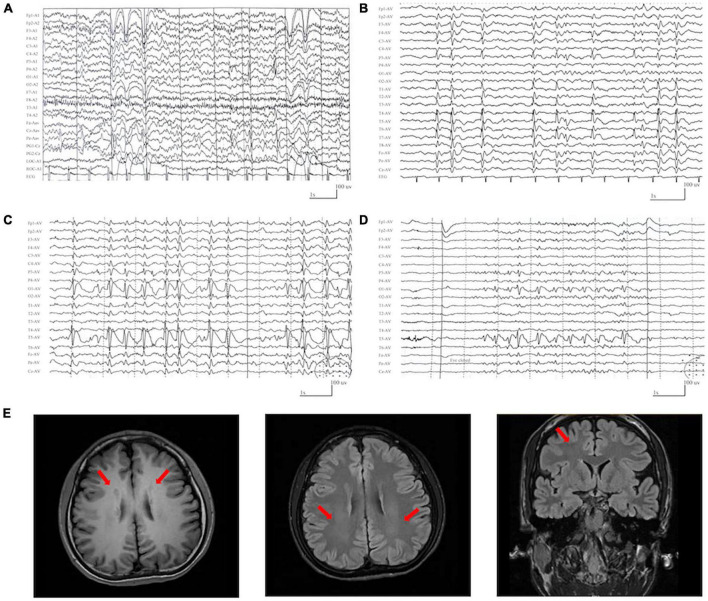
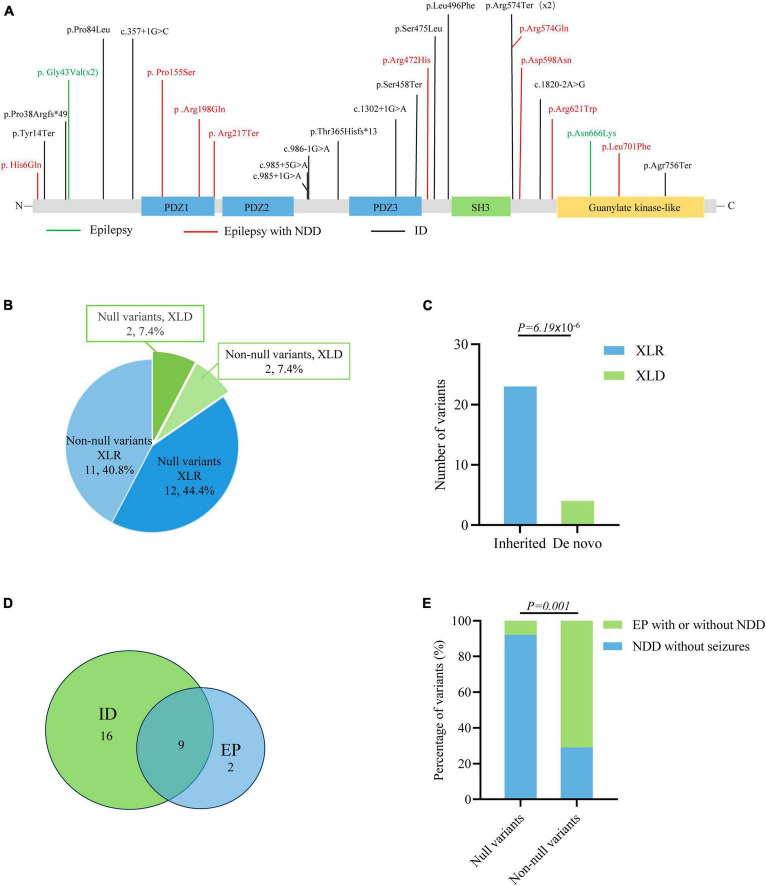
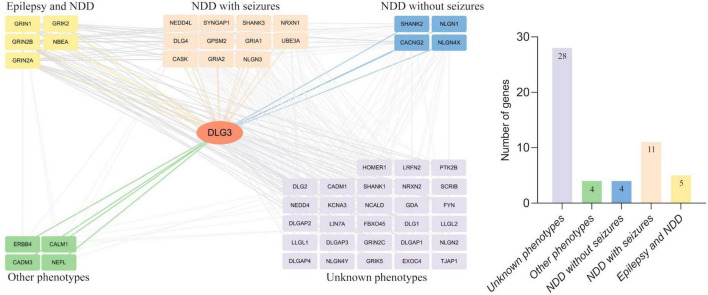
variants were identified in seven unrelated cases with epilepsy. These variants had no hemizygous frequencies in controls. All variants were predicted to be damaging by silico tools and alter the hydrogen bonds with surrounding residues and/or protein stability. Four cases mainly presented with generalized seizures, including generalized tonic-clonic and myoclonic seizures, and the other three cases exhibited secondary generalized tonic-clonic seizures and focal seizures. Multifocal discharges were recorded in all cases during electroencephalography monitoring, including the four cases with generalized discharges initially but multifocal discharges after drug treating. Protein-protein interaction network analysis revealed that interacts with 52 genes with high confidence, in which the majority of disease-causing genes were associated with a wide spectrum of neurodevelopmental disorder (NDD) and epilepsy. Three patients with variants locating outside functional domains all achieved seizure-free, while the four patients with variants locating in functional domains presented poor control of seizures. Analysis of previously reported cases revealed that patients with non-null variants presented higher percentages of epilepsy than those with null variants, suggesting a genotype-phenotype correlation.
This study suggested that variants were associated with epilepsy with/without NDD, expanding the phenotypic spectrum of . The observed genotype-phenotype correlation potentially contributes to the understanding of the underlying mechanisms driving phenotypic variation.
该基因编码盘状大膜相关鸟苷酸激酶支架蛋白3,其在兴奋性突触处N-甲基-D-天冬氨酸受体(NMDARs)的聚集过程中发挥着重要作用。此前,该基因已被确定为X连锁智力发育障碍90(XLID-90;OMIM#300850)的致病基因。本研究旨在探索该基因的表型谱以及基因型与表型的相关性。
对病因不明的癫痫患者进行基于三联体的全外显子组测序。为分析基因型与表型的相关性,对先前报道的该基因突变进行了系统回顾。
在7例无亲缘关系的癫痫患者中鉴定出了该基因突变。这些突变在对照人群中不存在半合子频率。所有突变经计算机工具预测均具有损害性,并且会改变与周围残基的氢键和/或蛋白质稳定性。4例患者主要表现为全身性癫痫发作,包括全身强直阵挛性发作和肌阵挛发作,另外3例患者表现为继发性全身强直阵挛性发作和局灶性发作。在脑电图监测期间,所有病例均记录到多灶性放电,包括最初有全身性放电但经药物治疗后出现多灶性放电的4例患者。蛋白质-蛋白质相互作用网络分析显示,该基因与52个基因存在高可信度的相互作用,其中大多数致病基因与广泛的神经发育障碍(NDD)和癫痫相关。3例突变位于功能域外的患者均实现了无癫痫发作,而4例突变位于功能域内的患者癫痫控制不佳。对先前报道病例的分析显示,具有非无效突变的患者癫痫发生率高于具有无效突变的患者,提示存在基因型与表型的相关性。
本研究表明该基因突变与伴有或不伴有NDD的癫痫相关,扩展了该基因的表型谱。观察到的基因型与表型的相关性可能有助于理解驱动表型变异的潜在机制。