Mehta Neet, Verma Anshuman, Achanta Divya Sree, Kannabiran Chitra, Roy Sanhita, Mishra Dilip Kumar, Chaurasia Sunita, Edward Deepak Paul, Ramappa Muralidhar
Academy of Eye Care Education, L V Prasad Eye Institute, Hyderabad, Telangana, India.
Centre for Rare Eye Diseases and Ophthalmic Genetics, L V Prasad Eye Institute, Hyderabad, Telangana, India.
Taiwan J Ophthalmol. 2023 Nov 28;13(4):405-416. doi: 10.4103/tjo.TJO-D-23-00135. eCollection 2023 Oct-Dec.
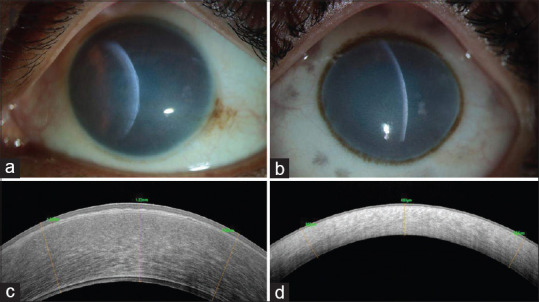
Congenital hereditary endothelial dystrophy (CHED) is a rare genetic corneal disorder causing progressive cornea clouding and significant visual impairment. CHED remains a leading indication for pediatric corneal transplantation despite its infrequency, particularly in regions with high consanguinity rates like Southeast Asia. Identifying the Solute Carrier Family 4 Member 11 (SLC4A11) gene as the genetic basis of CHED has led to the discovery of it's various genetic variations. However, a comprehensive understanding of its clinical-genetic correlation, pathophysiology, and optimal management is ongoing. This review aims to consolidate current knowledge about CHED, covering its genetic origins, pathophysiological mechanisms, clinical presentation, and management strategies. Surgical intervention, such as penetrating keratoplasty (PK), Descemet stripping automated endothelial keratoplasty (DSAEK), and Descemet membrane endothelial keratoplasty (DMEK), remains the primary treatment. DSAEK and DMEK offer advantages over PK, including quicker visual recovery, reduced complications, and longer graft survival, especially in the pediatric age group. The timing of surgical interventions depends on disease severity, age at presentation, comorbidities, and visual potential. Elevated oxidative stress in CHED corneal tissue suggests potential benefits from anti-inflammatory drugs to rescue mutated endothelial cells. Considering the limitations of corneal graft surgeries, exploring novel gene-based molecular therapies are essential for future management. Early diagnosis, appropriate surgical interventions, amblyopia control, and genetic counseling for predictive analysis are pivotal for optimizing CHED management. A multidisciplinary approach involving ophthalmologists, researchers, and genetic counselors is essential for precise diagnosis and optimal care for CHED patients.
先天性遗传性内皮营养不良(CHED)是一种罕见的遗传性角膜疾病,可导致角膜进行性混浊和严重视力损害。尽管CHED发病率较低,但仍是儿童角膜移植的主要指征,尤其是在东南亚等近亲结婚率较高的地区。确定溶质载体家族4成员11(SLC4A11)基因是CHED的遗传基础,已导致发现其各种基因变异。然而,对其临床-遗传相关性、病理生理学和最佳治疗方法的全面理解仍在进行中。本综述旨在整合有关CHED的现有知识,涵盖其遗传起源、病理生理机制、临床表现和治疗策略。手术干预,如穿透性角膜移植术(PK)、后弹力层剥除自动内皮角膜移植术(DSAEK)和后弹力层内皮角膜移植术(DMEK),仍然是主要治疗方法。DSAEK和DMEK比PK具有优势,包括视力恢复更快、并发症减少和移植物存活时间更长,尤其是在儿童年龄组。手术干预的时机取决于疾病严重程度、就诊年龄、合并症和视力潜力。CHED角膜组织中氧化应激升高表明抗炎药物可能有助于挽救突变的内皮细胞。考虑到角膜移植手术的局限性,探索基于基因的新型分子疗法对未来治疗至关重要。早期诊断、适当的手术干预、弱视控制和遗传咨询以进行预测分析对于优化CHED管理至关重要。眼科医生、研究人员和遗传咨询师的多学科方法对于CHED患者的精确诊断和最佳护理至关重要。