Division of Research, Kaiser Permanente Northern California, 2000 Broadway, Oakland, CA, 94612-2403, USA.
Physical Medicine and Rehabilitation, Kaiser Permanente Northern California, Santa Clara, CA, USA.
BMC Health Serv Res. 2024 Jan 22;24(1):112. doi: 10.1186/s12913-024-10558-3.
Given significant risks associated with long-term prescription opioid use, there is a need for non-pharmacological interventions for treating chronic pain. Activating patients to manage chronic pain has the potential to improve health outcomes. The ACTIVATE study was designed to evaluate the effectiveness of a 4-session patient activation intervention in primary care for patients on long-term opioid therapy.
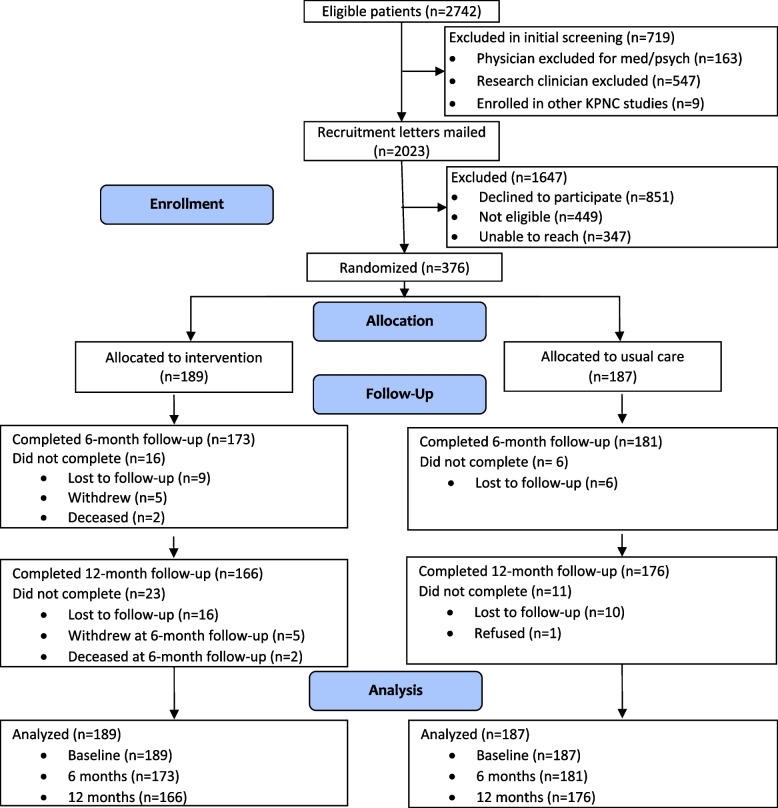
The two-arm, pragmatic, randomized trial was conducted in two primary care clinics in an integrated health system from June 2015-August 2018. Consenting participants were randomized to the intervention (n = 189) or usual care (n = 187). Participants completed online and interviewer-administered surveys at baseline, 6- and 12- months follow-up. Prescription opioid use was extracted from the EHR. The primary outcome was patient activation assessed by the Patient Activation Measure (PAM). Secondary outcomes included mood, function, overall health, non-pharmacologic pain management strategies, and patient portal use. We conducted a repeated measure analysis and reported between-group differences at 12 months.
At 12 months, the intervention and usual care arms had similar PAM scores. However, compared to usual care at 12 months, the intervention arm demonstrated: less moderate/severe depression (odds ratio [OR] = 0.40, 95%CI 0.18-0.87); higher overall health (OR = 3.14, 95%CI 1.64-6.01); greater use of the patient portal's health/wellness resources (OR = 2.50, 95%CI 1.42-4.40) and lab/immunization history (OR = 2.70, 95%CI 1.29-5.65); and greater use of meditation (OR = 2.72; 95%CI 1.61-4.58) and exercise/physical therapy (OR = 2.24, 95%CI 1.29-3.88). At 12 months, the intervention arm had a higher physical health measure (mean difference 1.63; 95%CI: 0.27-2.98).
This trial evaluated the effectiveness of a primary care intervention in improving patient activation and patient-reported outcomes among adults with chronic pain on long-term opioid therapy. Despite a lack of improvement in patient activation, a brief intervention in primary care can improve outcomes such as depression, overall health, non-pharmacologic pain management, and engagement with the health system.
The study was registered on 10/27/14 on ClinicalTrials.gov (NCT02290223).
鉴于长期处方类阿片类药物使用相关的重大风险,我们需要寻找非药物干预方法来治疗慢性疼痛。使患者积极参与慢性疼痛管理可能会改善健康结果。ACTIVATE 研究旨在评估在长期接受阿片类药物治疗的患者中,在初级保健中进行 4 节患者激活干预的有效性。
这项 2 组、实用、随机试验于 2015 年 6 月至 2018 年 8 月在综合医疗系统的两个初级保健诊所进行。同意参与的参与者被随机分配至干预组(n=189)或常规护理组(n=187)。参与者在基线、6 个月和 12 个月随访时完成在线和访谈者管理的调查。从电子健康记录中提取处方类阿片类药物的使用情况。主要结局是通过患者激活度量(PAM)评估的患者激活。次要结局包括情绪、功能、总体健康、非药物性疼痛管理策略以及患者门户的使用情况。我们进行了重复测量分析,并报告了 12 个月时的组间差异。
在 12 个月时,干预组和常规护理组的 PAM 评分相似。然而,与 12 个月时的常规护理相比,干预组表现出:更低程度的中度/重度抑郁(比值比[OR] = 0.40,95%CI 0.18-0.87);更高的总体健康(OR = 3.14,95%CI 1.64-6.01);更多地使用患者门户的健康/健康资源(OR = 2.50,95%CI 1.42-4.40)和实验室/免疫接种历史(OR = 2.70,95%CI 1.29-5.65);以及更多地使用冥想(OR = 2.72;95%CI 1.61-4.58)和运动/物理疗法(OR = 2.24,95%CI 1.29-3.88)。在 12 个月时,干预组的身体健康测量值更高(平均差异 1.63;95%CI:0.27-2.98)。
本试验评估了初级保健干预在改善长期接受阿片类药物治疗的慢性疼痛成年患者的患者激活和患者报告结果方面的有效性。尽管患者激活没有改善,但初级保健中的简短干预可以改善抑郁、总体健康、非药物性疼痛管理以及与医疗系统的参与度等结果。
该研究于 2014 年 10 月 27 日在 ClinicalTrials.gov 上注册(NCT02290223)。