Buonsenso Danilo, Sodero Giorgio, Camporesi Anna, Pierucci Ugo Maria, Raffaelli Francesca, Proli Francesco, Valentini Piero, Rendeli Claudia
Department of Woman and Child Health and Public Health, Fondazione Policlinico Universitario A. Gemelli IRCCS, 00168 Rome, Italy.
Centro di Salute Globale, Università Cattolica del Sacro Cuore, 00168 Roma, Italy.
Children (Basel). 2023 Dec 30;11(1):55. doi: 10.3390/children11010055.
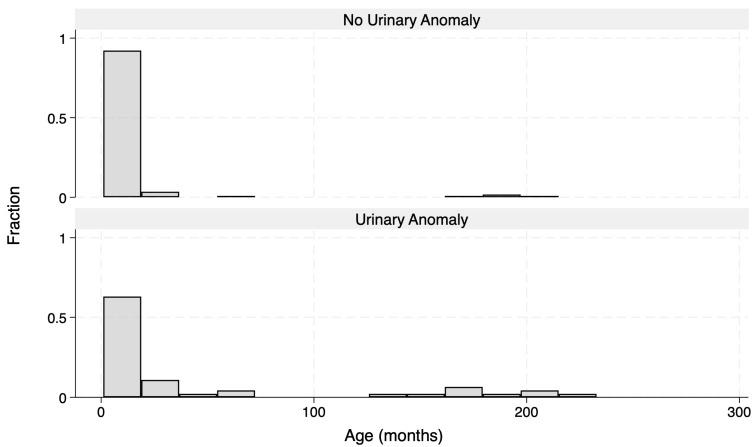
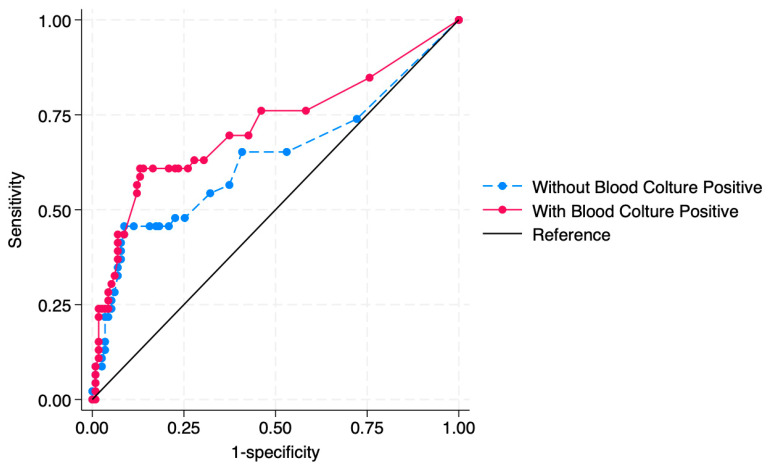
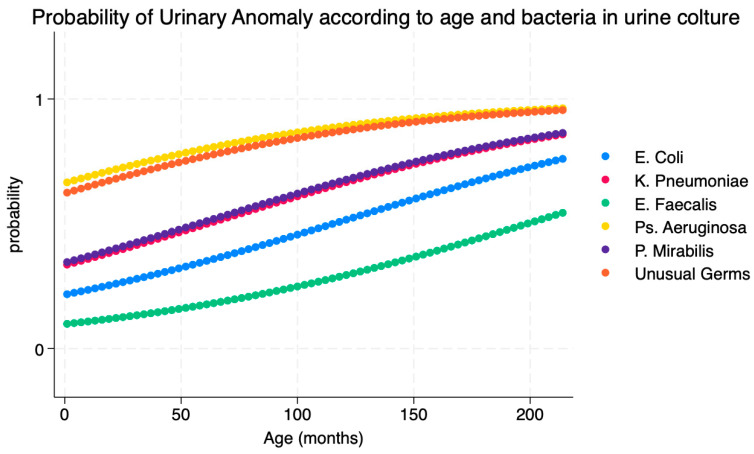
We aimed to investigate if children with their first UTI and a concomitant positive blood culture have a higher risk of abnormalities. We performed a retrospective study of children younger than 18 years of age with their first UTI. Multivariate logistic regression and receiver operating characteristic (ROC) curves were used to evaluate if positive blood cultures are associated with urinary abnormalities. After the screening process, we considered the enrolled 161 children with UTIs. The median age was three months, and 83 were females (43.2%). In multivariate analysis, age ( = 0.001, 95% CI 1.005-1.020), the presence of Pseudomonas aeruginosa or unusual germs in urine cultures ( = 0.002, 95% CI 2.18-30.36) and the positivity of blood cultures ( = 0.001, 95% CI 2.23-18.98) were significantly associated with urinary abnormalities. A model based on these parameters has an AUC of 0.7168 to predict urinary malformations ( = 0.0315). Conclusions include how greater age, a positive blood culture and the presence of Pseudomonas aeruginosa or unusual germs in urine culture in children hospitalised for their first episode of a UTI are factors associated with a significantly higher risk of urinary abnormalities. These data can guide the implementation of more personalized strategies to screen for urinary abnormalities that may be included in future guidelines.
我们旨在调查首次发生泌尿道感染(UTI)且血培养结果呈阳性的儿童是否有更高的异常风险。我们对18岁以下首次发生UTI的儿童进行了一项回顾性研究。采用多因素逻辑回归和受试者工作特征(ROC)曲线来评估血培养阳性是否与泌尿道异常相关。经过筛选过程,我们纳入了161例UTI患儿。中位年龄为3个月,其中83例为女性(43.2%)。在多因素分析中,年龄(P = 0.001,95%可信区间1.005 - 1.020)、尿培养中存在铜绿假单胞菌或不常见细菌(P = 0.002,95%可信区间2.18 - 30.36)以及血培养阳性(P = 0.001,95%可信区间2.23 - 18.98)与泌尿道异常显著相关。基于这些参数的模型预测泌尿道畸形的曲线下面积(AUC)为0.7168(P = 0.0315)。结论包括,对于因首次UTI住院的儿童,年龄较大、血培养阳性以及尿培养中存在铜绿假单胞菌或不常见细菌是与泌尿道异常风险显著升高相关的因素。这些数据可为实施更个性化的策略以筛查泌尿道异常提供指导,这些策略可能会纳入未来的指南中。