Ammenti Anita, Alberici Irene, Brugnara Milena, Chimenz Roberto, Guarino Stefano, La Manna Angela, La Scola Claudio, Maringhini Silvio, Marra Giuseppina, Materassi Marco, Morello William, Nicolini Giangiacomo, Pennesi Marco, Pisanello Lorena, Pugliese Fabrizio, Scozzola Floriana, Sica Felice, Toffolo Antonella, Montini Giovanni
Pediatric Polyspecialistic Group, Poliambulatorio Medi-Saluser, Parma, Italy.
Department of Woman and Child's Health, University of Padova, Padova, Italy.
Acta Paediatr. 2020 Feb;109(2):236-247. doi: 10.1111/apa.14988. Epub 2019 Oct 6.
Our aim was to update the recommendations for the diagnosis, treatment and follow-up of the first febrile urinary tract infection in young children, which were endorsed in 2012 by the Italian Society of Pediatric Nephrology.
The Italian recommendations were revised on the basis of a review of the literature published from 2012 to October 2018. We also carried out an ad hoc evaluation of the risk factors to identify children with high-grade vesicoureteral reflux or renal scarring, which were published in the previous recommendations. When evidence was not available, the working group held extensive discussions, during various meetings and through email exchanges.
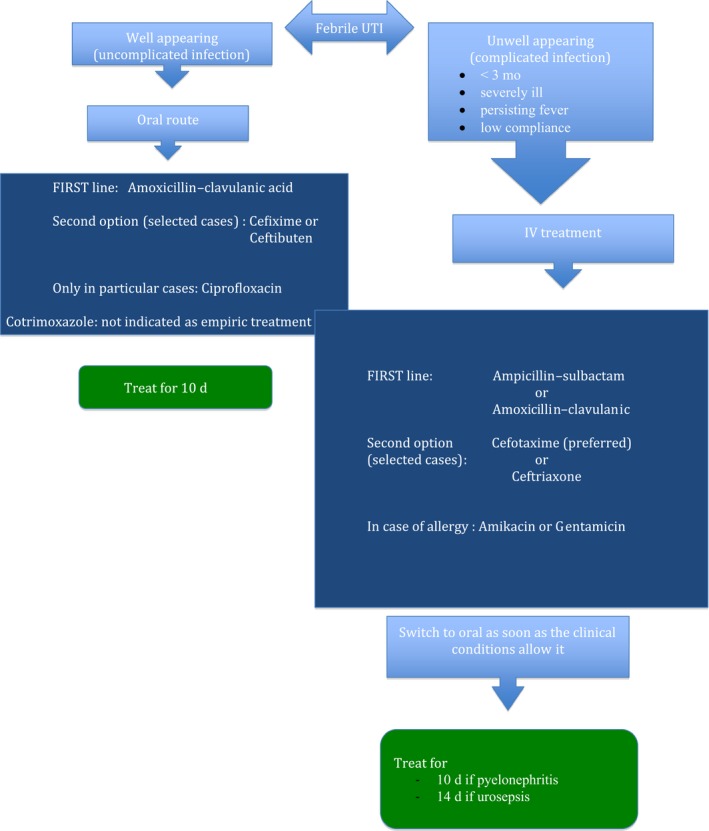
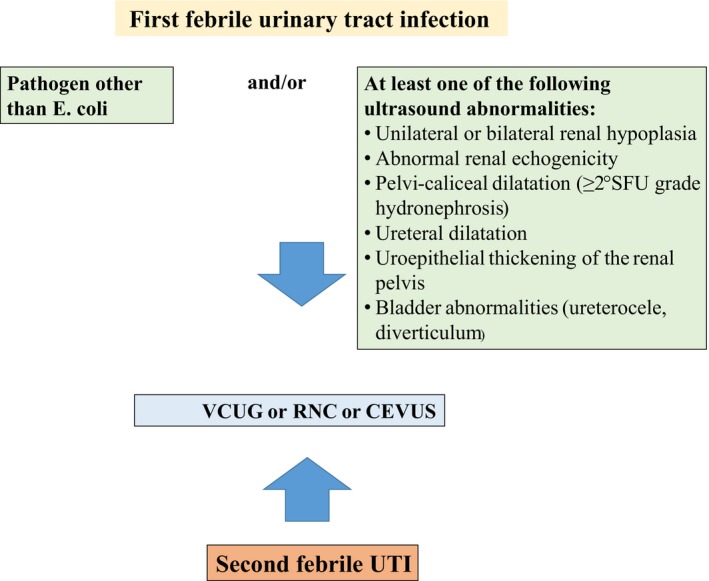
Four major modifications have been introduced. The method for collecting urine for culture and its interpretation has been re-evaluated. We have reformulated the algorithm that guides clinical decisions to proceed with voiding cystourethrography. The suggested antibiotics have been revised, and we have recommended further restrictions of the use of antibiotic prophylaxis.
These updated recommendations have now been endorsed by the Italian Society of Pediatric Nephrology and the Italian Society for Pediatric Infectivology. They can also be used to compare other recommendations that are available, as a worldwide consensus in this area is still lacking.
我们的目的是更新关于幼儿首次发热性尿路感染的诊断、治疗及随访的建议,这些建议于2012年得到意大利儿科学会认可。
基于对2012年至2018年10月发表的文献的回顾,对意大利的建议进行了修订。我们还对风险因素进行了专项评估,以识别出患有高级别膀胱输尿管反流或肾瘢痕形成的儿童,这些内容曾发表于之前的建议中。当缺乏证据时,工作小组在多次会议期间及通过电子邮件交流进行了广泛讨论。
引入了四项主要修改。重新评估了用于培养的尿液采集方法及其解读。我们重新制定了指导进行排尿性膀胱尿道造影临床决策的算法。对建议使用的抗生素进行了修订,并且我们建议进一步限制抗生素预防的使用。
这些更新后的建议现已得到意大利儿科学会和意大利儿科传染病学会的认可。它们还可用于比较其他现有建议,因为该领域仍缺乏全球共识。