Spine and Nerve Center, Department of Orthopaedic Surgery, Kansai Medical University Medical Center, Moriguchi, Osaka 570-8507, Japan.
Department of Orthopaedic Surgery, Kansai Medical University, Hirakata, Osaka 573-1191, Japan.
Medicina (Kaunas). 2024 Jan 6;60(1):107. doi: 10.3390/medicina60010107.
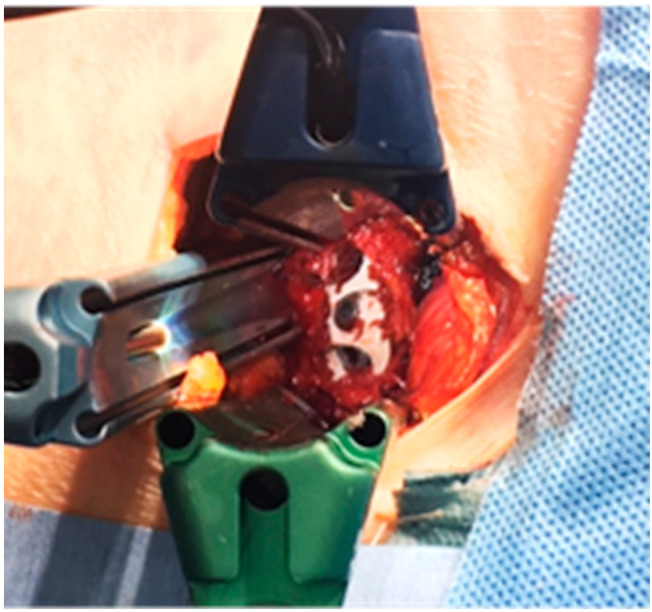
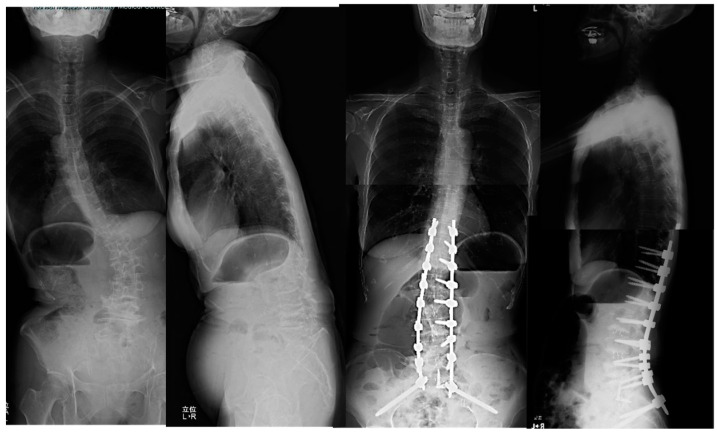
Although adult spinal deformity (ASD) surgery brought about improvement in the quality of life of patients, it is accompanied by high invasiveness and several complications. Specifically, mechanical complications of rod fracture, instrumentation failures, and pseudarthrosis are still unsolved issues. To better improve these problems, oblique lateral interbody fusion at L5/S1 (OLIF51) was introduced in 2015 at my institution. The objective of this study was to compare the clinical and radiologic outcomes of anterior-posterior combined surgery for ASD between the use of OLIF51 and transforaminal interbody fusion (TLIF) at L5/S1. A total of 117 ASD patients received anterior-posterior correction surgeries either with the use of OLIF51 (35 patients) or L5/S1 TLIF (82 patients). In both groups, L1-5 OLIF and minimally invasive posterior procedures of hybrid or circumferential MIS were employed. The sagittal and coronal spinal alignment and spino-pelvic parameters were recorded preoperatively and at follow-up. The quality-of-life parameters and visual analogue scale were evaluated, as well as surgical complications at follow-up. The average follow-up period was thirty months (13-84). The number of average fused segments was eight (4-12). The operation time and estimated blood loss were significantly lower in OLIF51 than in TLIF. The PI-LL mismatch, LLL, L5/S1 segmental lordosis, and L5 coronal tilt were significantly better in OLIF51 than TLIF. The complication rate was statistically equivalent between the two groups. The introduction of OLIF51 for adult spine deformity surgery led to a decrease in operation time and estimated blood loss, as well as improvement in sagittal and coronal correction compared to TLIF. The circumferential MIS correction and fusion with OLIF51 serve as an effective surgical modality which can be applied to many cases of adult spinal deformity.
虽然成人脊柱畸形(ASD)手术改善了患者的生活质量,但它伴随着高侵袭性和多种并发症。具体来说,杆断裂、器械失效和假关节等机械并发症仍然是未解决的问题。为了更好地改善这些问题,我院于 2015 年引入 L5/S1 斜外侧椎间融合术(OLIF51)。本研究旨在比较 ASD 患者前后联合手术中使用 OLIF51 和 L5/S1 经椎间孔融合术(TLIF)的临床和影像学结果。共有 117 例 ASD 患者接受了前后联合矫正手术,其中 35 例采用 OLIF51,82 例采用 L5/S1 TLIF。两组均采用 L1-5 OLIF 和微创后路杂交或环形微创技术。术前及随访时记录矢状面和冠状面脊柱排列及脊柱骨盆参数。评估生活质量参数和视觉模拟评分,以及随访时的手术并发症。平均随访时间为 30 个月(13-84)。平均融合节段数为 8 个(4-12)。OLIF51 的手术时间和估计失血量明显低于 TLIF。OLIF51 的 PI-LL 不匹配、LLL、L5/S1 节段前凸和 L5 冠状倾斜明显优于 TLIF。两组并发症发生率无统计学差异。OLIF51 应用于成人脊柱畸形手术,与 TLIF 相比,可减少手术时间和估计失血量,改善矢状面和冠状面矫正。OLIF51 的环形微创矫形和融合术是一种有效的手术方法,可应用于多种成人脊柱畸形病例。